Quick Answer: The highest-fiber whole foods are legumes (navy beans 9.6g, split peas 8g, lentils 7.8g per half cup), seeds (chia 10g per ounce, ground flax 8g per two tablespoons), certain produce (artichokes 10g, avocado 10g, raspberries 8g per cup), and a handful of whole grains (bulgur 8g, barley 6g per cup cooked). Adults need 25-38 grams of fiber a day. The average American gets about 15. Including more of the foods below is the simplest way to close that gap.
Most adults need 25 to 38 grams of fiber a day, depending on age and sex. The average American gets about 15.1 That gap is the single most consistent nutritional shortfall in the U.S. diet, and the simplest way to close it is to know which foods are actually doing the heavy lifting — and which ones merely look like they should.
For the bigger picture on why this matters — what fiber actually does in your body, why 95% of Americans are deficient2, and what the latest research says about gut bacteria, blood sugar, and weight — our Ultimate Guide to Dietary Fiber covers the full science. This article is the practical companion: thirty foods, all from the produce, dry goods, and bulk sections of any grocery store, organized by what they actually deliver per serving. The numbers below come from USDA FoodData Central, calculated for typical cooked or raw portions as noted.
Health starts with a healthy gut
Get all of our FREE info on fiber — best foods, soluble vs. insoluble, recipes and more
The heavy hitters
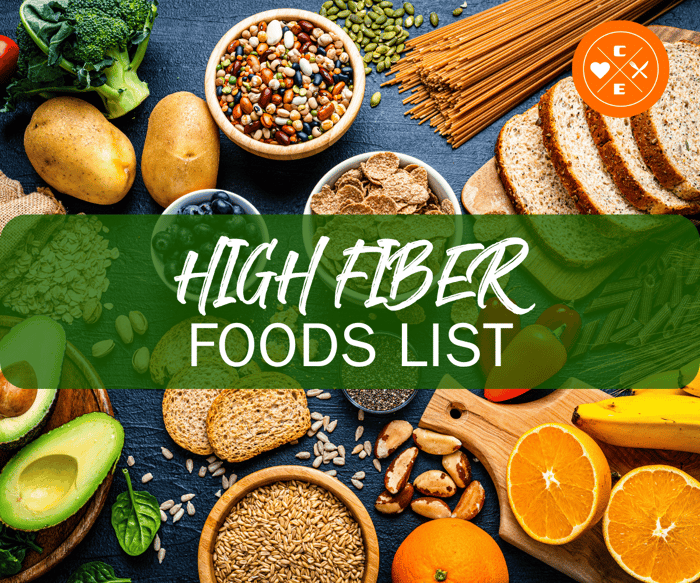
Legumes are the unambiguous winner for fiber per calorie and per dollar. Navy beans pack 9.6 grams per half-cup cooked, split peas 8, lentils 7.8, black beans 7.5, chickpeas 6.2, kidney beans 5.7, and edamame 4 per half cup shelled. They also deliver 7-9 grams of plant protein in the same package, which is a combination almost no other food category matches. The protein-fiber pairing is part of why beans show up on every credible weight-loss food list — it produces a kind of sustained fullness that's genuinely hard to replicate with chicken and broccoli alone.
Seeds punch well above their weight. An ounce of chia — about two tablespoons — delivers 10 grams of fiber. Two tablespoons of ground flax brings 8. Almonds and pistachios are respectable at roughly 3.5 grams per ounce. The practical move here is adding chia or flax to oatmeal, yogurt, or smoothies, which can fold an extra 8-10 grams of fiber into a single meal without adding much volume to your day.
Avocado deserves its own mention because almost nobody thinks of it as a fiber food. A medium avocado contains 10 grams — more than most fruits, more than most vegetables, more than a half cup of most beans. It's quietly one of the highest-fiber foods that regularly appears in American diets.
Vegetables, fruit, and grains worth your attention
Vegetables vary wildly, and the leaders are unintuitive. A single artichoke delivers 10 grams of fiber. A cup of cooked green peas brings 9. Acorn squash matches at 9 grams per cup baked. After that comes a solid middle tier: broccoli at 5 grams per cup cooked, Brussels sprouts at 4, sweet potato (with the skin) at 4 per medium tuber, carrots at 3.6 per cup chopped. Salad greens, despite their reputation, are mostly water — iceberg lettuce barely delivers a gram per cup, which is part of why a "big salad" alone rarely fills anyone up.
Fruit fiber is mostly skin-dependent. A pear with the skin on hits 5.5 grams; peeled, you lose nearly half. Apples follow the same pattern at 4.4 grams with skin. Berries are where fruit really pays off — a cup of raspberries hits 8 grams, blackberries 7.6. Bananas are reliable but moderate at 3 grams per medium fruit. Oranges deliver 3 if you eat the whole fruit; orange juice strips that out almost entirely, which is part of why the fruit-versus-juice distinction matters more than people assume.
Whole grains are inconsistent. Bulgur is quietly exceptional at 8 grams per cup cooked. Barley follows at 6, and whole-wheat pasta matches at 6. Oats land at 4 grams per cup cooked but bring beta-glucan, the soluble fiber linked to lower LDL cholesterol. Quinoa hits 5. Brown rice is mediocre at 3.5 grams. White rice, technically a grain, contains essentially no fiber — about half a gram per cup. Most "wheat" or "multigrain" breads at the supermarket are made primarily with refined flour and clock 1-2 grams per slice; the only way to get meaningful fiber from bread is to find one that lists "100% whole wheat" or "whole grain" as the first ingredient.
What looks high-fiber but isn't
A few foods consistently fool people, and worth flagging before they sabotage an otherwise reasonable plan.
Iceberg and romaine lettuce, despite their bulk on the plate, deliver less than a gram of fiber per cup. Most of what you're chewing is water. White rice, white pasta, and white bread are the obvious offenders, but the deceptive ones are products labeled "multigrain," "stone-ground," or "wheat" without the "whole" qualifier — these are usually refined flour with a small amount of bran added back. Read the first ingredient.
Fruit juice is the biggest stealth offender. A cup of orange juice has about half a gram of fiber. A whole orange has three. Juicing strips out exactly the part that was supposed to be doing the work, then concentrates the sugar that was supposed to be balanced by it.
Processed snack bars and cereals labeled "good source of fiber" often hit that claim by adding isolated fiber powders — inulin, chicory root extract, methylcellulose. These technically count toward your daily total, but they don't deliver the micronutrient package of whole-food fiber, and many people find added fibers cause more bloating than the fiber in actual plants.
Building a 30-gram day
The trick to consistently hitting your fiber target is to make it ambient — built into meals you'd eat anyway — rather than chasing the number after the fact.
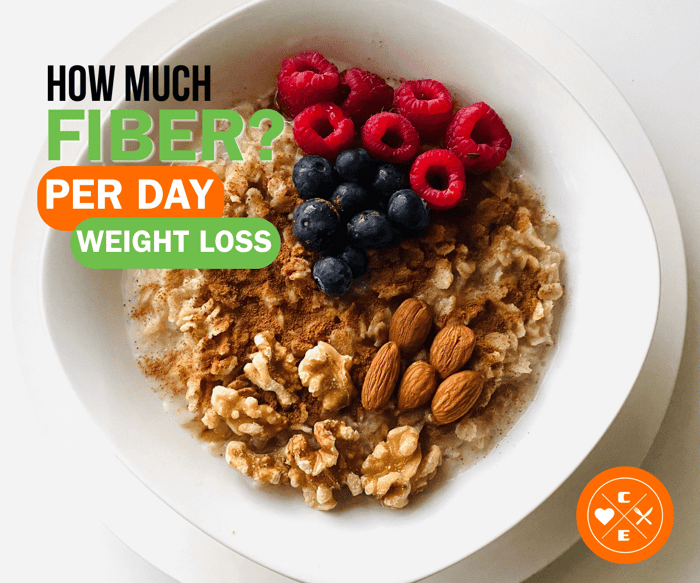
A 30-plus gram day looks something like this: oatmeal with a tablespoon of chia seeds and a half cup of raspberries at breakfast (13 grams), a salad with half a cup of black beans and a slice of whole-grain bread at lunch (10), an apple with the skin on as a snack (4), and salmon with a cup of broccoli and half a cup of quinoa at dinner (8). That comes to 35 grams without any single meal feeling fiber-heavy.
The reason this distribution works matters. Spreading 30 grams across four moderate contributions is dramatically easier on your gut than landing the same total in one sitting. Going from a low-fiber baseline to a high-fiber one too quickly is also the single biggest reason people give up on these diets — our guide to ramping up fiber without the bloating covers the gradual approach that actually works.
If building four fiber-rich meals from scratch every week isn't realistic, prepared meals built on whole-food fiber sources can do the work for you. Our High Fiber Meal Plan is designed around exactly this principle: every meal contains at least 5 grams of fiber from vegetables, legumes, and whole grains, with no added fiber powders or fortification. If you're still figuring out whether prepared meal delivery is even the right move for fiber-conscious eating, our comparison of the best high-fiber meal delivery services walks through what actually distinguishes the options.
A few questions people ask
What food has the highest fiber content per serving?
Chia seeds at 10 grams per ounce, avocado at 10 grams per medium fruit, and a single artichoke at 10 grams all tie at the top. Among legumes, navy beans lead at 9.6 grams per half cup cooked.
How do I get 30 grams of fiber a day?
Distribute it across meals. Oatmeal with chia and berries at breakfast, a salad with beans at lunch, an apple as a snack, and a dinner with vegetables and a whole grain typically lands at 30-35 grams without any single meal feeling fiber-heavy.
Are bananas high in fiber?
Bananas are moderate. A medium banana has about 3 grams. They're fine to include, but raspberries (8 grams per cup) and avocado (10 grams per fruit) deliver far more.
Is rice a high-fiber food?
White rice has essentially no fiber — about half a gram per cup. Brown rice is better at 3.5 grams. Bulgur (8), barley (6), whole-wheat pasta (6), and quinoa (5) all outperform brown rice if fiber is the goal.
What vegetables have the most fiber?
Artichokes (10 grams per medium artichoke), green peas (9 per cup), and acorn squash (9 per cup) lead the field. Broccoli, Brussels sprouts, and sweet potato with the skin are solid mid-range choices in the 4-5 gram range.
The bottom line
Closing the gap between 15 grams and 28-plus doesn't require an overhaul. Adding beans or lentils to a few meals a week, swapping white rice for bulgur or barley, eating fruit instead of drinking it, and keeping chia or flax handy for breakfast are enough to move most people from below average to comfortably ahead of recommendations within a month.
If meal planning isn't where you want to spend your time this week, our High Fiber Meal Plan covers the same ground in chef-prepared form — every meal built around the kinds of whole foods on this list.
References
1. U.S. Department of Agriculture and U.S. Department of Health and Human Services. Dietary Guidelines for Americans, 2020-2025.
2. Quagliani D, Felt-Gunderson P. Closing America's Fiber Intake Gap: Communication Strategies From a Food and Fiber Summit. American Journal of Lifestyle Medicine. 2017;11(1):80-85.
3. U.S. Department of Agriculture, Agricultural Research Service. FoodData Central.