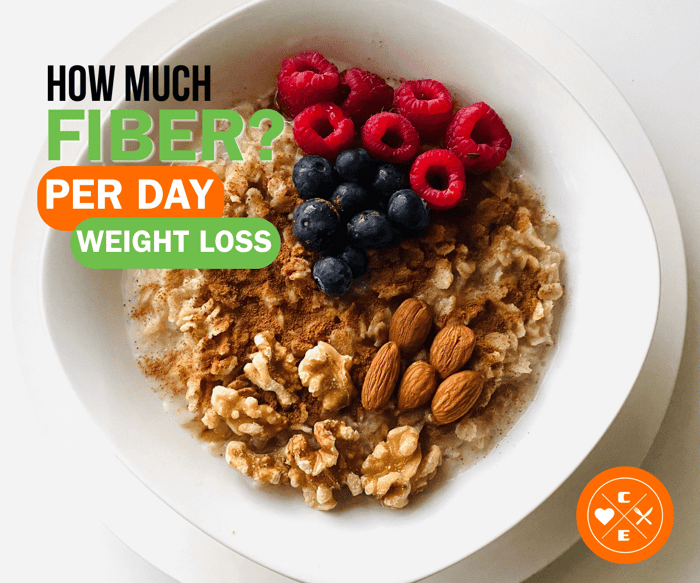
Quick Answer: Adults should eat about 14 grams of fiber per 1,000 calories — which lands at 25-28 grams a day for women under 50, 31-34 grams for men under 50, and somewhat less for adults over 50. The FDA Daily Value is 28 grams. The average American gets only about 15. To find your personal target, multiply your daily calorie intake by 0.014 (so 2,000 calories × 0.014 = 28g of fiber).
The recommended daily fiber intake for adults is somewhere between 22 and 38 grams, depending on age, sex, and how many calories you eat. The average American eats 15. That gap is one of the most consistent nutritional shortfalls in the U.S. diet — about 95% of adults fall short of meeting the recommendation, and the deficit is large enough that closing it tends to improve digestion, blood sugar, cardiovascular markers, and weight management at once.
Knowing your specific number is more useful than aiming at the generic "eat more fiber" advice. The number you need depends on what you actually eat, not on age and sex alone. Here's how to calculate yours, what the research-backed targets look like at different life stages, and why most people undershoot.
For the bigger picture on what fiber does in your body and why hitting the target matters more than almost any other nutrient — gut bacteria, blood sugar, heart health, weight loss, the works — our Ultimate Guide to Dietary Fiber covers the science. This article is the practical companion: how much, calculated for you.
Health starts with a healthy gut
Get all of our FREE info on fiber — best foods, soluble vs. insoluble, recipes and more
Daily fiber recommendations by age and sex
The U.S. Dietary Guidelines and the Institute of Medicine both publish age- and sex-specific targets. Women aged 19-50 should aim for 25-28 grams a day; over 50, that drops to about 22 grams as calorie needs decline. During pregnancy the recommendation rises to 28 grams; during breastfeeding, 29.1
For men, the targets run higher. Men aged 19-50 should target 31-38 grams a day. Over 50, the recommendation drops to 28-30 grams. The reason men's targets are higher isn't biological complexity — it's just that men typically eat more calories, and fiber needs scale with caloric intake.
Children's recommendations also vary by age and sex. Kids 1-3 need about 19 grams a day. From age 4-8, it's 25 grams. Boys 9-13 need 31; girls of the same age, 26. The teenage years are where the biggest gap opens — boys 14-18 need 38 grams a day, while girls of the same age need 26.
The Food and Drug Administration uses a single number on nutrition labels: 28 grams a day, calculated for an adult on a 2,000-calorie diet.2 If you don't want to track a personalized target, 28 grams is a reasonable middle-of-the-road number that works for most adults.
The calorie-based calculator
The cleaner way to find your target is to base it on your actual calorie intake. The official rule is 14 grams of fiber per 1,000 calories consumed.3 This scales naturally with body size, activity level, and metabolic needs in a way that age-and-sex categories don't.
To calculate yours, take your typical daily calorie intake and multiply by 0.014 (or divide by 1,000 and multiply by 14). The math: 1,500 calories lands at 21 grams of fiber, 1,800 at 25, 2,000 at 28, 2,200 at 31, 2,500 at 35, 3,000 at 42, and 3,500 at 49.
This formula is more accurate than rigid age and sex categories because it adjusts to what you actually eat. A small, sedentary adult on 1,600 calories doesn't need 35 grams of fiber. A 6'4" construction worker eating 3,200 calories genuinely needs more than the standard 38 grams listed for "adult men." If you don't track calories and don't want to start, the simpler rules work fine: 25 grams for women, 35 grams for men, give or take. Closing the gap to either number delivers most of the available health benefit.
Why most Americans miss the target
The average American adult consumes about 15 grams of fiber per day — roughly half the recommended amount. About 95% of adults fail to meet the recommendation entirely.4 This is the most consistent nutrient gap in the American diet, and it's not subtle.
The reasons are straightforward. Fiber comes from whole plant foods: vegetables, fruits, legumes, whole grains, nuts, and seeds. The American diet has shifted heavily toward refined grains (white bread, white rice, pasta), meat, dairy, and ultra-processed foods, all of which contain little to no fiber. Even people who consider themselves healthy eaters often miss the mark because the foods commonly framed as "healthy" — chicken breast, Greek yogurt, eggs, lean ground beef — contain zero fiber. You can build an entire "clean eating" diet around protein-forward whole foods and still land at 15 grams a day.
The cost of the deficit isn't theoretical. The 2020-2025 Dietary Guidelines list low fiber intake as a "nutrient of public health concern," meaning the deficiency is widespread enough to drive measurable disease outcomes at the population level.5 Low fiber intake is associated with higher rates of heart disease, type 2 diabetes, certain cancers, obesity, and digestive disorders.
How to actually hit your number
The most important thing about hitting a fiber target is that it's much easier than it sounds — provided you build fiber into every meal rather than chasing the number after the fact.
A typical 28-gram day might look like this. Breakfast: a bowl of oatmeal (4g) with a tablespoon of chia seeds (5g) and a half cup of raspberries (4g) — that's 13 grams before 9 a.m. Lunch: a salad with a half cup of black beans (7g) and a slice of whole-grain bread (3g) brings another 10. An apple as a snack adds 4. Dinner of salmon with a cup of broccoli (5g) and a half cup of quinoa (3g) closes it out at 35 grams total. No single meal felt fiber-heavy, and you didn't have to think about it past breakfast.
The key is variety. Different fiber-rich foods feed different gut bacteria, so spreading your intake across legumes, fruits, vegetables, and whole grains delivers more health benefit than hitting the same number from a single source. For specific high-fiber foods organized by category, our list of the 30 highest-fiber foods covers what to actually buy.
If you're currently at 15 grams and need to get to 28 or higher, don't try to make the jump in a day. Increasing fiber too fast causes bloating, gas, and discomfort that's hard to push through, and most people quit the diet rather than the symptoms. The standard recommendation is to add no more than 5 grams of new fiber per week, paired with a meaningful increase in water intake. Our guide to ramping up fiber without the bloating covers the gradual approach.
The easy path to your number
The most reliable way to consistently hit a daily fiber target is to make the most of your meals fiber-dense by default. When the meals you eat regularly already contain 5-10 grams of fiber each, the math takes care of itself.
Our High Fiber Meal Plan is built around exactly this principle — every meal contains at least 5 grams of fiber from whole-food sources like vegetables, legumes, and whole grains, supporting a daily intake comfortably above 28 grams without tracking. Our comparison of the best high-fiber meal delivery services covers how the major options stack up if you're shopping around.
A few questions people ask
How much fiber should I eat per day?
The general rule is 14 grams per 1,000 calories — about 25-28g for most women, 31-34g for most men. The FDA Daily Value used on nutrition labels is 28 grams. The average American gets only 15g, so most people need to roughly double their intake.
Is 30 grams of fiber a day enough?
Yes — 30g meets or exceeds the recommendation for most adults and is well above the U.S. average. Some research suggests continued benefits at 35-40g, but 30g is sufficient for clear improvements in digestion, blood sugar, heart health, and weight management.
Can you eat too much fiber?
Yes, although it's rare from food alone. Above 50-70g daily, especially if increased rapidly, fiber can cause bloating, cramping, and impaired mineral absorption. Most overshoots involve fiber supplements, not whole foods.
How much fiber per day for a woman?
25-28g for women under 50, 22g for women over 50, 28-29g during pregnancy or breastfeeding. Adjust up if your calorie intake is higher than the typical 1,800-2,000.
How much fiber per day for a man?
31-38g for men under 50, 28-30g for men over 50. Active or larger men should target the higher end of the range based on calorie intake.
The bottom line
Most adults need somewhere between 25 and 38 grams of fiber per day, depending on age, sex, and how many calories they eat. The cleanest formula is 14 grams per 1,000 calories. Most Americans are eating about half of what they should — closing that gap is one of the most reliable health gains available from any single dietary change.
If hitting your number from scratch every day feels like more planning than your week allows, our High Fiber Meal Plan takes the calculation out of it.
References
1. Institute of Medicine. Dietary Reference Intakes for Energy, Carbohydrate, Fiber, Fat, Fatty Acids, Cholesterol, Protein, and Amino Acids. National Academies Press. 2005.
2. U.S. Food and Drug Administration. Daily Value on the Nutrition and Supplement Facts Labels. 2024.
3. U.S. Department of Agriculture and U.S. Department of Health and Human Services. Dietary Guidelines for Americans, 2020-2025.
4. Quagliani D, Felt-Gunderson P. Closing America's Fiber Intake Gap: Communication Strategies From a Food and Fiber Summit. American Journal of Lifestyle Medicine. 2017;11(1):80-85.
5. U.S. Department of Health and Human Services and U.S. Department of Agriculture. 2020-2025 Dietary Guidelines for Americans.