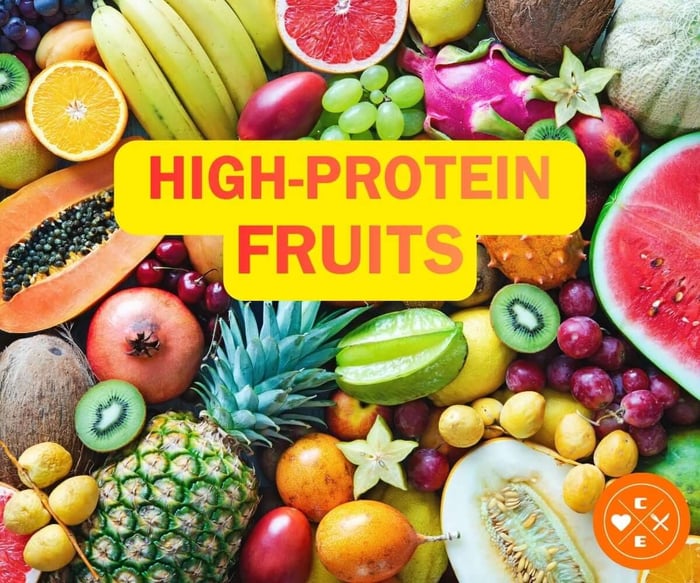

Quick Answer: Passion fruit has more protein than any other common fruit at about 5.2 grams per cup, with guava close behind at 4.2 grams. Every other fruit lands between 0.5 and 3 grams per serving. That is enough to matter as a supporting player and nowhere near enough to count as a protein source, so the useful question is not which fruit has the most protein but what you pair it with.
Search "high protein fruits" and you get list after list of the same eight fruits, ranked, with no context. What almost none of them tell you is the part that decides whether the information is useful: even the winner supplies less protein than two tablespoons of peanut butter.
That is not a reason to skip fruit. It is a reason to stop treating fruit as a protein strategy and start treating it as what it is — a fiber and micronutrient source that happens to carry a gram or two of protein along for the ride.
The fruits with the most protein, ranked
All figures below come from the USDA FoodData Central database, measured per one-cup serving so the comparison is apples to apples. Or, more accurately, guavas to apples.
| Fruit | Serving | Protein |
|---|---|---|
| Passion fruit | 1 cup | 5.2 g |
| Dried apricot halves | 1 cup | 4.4 g |
| Guava | 1 cup | 4.2 g |
| Avocado, cubed | 1 cup | 3.0 g |
| Pomegranate arils | 1 cup | 2.9 g |
| Jackfruit, sliced | 1 cup | 2.8 g |
| Apricots, fresh sliced | 1 cup | 2.3 g |
| Kiwi | 1 cup | 2.1 g |
| Blackberries | 1 cup | 2.0 g |
| Raspberries | 1 cup | 1.5 g |
| Banana | 1 medium | 1.3 g |
| Orange | 1 medium | 1.2 g |
| Apple | 1 medium | 0.5 g |
Two notes on that table, because both trip people up.
Avocado gets quoted at anywhere from 3 to 4.5 grams depending on the list, and both numbers are right. Cubed avocado is mostly air pockets; mashed avocado packs denser, so a cup of it weighs more and carries more of everything. If you are tracking, weigh it.
Dried fruit looks impressive on this list for a boring reason. Drying removes water, so a cup of dried apricots is simply more apricot than a cup of fresh ones — along with several times the sugar and calories. Nothing about the fruit got more protein-dense per bite of actual food.
Why "high-protein fruit" is a relative term
Guava is genuinely the protein standout of the produce aisle, containing roughly triple what an apple, a grape, or a mango carries gram for gram. It also brings 8.9 grams of fiber per cup at 112 calories, which is the more interesting number on its nutrition panel.
Now put it against a real protein source. The Recommended Dietary Allowance for protein is 0.8 grams per kilogram of body weight, which works out to about 56 grams a day for a 155-pound adult. Researchers writing in Advances in Nutrition have pointed out that this figure was derived as the minimum needed to avoid losing body nitrogen, not as a performance target. Anyone lifting, dieting, over 60, or on a GLP-1 medication is generally aiming higher — the International Society of Sports Nutrition puts the range for active people at 1.4 to 2.0 grams per kilogram per day.
Call it 110 grams for that same adult if they train. Reaching it on guava alone means 26 cups. Roughly 2,900 calories of guava. Before anything else you eat that day.
Fruit is not going to do this job. It was never applying for it.
What fruit protein is actually good for
The protein in fruit matters in one specific way: it arrives attached to fiber, water, and a pile of micronutrients, in a food most people are happy to eat. That combination makes fruit an excellent partner to a protein source and a poor substitute for one.
Timing is where this gets practical. A crossover feeding trial published in The Journal of Nutrition found that spreading protein evenly across the day at roughly 30 grams per meal produced about 25% more 24-hour muscle protein synthesis than eating the same daily total but loading most of it at dinner. Breakfast is where that usually falls apart, and breakfast is also where fruit shows up most.
So the fix is not swapping in a higher-protein fruit. It is adding a protein anchor next to whatever fruit you already like. A cup of blackberries over Greek yogurt turns 2 grams into about 20. Sliced kiwi with two eggs, roughly 14. Guava alongside a prepared breakfast meal, north of 25. We cover the wider picture of which fruits earn a regular spot in portions, fiber, and easy ways to use fruit, and the per-meal math in more depth in our breakdown of the 30-gram-per-meal method.
The fiber angle deserves its own mention, since it is the thing fruit is genuinely best in class at. Our complete guide to dietary fiber covers why that matters more for appetite than the protein gram count ever will, and our guide to the best foods for weight loss puts both macros in context.
What 30 grams of protein actually looks like
Here is the comparison the listicles cannot make, because it requires having a menu.
The 36 meals on our July 15 – August 15, 2026 menu run from 23 grams of protein to 55 grams, with a median of 31.5 grams. Twenty of those 36 clear 30 grams in a single tray. You can see every meal's calories, protein, carbs, fat, and allergens on our nutrition page, which is also where those numbers come from.
Take the lowest-protein meal on that menu — Basic Beef Barbacoa, at 23 grams. Matching it with guava, the protein champion of the fruit world, takes five and a half cups. That is about 613 calories of guava replacing a 360-calorie meal, and you would still be short on the amino acid profile.
None of which makes guava a bad food. It makes it a side dish.
If protein is the number you are chasing, the practical move is to fix the anchor and let fruit be fruit. Our High Protein Meal Plan runs 35 grams or more per serving with two extra ounces of meat in every tray. If you would rather choose meal by meal, the Build A Meal Plan menu has a protein filter with 20–30g, 31–40g, and 41g+ tiers, so you can build a box where every meal clears your per-meal target before the fruit bowl enters the conversation. Everything ships cooked and frozen — the mechanics of prepared meal delivery are covered in full if that part is new to you.
Frequently asked questions
What fruit has the most protein?
Passion fruit leads at about 5.2 grams of protein per cup, followed by guava at roughly 4.2 grams per cup. Guava is the better everyday pick because it is far easier to find fresh and costs less per serving.
Does fruit have protein?
Yes, but very little. Most fruit falls between 0.5 and 2 grams of protein per serving, which is a rounding error next to chicken, eggs, Greek yogurt, or a prepared high-protein meal.
Can you build muscle by eating high-protein fruit?
No. Building muscle takes roughly 1.4 to 2.0 grams of protein per kilogram of body weight daily, and hitting that on fruit alone would mean eating 30 or more cups a day. Fruit supports a high-protein diet, but it never anchors one.
Is dried fruit higher in protein than fresh fruit?
Per cup, yes, because drying removes water and concentrates everything. A cup of dried apricot halves has about 4.4 grams of protein versus 2.3 grams for fresh sliced apricots, but it also carries several times the sugar and calories.
How much protein should I eat at one meal?
Research on protein timing points to about 25 to 30 grams per meal to support muscle. No fruit gets you there on its own, which is why fruit belongs alongside a protein source rather than in place of one.
The bottom line
Passion fruit and guava top the list, and the list itself is a curiosity rather than a plan. Fruit contributes one to five grams of protein per serving — real, worth knowing, and not remotely enough to build a day around.
Eat the fruit for the fiber, the water, the vitamin C, and the fact that it tastes good. Get the protein from something that actually has some.