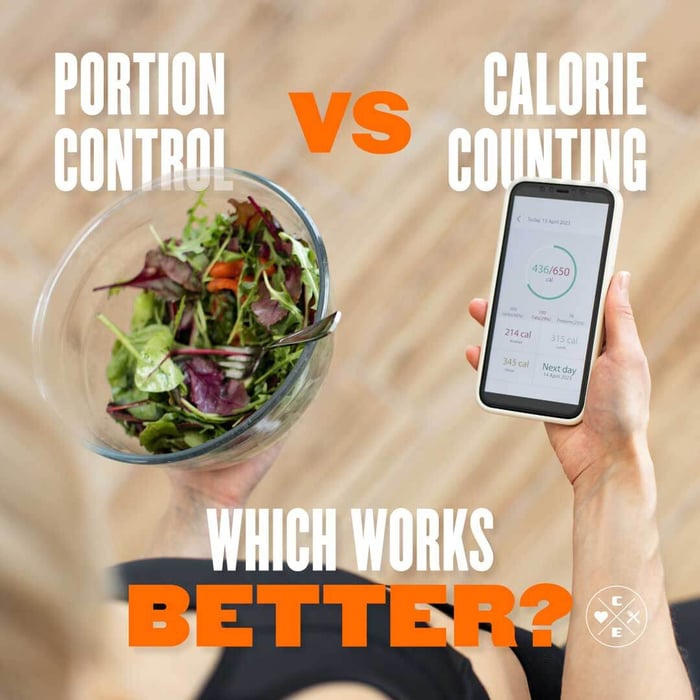
Quick Answer: Both methods work—the best one is whichever you'll actually stick with. Calorie counting gives you precision and flexibility when you're willing to log consistently. Portion-based approaches (plate methods, hand guides, focusing on lower energy-density foods) can deliver similar results with less daily friction. Many people find success with a hybrid: a few weeks of counting to calibrate your eye, then portion guidance for everyday life.1,2,3
What Do These Terms Actually Mean?
Calorie counting means tracking the total energy from everything you eat, usually through an app or food journal. You get precise numbers, you can adjust targets as needed, and it works with any cuisine or eating style.
Portion control uses visual templates instead of numbers. Think the MyPlate model, hand-size guides (palm = protein, fist = carbs, thumb = fats), measured servings, and a focus on foods with lower energy density—foods that have more water and fiber, so you get fewer calories per bite. Often no logging required.
What the Research Actually Shows
Here's the thing: both approaches have solid science behind them.
A randomized trial comparing MyPlate-style portion guidance against traditional calorie counting found that both groups improved their satiety and reduced waist circumference. The portion-focused group even showed better blood pressure improvements at the six-month mark. The takeaway? Portion control is a legitimate alternative to counting—not a watered-down version.1
Year-long studies on energy density tell a similar story. When people focused on adding more fruits, vegetables, soups, and lean proteins—lowering their overall calorie density—they lost weight and felt more satisfied without tracking every morsel.2,3
Portion-control plates have also shown promise. One study found adults with type 2 diabetes lost more weight using specially designed plates compared to usual care.5 That said, research on plate size alone is mixed—the key seems to be the overall strategy, not just smaller dishes.6
But here's the most important finding across all the research: consistency matters more than the method itself. Studies repeatedly show that how often you self-monitor—whether that's logging meals or being mindful of portions—predicts success more than which diet you choose.4,7,8
Pros and Cons of Each Approach
Calorie counting gives you precision and flexibility. It's great when you want to hit a specific deficit (say, 300-500 calories below maintenance) or when you're eating out and need to fit indulgences into your day. The downside? It takes time and attention. Label accuracy isn't perfect—the FDA allows some tolerance in nutrition labeling—and many people experience logging fatigue after a few months.9 This approach works best for data-driven people, short calibration phases, or when you've hit a plateau and need to tighten things up.
Portion control and energy density approaches are simpler day-to-day. They naturally support fullness, require less mental bandwidth, and work well for families or busy schedules. The risk? Without occasional check-ins, portions can drift upward over time. You also need to pay attention to food quality—this isn't a "just eat less" strategy. These methods shine for long-term maintenance and for anyone who finds logging tedious.
For a deeper dive into which foods support weight loss best, check out our complete guide to the best foods for weight loss.
The Hybrid Approach That Actually Sticks
Here's what works for most people: use two to four weeks of calorie counting to learn what your true portions look like, then shift to portion templates and lower energy-density choices for daily life. If progress stalls, bring back counting for a week to recalibrate.7,8
This balances accuracy with sustainability. You get the education that counting provides without the burnout of doing it forever.
How to Put This Into Practice This Week
Choose your primary mode. Decide whether you'll start with counting, portions, or a hybrid. There's no wrong answer—just pick one and commit for at least two weeks.
Set a realistic deficit. Most adults do well trimming 300-500 calories per day if counting, or simply shrinking portions one notch while adding more vegetables if using the portion approach. Our calorie goal guide can help you dial in your numbers.
Build volume into your meals. Fill half your plate with non-starchy vegetables, a quarter with lean protein, and a quarter with quality carbs. Add a thumb or two of healthy fats for satiety. This is basically the MyPlate model in action.
Anchor with protein. Aim for roughly 1.2-1.6 grams per kilogram of body weight daily to maintain muscle while losing fat. If you're not sure what qualifies as high-protein eating, see our breakdown of what a high-protein diet actually looks like.
Make adherence easier. Pre-log or pre-portion your meals and snacks. This is where calorie-controlled meal plans become genuinely useful—the portioning and macro math is already done. You can check exact nutrition info on our nutrition page.
Watch weekends and eating out. These are where most people's plans fall apart. Use hand-size portions when you can't weigh food (palm of protein, cupped hand of carbs, thumb of fats), prioritize lean protein and vegetables, and if you're counting, scan menus ahead of time to pre-select your order.
Pre-portioned meals take the guesswork out of both approaches—whether you're counting or not, you know exactly what you're getting. That's a big part of why meal prep strategies work so well. Our complete meal prep guide breaks down how to set this up for yourself.
Want to add movement to accelerate results? See our guide on how much exercise you actually need per day.
Troubleshooting — When Progress Stalls (and What to Do)
If your results slow down, don’t assume the method “stopped working.” Most stalls come from a few predictable friction points. Here are the most common ones—and simple fixes you can try this week.
1. Weekends undo the deficit
What happens: Meals out + drinks + snacks turn into a 2–3 day calorie surplus.
Try this: Use a “bookends” strategy: protein + veggies at your first and last meal, and keep indulgences to one planned item (dessert or drinks, not both).
2. Portions drift upward (even with “healthy” foods)
What happens: Nuts, oils, cheese, granola, and “healthy” snacks quietly add up.
Try this: Pre-portion your calorie-dense foods for 7 days (nuts, olive oil, nut butter). Keep them visible in single servings.
3. Protein is too low (hunger stays high)
What happens: You’re “eating less,” but you’re not satisfied.
Try this: Anchor each main meal with a clear protein portion (palm-sized minimum). Add protein first, then adjust carbs/fats.
4. Liquid calories sneak in
What happens: Coffee add-ins, juices, smoothies, and alcohol can cancel your deficit fast.
Try this: Pick one: keep your favorite, but simplify the rest (e.g., one latte/day, otherwise black coffee or unsweetened options).
5. “I’m good all day, then snack all night”
What happens: Under-eating earlier leads to rebound eating.
Try this: Add a planned afternoon mini-meal: protein + fiber (Greek yogurt + berries, hummus + veggies, turkey + fruit).
6. Eating out feels impossible
What happens: Portions are large, and hunger cues get overridden.
Try this: Use the “half now, half later” rule. Ask for a box when the meal arrives. Prioritize grilled/roasted proteins + veggies.
7. Scale weight isn’t moving (but you’re doing a lot “right”)
What happens: Water retention, cycle stress, sodium, new training, constipation.
Try this: Track trends: weekly average weight + waist measurement. Give it 2 full weeks before changing the plan.
8. Tracking burnout (or too much mental load)
What happens: You quit because the method takes over your life.
Try this: Switch to a “minimum effective dose” approach for 14 days: track just 2 meals/day or do one weekly check-in day, while using portion templates daily.
Bottom line: Don’t change everything—change one lever, test for 7–14 days, then reassess.
FAQs
Which is better for fat loss: portion control or calorie counting?
Neither is universally better—adherence wins. If you'll reliably log your food, calorie counting gives you precision. If you hate logging, portion control and energy-density strategies are research-validated and often more sustainable long-term.1,2,3
Do I have to count calories to lose weight?
No. Randomized controlled trials show you can reduce energy density and control portions to lose weight without daily counting. Many people find portion-based approaches easier to maintain long-term.2,3
Are calorie labels perfectly accurate?
Labels guide choices but aren't perfect. There's regulatory tolerance and normal manufacturing variation, so your actual intake may differ slightly from what's printed.9
What if I keep slipping on weekends?
Try a hybrid approach: count Monday through Thursday, then use portion guidance Friday through Sunday. Pre-portion snacks and choose lower energy-density options like salads, broth-based soups, and grilled proteins when eating out.
References
1. McCarthy WJ et al. MyPlate vs. calorie counting randomized trial: both reduced waist; MyPlate improved SBP at 6 months. Ann Fam Med (2023) | PCORI report.
2. Ello-Martin JA et al. Lowering dietary energy density increases satiety and aids year-long weight loss. Am J Clin Nutr (2007).
3. Rolls BJ et al. Provision of lower energy-density foods improved weight loss over 1 year. Obesity (2005).
4. Turk MW et al. Self-monitoring adherence mediates weight-loss success in a behavioral program. Int J Behav Med (2013).
5. Pedersen SD et al. Portion-control plate helped induce weight loss in adults with type 2 diabetes. Arch Intern Med (2007).
6. Robinson E et al. Smaller plates alone show small/mixed effects on intake (meta-analysis). Obes Rev (2014).
7. Turner-McGrievy GM et al. Best predictor of loss was days with ≥2 eating occasions logged (apps). J Acad Nutr Diet (2019).
8. Payne JE et al. Frequent app-based diet self-monitoring associated with short-term loss. Obes Sci Pract (2021).
9. FDA/USDA resources on labeling & tolerance: FDA Nutrition Facts · FDA Labeling Guidance · FSIS Nutrition Labeling Overview.
Educational content only; not medical advice.