
Potatoes for weight loss
Are potatoes good for weight loss? Most filling food tested
Yes, cooked plain. Boiled potatoes topped a 38-food satiety test at 323% of white bread. What the trials found, why frying changes everything and a crispy recipe on one tablespoon of oil.
- Free Shipping on Every Meal PlanFree Shipping
- Up to 20% Off 30-Meal PlansUp to 20% Off
- Chef Cooked, Dietitian BuiltDietitian Built
- Heat & Eat in MinutesHeat & Eat

The most filling food tested
Are potatoes good for weight loss?
Quick answer
Yes, when they're cooked plain. In the best-known satiety study, boiled potatoes were the most filling of 38 foods tested, scoring 323% against white bread at 100%. In an 8-week feeding trial, people on a potato-based diet lost weight as well as people on a bean-based one.
In 1995, researchers at the University of Sydney gave volunteers 240-calorie portions of 38 foods and measured how full they felt and how much they ate afterward. Boiled potatoes scored 323% on the resulting satiety index, against white bread at 100%, according to the study in the European Journal of Clinical Nutrition. That put them ahead of porridge, beef and eggs, and roughly seven times ahead of a croissant.
It was one study, with 11 to 13 volunteers per food and a single sitting each, three decades ago. Treat it as a strong signal rather than proof. Potatoes sit at the top of the list that's been measured, and we haven't found later work that knocked them off it.
Part of the reason is simple arithmetic. A boiled potato is close to 80% water and carries under 1 calorie per gram, so a satisfying portion costs very little. Cheese runs about 4 calories per gram, and nuts about 6. The authors saw the same pattern across the whole list: the foods that weighed more per 240 calories tended to score higher.
Potato diet trial results
Do people lose weight eating potatoes?
Quick answer
They did in a controlled trial. Over 8 weeks, 36 adults with insulin resistance ate low-energy-density meals built around potatoes or beans. The potato group lost 5.6% of body weight and the bean group 4.1%, and the difference wasn't statistically significant.
Lab ratings of fullness only go so far. The better evidence is a randomized feeding trial at Pennington Biomedical Research Center, published in the Journal of Medicinal Food. Thirty-six adults with insulin resistance ate low-energy-density meals built around either potatoes or beans for eight weeks. The potato group lost 5.6% of body weight and the bean group 4.1%, and the difference wasn't statistically significant.
The fair reading is that potatoes did as well as beans, the food usually held up as the model for blood sugar. Not better. And the study kitchen prepared every meal, so it shows what the food does when portions are controlled, not what happens when you cook for yourself.
That's also where most potato diets go wrong in practice. In a Harvard analysis of 120,877 US adults, each added daily serving of potatoes tracked with 1.28 more pounds of gain over 4 years, and potato chips with 1.69 pounds. That's observational, and it counts fries and loaded baked potatoes alongside boiled ones, so it can't tell you the potato did it. It does tell you how potatoes usually get eaten.
Boiled vs fried potatoes
Does how you cook potatoes matter?
Quick answer
More than anything else about them. Boiling, baking and microwaving add nothing. Frying adds oil, and a single tablespoon of olive oil is about 120 calories. A plain baked potato and a large order of fries start from the same vegetable and end up nowhere near each other.
Boiled and fried are two different foods. A plain baked potato and a large order of fries start from the same vegetable and end up nowhere near each other on calories. Frying adds oil, and oil is the most calorie-dense thing in most kitchens: a tablespoon of olive oil is about 120 calories (search "olive oil" in USDA FoodData Central). Butter and sour cream on a baked potato do the same thing more slowly.
Boiling, baking and microwaving add nothing. Roasting and air-frying add whatever oil you use, which is why it's worth measuring: a teaspoon per serving is enough to crisp the edges, and a pour from the bottle is usually several times that. Leave the skin on. It's where much of the fiber is, and peeling is extra work for a worse result.
Chilled potatoes & resistant starch
Do chilled potatoes help with weight loss?
Quick answer
A little, and mostly for blood sugar. Refrigerating boiled potatoes for 24 hours raised resistant starch from about 3.3% to 5.2% of total starch. In a trial of 30 women, total glucose over two hours didn't differ from hot potatoes, so treat it as a bonus.
Cooking makes potato starch soft and fast to digest. Cooling it lets some of the starch re-form into resistant starch, which isn't absorbed in the small intestine. In testing at Lund University, refrigerating boiled potatoes for 24 hours raised resistant starch from about 3.3% to 5.2% of total starch. That was a small study of 13 healthy people.
The effect on blood sugar is smaller than the internet makes it sound. In a crossover trial of 30 women with higher-than-normal fasting glucose, published in Nutrients, chilled potatoes lowered glucose 4.8% at 15 minutes and 9.2% at 30 minutes, and cut the two-hour insulin response by about 18%. Total glucose over the full two hours, the study's main measure, didn't differ significantly from hot potatoes.
So it's a small bonus, not a strategy. If you cook potatoes ahead and eat them over a few days, which is good practice anyway (see our meal prep guide), you get it for free.
Crispy smashed potatoes recipe
How do you get crispy potatoes on less oil?
Quick answer
Smash them. Boiling and flattening baby potatoes before roasting gives them more surface area, so one measured tablespoon of oil crisps four servings. Each serving is about 165 calories, with 30 grams of carbohydrate and 4 grams of fat.
Smashing boiled potatoes before roasting gives them more surface area, so a measured tablespoon of oil crisps four servings.
Serves 4- 1.5 lb baby potatoes (about 20 small), any variety
- 1 tablespoon olive oil
- 1/2 teaspoon garlic powder
- 1/2 teaspoon smoked paprika
- 1/4 teaspoon black pepper
- 1/4 teaspoon salt
- Fresh herbs (rosemary, thyme or chives) for topping
- 1
Boil the potatoes
Boil the potatoes in salted water for 15 to 20 minutes, until fork-tender.
- 2
Drain & cool slightly
Drain and let them cool for about 5 minutes, just enough to handle.
- 3
Heat the oven
Preheat the oven to 425°F (220°C). Line a baking sheet with parchment paper.
- 4
Space them out
Arrange the potatoes on the sheet, leaving space between each one.
- 5
Smash them flat
Use the bottom of a glass or a fork to gently smash each potato to about 1/2 inch thick.
- 6
Oil & season
Brush with the olive oil and season with garlic powder, paprika, salt and pepper.
- 7
Bake until crispy
Bake for 20 to 25 minutes, until the edges are golden and crispy.
- 8
Top & serve
Top with fresh herbs and serve right away.
Smashed potato nutrition
Each serving is about 165 calories, with 30 grams of carbohydrate, 4 grams of fat, 4 grams of protein and 4 grams of fiber, estimated from USDA FoodData Central using the raw weight of the potatoes and the oil. USDA's red and white potato entries run closer to 150 calories. Most of the fat is the tablespoon of oil, split four ways. Leftovers reheat well in an air fryer, and the night in the fridge adds a little resistant starch.
Potato meals with protein
How do you build a potato meal that lasts?
Quick answer
Put it next to protein. A potato on its own won't hold you for long, so pair a medium potato with a palm-sized portion of chicken and a vegetable. On our menu, the leaner potato meals run 300 to 420 calories with at least 24 grams of protein.
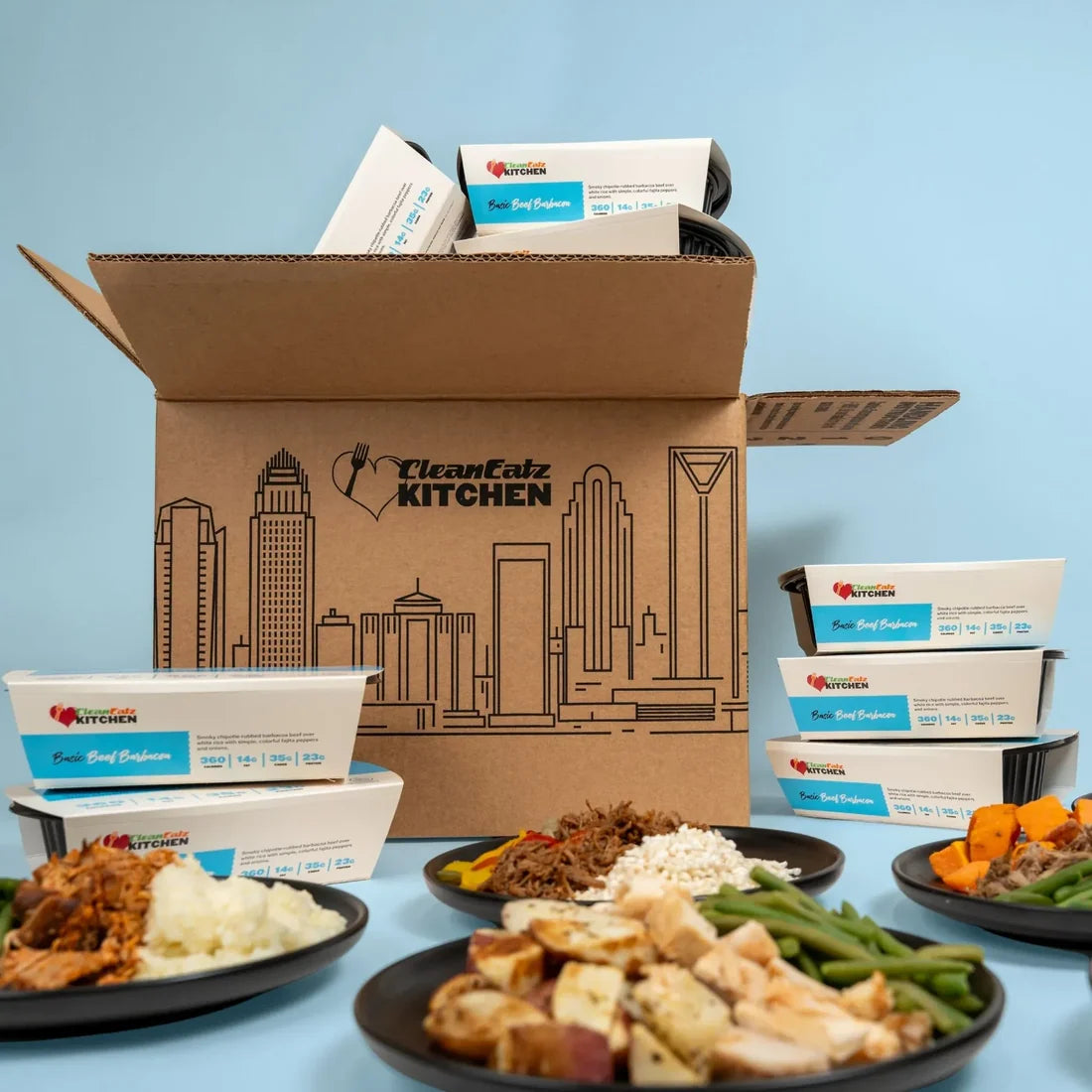
A potato on its own won't hold you for long. The fullness lasts when it sits next to protein, which is how our own kitchen uses them. These are some of the leaner potato meals on our current menu, from our nutrition page, checked November 2026:
| Meal | Calories | Protein | Sodium |
|---|---|---|---|
| Basic Chicken Breast & Sweet Potatoes | 300 | 40g | 580mg |
| Basic Diced Chicken & Red Potatoes | 300 | 25g | 360mg |
| Basic Beef & Sweet Potatoes | 310 | 24g | 750mg |
| XL BBQ Chicken Red Potatoes | 420 | 48g | 550mg |
Potato meals on the Clean Eatz Kitchen menu, from our nutrition page, November 2026
Every one of them is a potato and at least 24 grams of protein for 420 calories or less. Not everything on the menu is that light, and it would be odd to pretend otherwise: our Chicken & Sweet Potato Nacho Fries run 520 calories with 19 grams of fat, which is the toppings doing exactly what this post warned about.
You can build the same plate at home with a medium potato and a palm-sized portion of chicken. If the cooking is the part that isn't happening, that's a workload problem. These meals are in our Build A Meal Plan, and our Weight Loss Meal Plan is portion-controlled and calorie-controlled, from $89.95 for 10 meals with free shipping.
For the foods that do this job alongside potatoes, see our guides to beans and the 100 best foods for weight loss.
 Make it easy withWeight Loss Meal PlanFrom $89.95View plan
Potatoes for weight loss FAQ
Questions about potatoes, answered
How many calories are in a potato?
About 130 for a 150-gram potato boiled in its skin with nothing added, or about 140 baked. USDA's medium baked potato is 173 grams, about 160 calories. It has almost no fat and 3 to 4 grams of protein. Add a tablespoon of butter or oil and you've nearly doubled it, which is why the toppings matter more than the potato.
Are sweet potatoes better for weight loss?
Not by enough to matter much. The gap between a sweet potato and a white one is far smaller than the gap between a boiled potato and a fried one, so pick whichever you'll actually eat next to some protein. For the full comparison, see are sweet potatoes good for weight loss.
How much potato should I eat at a meal?
One medium potato, about 150 grams cooked, works well as the starch on a plate. Pair it with 20 to 35 grams of protein and a non-starchy vegetable. If you're more active or your calorie target is higher, add more potato before you add more oil, since it brings far more food for the calories.
Do potatoes make you gain weight?
Not on their own. In a controlled feeding trial, people eating potato-based meals lost 5.6% of body weight in 8 weeks. Large observational studies do link potatoes with weight gain over time, but those counts include fries and loaded potatoes. Plain potatoes in a calorie-controlled plan are a different food from either.
More nutrition & weight loss guides
Keep reading
 Weight loss
Are Sweet Potatoes Good for Weight Loss? Understanding the Benefits
 Romaine Rusnak, RD, LDN · Jun 16, 2023
 Weight loss
Are Beans Good for Weight Loss? Protein, Fiber, Portions & Easy Meals
 Sherrill Johnson, RD, LDN · Oct 1, 2026
 Weight loss
Best Foods for Weight Loss: 100-Food Complete Guide
Romaine Rusnak, RD, LDN · Oct 16, 2025Sources
On this page