

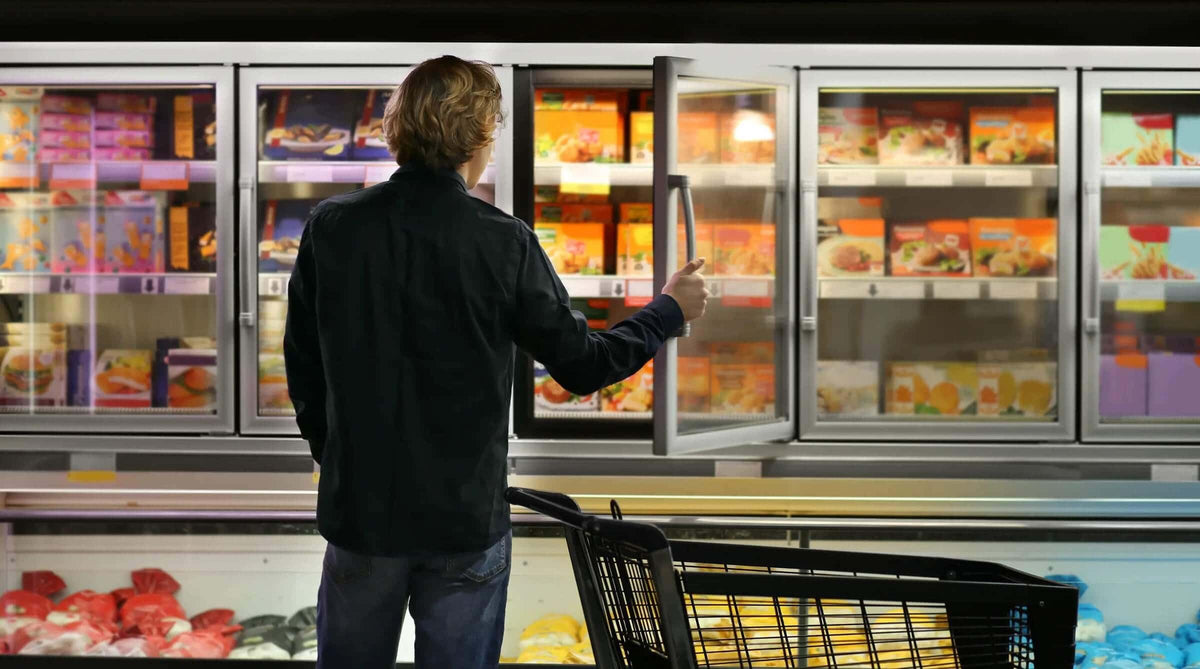
For most low-calorie eaters, frozen wins. Freezing leaves calories and macros unchanged and keeps most vitamins, and a frozen meal at 0°F stays safe indefinitely, while USDA gives refrigerated cooked food 3 to 4 days. Fresh wins one real category: salads and crisp, raw ingredients. If your week is predictable, either works. If it isn't, frozen wastes less.
Choosing a low-calorie meal delivery service often comes down to one big question: fresh meals or frozen? Food science and modern packaging have changed how both formats perform on nutrition, taste, shelf life and convenience.
If you're trying to manage calories, control portions and take some of the daily work out of meal planning, the difference between these two delivery styles matters more than the marketing suggests. Here are the pros and cons of each, and how to pick the one that will work for you.
Fresh vs frozen meal delivery verdict
Same meal, different clock
We compared the two formats on the things that change your week: what freezing does to nutrients, how the food tastes, how long it keeps, how much of it ends up in the trash, and how it reheats.
Frozen takes shelf life, food waste and flexibility. Fresh takes texture on raw and crisp dishes. Nutrition comes out close to even.
So, is fresh better than frozen? Not in the way the "never frozen" labels suggest. A cooked chicken and rice meal has the same calories, protein, carbs and fat whether it spent last night in a fridge or a freezer. The difference is time. A refrigerated meal starts counting down the day it's cooked. A frozen one waits.
For a low-calorie plan, that waiting is the point. You don't want to eat a meal because it's about to expire, and you don't want to throw out food you paid for because Tuesday went sideways.
Fresh & frozen meal delivery at a glance
Two formats, one grid
Fresh meal delivery usually means fully cooked meals that are refrigerated, not frozen, and shipped cold in insulated boxes with ice packs. They arrive ready to heat and carry a use-by date a few days out. Some services stretch that window with modified atmosphere packaging, which swaps the oxygen in the sealed tray for gases like nitrogen and carbon dioxide to slow bacterial growth.
Frozen meal delivery means meals are cooked, then frozen fast, often by flash freezing or blast freezing, before they ship. They arrive solid, go straight into a freezer at 0°F or below, and can sit there for months before you eat them.
| Fresh (refrigerated) | Frozen | |
|---|---|---|
| Storage | Refrigerator, 40°F or below | Freezer, 0°F or below |
| Safe window | 3 to 4 days for cooked food, per USDA | Safe indefinitely at 0°F, per USDA ✓ |
| Best quality | The first day or two | Months. Ours: up to 12 months from the production date ✓ |
| Calories & macros | Unchanged | Unchanged |
| Vitamins | Decline slowly in the fridge | Close to fresh, often better for produce ✓ |
| Crisp & raw foods | Keep their crunch ✓ | Go soft after thawing |
| Food waste | Higher if plans change | 47% less household waste in a UK review ✓ |
| Skipping a day | Costs you a meal | Costs you nothing ✓ |
The distinction matters because each method trades convenience, flexibility and time differently. Credit where it is due: if your meals are built around salads, fresh salsas and crisp raw vegetables, fresh delivery has a real advantage that freezing can't match.
We compared published food science and food safety guidance, not plates. Nutrient findings come from peer-reviewed reviews and trials, storage times from the USDA Food Safety and Inspection Service, and the waste figures from a 2017 review and the American Frozen Food Institute.
- Nutrition: what freezing, thawing and blanching do to vitamins and macros
- Taste and texture, by type of dish
- Shelf life and food safety, from USDA guidance
- Food waste and the real cost of a meal you never eat
- Reheating: how much technique each format asks of you
How flash freezing works
Fast freezing, small crystals
Not all freezing is equal. Commercial freezers pull the heat out of food far faster than the freezer in your kitchen, and speed is what decides the size of the ice crystals. Fast freezing forms many tiny crystals that leave cell structure mostly intact. Slow freezing, like a container of leftovers in a home freezer, grows large crystals that rupture cell walls and soften texture.
A 2023 review in the Journal of Food Science on commercial flash freezing and its newer relatives calls freezing a superior method of preservation for nutrient retention and sensory quality. The authors also note its weak spots, which come from slow heat exchange and the physical changes of freezing and thawing. That is why commercially frozen food keeps its quality far better than the home-frozen equivalent.
You may see a specific number for how fast flash freezing works. We couldn't find a source that supports one figure for every product, so we aren't giving one. The direction is what matters: faster is better.
Fresh vs frozen meals side by side
Row by row
The grid gives the quick answer. This breakdown explains each row and names a winner where there is one.
Frozen takes three categories, fresh takes one, and the one that worries people most, nutrition, comes out close to even.
Does freezing destroy nutrients
Result: Even matchThis is the claim behind most "never frozen" marketing: that freezing strips away the vitamins and minerals you're paying for. The science tells a different story. Freezing itself does not destroy nutrients, and the calories and macros of a meal don't change at all.
Flash-frozen fruits and vegetables can actually retain more nutrients than fresh ones that have sat around, Mayo Clinic cardiologist Dr. Stephen Kopecky said in a 2019 Mayo Clinic Minute. The reason is timing. Fresh produce starts to decay the moment it's harvested, and by the time it has traveled to a distribution center, a store and your refrigerator, days or weeks have passed. Produce bound for the freezer is usually processed within hours of harvest.
There are specific places where nutrition does take a hit:
- Freeze-thaw cycles are the biggest culprit. A 2025 review of frozen meat found that each round of thawing and refreezing reorganizes ice crystals, damages cell membranes and increases drip loss, the liquid that leaves the meat on thawing. Protein, fat and vitamins degrade along with quality. That's why a meal that thaws and refreezes in transit arrives worse than one that stays frozen.
- Fats are more vulnerable over long storage. The same review describes lipid oxidation in frozen meat, which slowly changes flavor and nutrition over extended storage.
- Blanching before freezing costs some vitamin C and potassium. In a 2024 study of kale and spinach, those two were the most sensitive to heat and leaching, and losses grew the longer the vegetables were blanched. The trade is well understood: blanching stops the enzymes that would otherwise keep breaking vegetables down in the freezer.
Put together, the micronutrient differences between a fresh and a frozen cooked meal are small, and unlikely to matter in an overall balanced diet. Call it even, with a slight edge to frozen produce over produce that has sat in a fridge for a week.
Taste & texture
Winner: Fresh, for crisp & raw dishesDishes with crisp vegetables, delicate herbs or textural contrast can taste better when they've never been frozen. Water-rich ingredients like lettuce, cucumber and tomatoes lose their structure when frozen and thawed, because expanding ice ruptures their cell walls. If your low-calorie plan revolves around salads, fresh salsas or dishes where raw produce is the star, fresh delivery has a real advantage.
For cooked dishes, the gap has narrowed a lot. Grilled proteins, roasted vegetables, stews, curries and grain-and-protein bowls hold up well, because fast freezing preserves the moisture and structure of cooked food far better than slow freezing. The tiny crystals don't puncture cell walls the way large ones do.
Clean Eatz Kitchen ships flash-frozen meals that are cooked first and frozen right after, then shipped on dry ice. Our heating instructions are written for the specific problems of frozen-to-table: vent the film, heat in short 30-second steps after the first couple of minutes, and drain excess water from meals without rice. That avoids the rubbery texture people remember from old-school frozen dinners. If you eat mostly cooked, protein-forward, low-calorie meals, a well-made frozen meal heated properly is hard to tell from a fresh one that has sat in your fridge for a few days.
Shelf life & food safety
Winner: FrozenUSDA's Food Safety and Inspection Service says to eat refrigerated leftovers within three to four days, and the same clock applies to a cooked meal in your fridge. Some delivery services print longer windows on fresh meals, often by using modified atmosphere packaging. But the biology doesn't change: bacteria grow fastest between 40°F and 140°F, and even a properly refrigerated meal slowly loses ground.
That builds pressure into fresh delivery. You receive five or six meals, and every day narrows the window. Miss a couple of dinners because plans changed, and you're looking at a meal on day five or six, wondering whether it's still safe. Perishable food left at room temperature for more than 2 hours, or 1 hour above 90°F, should be thrown out.
Frozen meals stored at 0°F or below are safe indefinitely, according to the same USDA page. Quality is a separate clock: flavor and moisture fade over long storage, which is why USDA suggests 3 to 4 months for home-frozen leftovers. Commercially frozen meals carry their own dates. Ours keep up to 12 months from the production date printed on each package, and once thawed they follow the same 3 to 4 day rule as any cooked food.
That margin is enormous. A delivery can arrive on Monday, two meals go that week, three the next, and the rest wait for next month. For a low-calorie eater that matters, because you never have to eat a meal just because it's about to expire.
Food waste & cost
Winner: FrozenAlmost 40% of all food in the United States goes uneaten or wasted, according to the American Frozen Food Institute, and the format you choose can be part of that. A 2017 review by Wayne Martindale reported that frozen foods produce 47 percent less household food waste than fresh food categories. When food lasts longer, less of it ends up in the trash. Two caveats: the 47% figure comes from one UK researcher's household work, and the AFFI is an industry group, so treat the size of the effect as a strong signal rather than a precise number.
Fresh meal delivery, by its nature, creates urgency. If life gets in the way, those carefully portioned, calorie-counted meals go in the trash. You paid for the food, the cooking and the shipping, and none of it reached your plate. Frozen delivery removes most of that risk.
Quick cost example
Say a fresh meal costs $12 and one in five goes uneaten before its date. Your real cost is $15 a meal eaten. A frozen meal at about $9.00 that you eat every time costs $9.00. For budget-conscious dieters counting both calories and dollars, the waste you avoid can outweigh any difference in sticker price.
Microwave reheating tips
Technique matters
Most frozen low-calorie meals are designed for the microwave, and a few habits make a big difference. Heat every prepared meal to an internal temperature of 165°F, the reheating temperature USDA gives for leftovers. Then:
- Thaw ahead when you can. Moving a meal to the refrigerator about a day before you eat it gives you more even heating and better texture. Eat it within 3 to 4 days once thawed.
- Heating straight from frozen is fine. Vent the film, start with 2 to 3 minutes in a 1,000-watt microwave, stir, then go in 30-second steps until it's hot all the way through.
- In a stronger or weaker microwave, adjust. Lower power for longer keeps the edges from overcooking while the center catches up.
- Drain, don't add. Meals without rice or another absorbent carb can release water as they heat. Tilt the tray over the sink and pour it off through the vent.
Those last two steps are what keep proteins moist and vegetables from going soggy, without adding a single calorie.
Oven & skillet reheating
Worth the extra minutes
If you have an extra 15 minutes, the oven gets closer to freshly cooked. Move the meal to an oven-safe pan and bake at 325°F for 15 to 20 minutes. It works especially well for protein-heavy meals where you want a little crust instead of the even softness a microwave gives.
A skillet gives you the most control over texture. Transfer the meal, heat it on low for 5 to 10 minutes, cover it, stir now and then, and add a splash of water only if it starts to stick. It isn't always practical on a weeknight, but it's worth knowing for the meals you want to enjoy more slowly.
Who should choose fresh or frozen meal delivery
Pick by your schedule
Key takeaways
- Freezing doesn't change a meal's calories or macros, and vitamin losses are small.
- Refrigerated cooked meals are good for 3 to 4 days. Frozen meals at 0°F are safe indefinitely, and ours keep up to 12 months for quality.
- Fresh wins on salads and crisp, raw ingredients. Cooked protein bowls hold up well frozen.
- Frozen food was linked to 47% less household food waste in one review.
- A frozen meal heats in a few minutes. Venting, stirring and draining excess water make the difference.
There's no universally correct answer. The right choice depends on how you eat, how predictable your week is, and what you're optimizing for. If your hard part is that plans change, that's a scheduling problem, not a nutrition one, and a freezer solves it. Our Weight Loss Meal Plan is portion-controlled and calorie-controlled, ships free on every meal plan order, and lists every meal's calories, protein, carbs and fat on our Nutrition Info page.
Go with the list that matches more of your week.
Fresh delivery fits best if you
- Eat on a consistent schedule: same meals, same days, every week
- Prioritize raw or lightly cooked ingredients like salads, fresh herbs and crisp vegetables
- Live where deliveries are brought inside quickly
- Prefer not to think about reheating technique
- Order only what you'll realistically eat within a few days
Frozen delivery fits best if you
- Have an unpredictable schedule with travel, late nights or shifting plans
- Want to stock a rotating supply of calorie-controlled meals
- Want close to zero food waste and full value from every dollar
- Eat mostly cooked, protein-forward meals, where frozen quality is high
- Need to skip days without losing meals or money
Clean Eatz Kitchen is built around the second profile: flash-frozen, macro-balanced meals that go straight into the freezer and stay there until you need them. For anyone running a low-calorie plan alongside a busy or unpredictable life, that format removes the time pressure that makes fresh delivery stressful rather than convenient.
Fresh vs frozen meal delivery bottom line
A format, not a quality tier
The fresh versus frozen debate in meal delivery runs more on marketing than on nutrition science. Fast freezing keeps the calories, the macronutrients and most of the micronutrients that matter for a controlled eating plan.
Where fresh meals hold a real advantage, raw-ingredient dishes and peak-day texture, that edge is narrow and applies to specific meals rather than to meal delivery as a whole. What frozen offers in return is bigger: months of shelf life instead of days, much less food waste, a schedule that can bend, and a lower cost per meal you actually eat. Having a 400-calorie meal waiting in the freezer on a chaotic Wednesday, instead of finding that Tuesday's fresh delivery is past its date, is an advantage that compounds over weeks and months.
So stop treating "fresh" and "frozen" as quality tiers and start treating them as delivery formats. If your life runs on a clock and you eat like clockwork, fresh can work beautifully. If your life is anything less than predictable, frozen low-calorie meal delivery is the more practical choice.
Fresh vs frozen meals FAQ
Your questions
Short answers to the questions we hear most about fresh and frozen meals, with sources at the end of the page.
Are frozen meals less nutritious than fresh meals?
Not in any way that matters for most people. Freezing doesn't change calories, protein, carbs or fat. Some vitamin C can be lost when vegetables are blanched before freezing, but fresh produce also loses vitamins every day it sits in the fridge. For cooked meals, the difference is small enough to ignore.
How long do fresh prepared meals last in the fridge?
USDA guidance for cooked food is 3 to 4 days in the refrigerator at 40°F or below. Some delivery services print longer dates by using special packaging, but bacteria still grow slowly in the fridge. If a meal sat at room temperature for more than 2 hours, throw it out.
How long do frozen meals last?
At 0°F or below, frozen food stays safe indefinitely, according to USDA. Quality fades over time, so follow the date on the package. Clean Eatz Kitchen meals keep up to 12 months from the production date printed on each one. Once thawed, eat them within 3 to 4 days.
Can you refreeze a thawed frozen meal?
USDA says food thawed in the refrigerator can be refrozen, but every freeze-thaw cycle grows larger ice crystals, pushes out moisture and softens texture. If you've thawed a meal you won't eat in time, it's safe to refreeze, but expect it to be a little drier. Better to thaw only what you'll eat.
Are Clean Eatz Kitchen meals fresh or frozen?
Frozen, on purpose. Every meal is chef-cooked, flash-frozen right after cooking and shipped on dry ice, so it arrives frozen, not fresh. Put the box in the freezer when it arrives, heat a meal in a few minutes in the microwave, and you can heat it straight from frozen.
More frozen meal guides
Keep reading
 Nutrition
How to Store Frozen Meals: Guide for Maximum Freshness
 Staci Gulbin, MS, MEd, RD · Dec 23, 2024
 Nutrition
Debunking Myths About Frozen Prepared Meals (2026)
 Dorothy M. Shirnyl, RND · Sep 18, 2024
 Nutrition
Meal Kits vs. Prepared Meals for Weight Loss: Which Format Actually Delivers Results?
Dorothy M. Shirnyl, RND · Feb 22, 2026
Sources
- Grover Y, Negi PS. Recent developments in freezing of fruits and vegetables: Striving for controlled ice nucleation and crystallization with enhanced freezing rates. Journal of Food Science (2023)
- Zhu et al. Effects of Freezing, Frozen Storage and Thawing on the Water Status, Quality, Nutrition and Digestibility of Meat: A Review. Food Science & Nutrition (2025)
- Williams V. Mayo Clinic Minute: Benefits of flash-frozen produce. Mayo Clinic News Network (2019)
- USDA Food Safety and Inspection Service: Leftovers and Food Safety
- American Frozen Food Institute: New Research Reveals Frozen Food's Role in Reducing Food Waste (2023)
- Mugo et al. Effect of blanching time-temperature on potassium and vitamin retention/loss in kale and spinach. Food Science & Nutrition (2024)
- Martindale W. The potential of food preservation to reduce food waste. Proceedings of the Nutrition Society (2017)