
Quick Answer: The biggest portion control mistakes are eyeballing instead of measuring, eating directly from containers, and trusting restaurant serving sizes. These habits can add hundreds of hidden calories daily. The fix isn't complicated: measure calorie-dense foods (oils, nuts, nut butters), use smaller plates, pre-portion snacks, and consider pre-portioned meals when consistency matters most.
Why Portion Control Matters More Than You Think
Here's a number that should get your attention: Americans eat 20-25% more calories daily than they did in the 1980s. That increase didn't come from eating more meals—it came from larger portions. Just 300 extra calories per day, roughly the difference between a proper portion and an oversized one, can lead to 30 pounds of weight gain over a year.
The frustrating part is that most people think they're eating reasonable amounts. They're not intentionally overeating, but our eyes are not reliable at estimating portions. Food manufacturers, restaurants, and even our own plates have gradually normalized serving sizes that are two to three times larger than recommended.
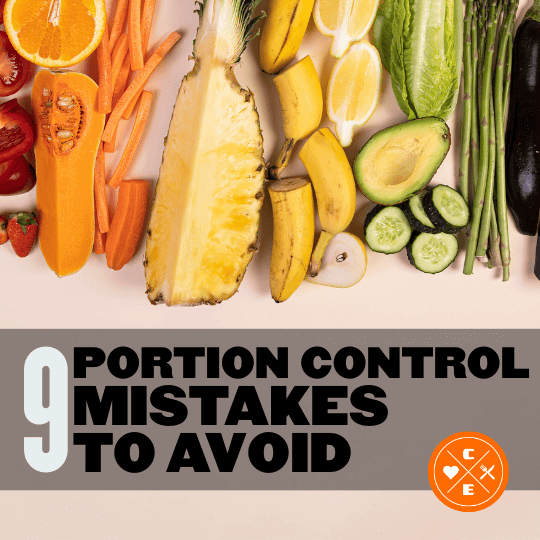
The good news: once you know where the traps are, they're easy to avoid. Here are the nine most common portion control mistakes—and how to fix each one.
Meal prep doesn't have to be complicated.
Get our free guide — shortcuts, meal ideas, and a system that makes eating well the easy option.
Mistake #1: Pouring Cereal Without Measuring
A proper serving of most cereals is ¾ cup to 1¼ cups—far less than what most people pour into the bowl. In one study, 92% of people exceeded the recommended serving, with some pouring nearly three times the amount listed on the box. The problem is worse with denser cereals like granola, where a serving is ¼ cup but a typical pour might be a full cup or more.
The fix is simple: measure your cereal for a few days until you know what a proper serving actually looks like. Use a smaller bowl—research shows that bowl size directly influences how much people pour. And don't forget to account for milk; a cup of whole milk adds 150 calories on top of whatever's in your bowl.
Mistake #2: Eyeballing Protein Portions
The recommended serving of chicken breast is 3-4 ounces—about the size of a deck of cards or your palm. But most store-bought chicken breasts weigh 6-12 ounces, meaning a single piece is often two to three servings. When you eat the whole breast thinking it's "one serving," you've doubled or tripled your protein calories without realizing it.
A kitchen scale solves this instantly. Weigh raw chicken before cooking (it loses about 25% of its weight during cooking), or divide larger breasts before you cook them. If you don't have a scale, your palm (without fingers) is a reasonable visual guide for a single protein serving.
Mistake #3: Eating Ice Cream From the Container
Newsflash: A single serving of ice cream is ½ cup. A standard pint contains four servings. But when you're eating directly from the container with a spoon, portion awareness goes out the window. There's no visual feedback, no natural stopping point, and before you know it, half the pint is gone.
The solution: do not eat ice cream straight from the container. Measure out a ½ cup portion into a small bowl, then put the container back in the freezer. Sit down and enjoy it. Even better, pre-portion the entire pint into small containers when you bring it home. That way each container is exactly one serving—no willpower required.
Mistake #4: Misjudging "Healthy" Calorie-Dense Foods
Avocados, nuts, nut butters, and olive oil are nutritious—but they're also packed with calories. This creates a dangerous mental shortcut: "It's healthy, so I don't need to worry about how much I'm eating." But a whole avocado is 250+ calories. A generous handful of almonds can be 300+ calories. A "drizzle" of olive oil that's really 3 tablespoons adds 360 calories to your salad.
The serving sizes for these foods are much smaller than most people are aware of:
Avocado: ⅓ of a medium avocado (about 80 calories). Although it contains healthy fats, eating avocados can contribute to a significant amount of calories if not portioned.
Nuts: 1 ounce, which is about 24 almonds, 14 walnut halves, or a small handful (160-180 calories). Because they are calorie-dense portions need to be controlled by measuring out.
Nut butters: 1 tablespoon (90-100 calories). Most people use 2-4 tablespoons without realizing it.
Olive oil: 1 tablespoon (120 calories). Measure it—a "drizzle" and a measured tablespoon look very different.
Mistake #5: Ignoring Cooking Oils and Sprays
Cooking spray labels say "zero calories," but that's based on a 0.25-second spray—which covers almost nothing. A realistic spray lasts 2-5 seconds and adds 15-40 calories. If you're cooking three times a day and spraying generously each time, that's 50-120 invisible calories daily.
Liquid cooking oils are even more deceptive. The difference between 1 teaspoon and 1 tablespoon of olive oil is 80 calories, but they can look almost identical when poured into a pan. Measure your cooking oil, at least until you can accurately eyeball a teaspoon.
Mistake #6: Free-Pouring Coffee Creamer
One tablespoon of liquid creamer is about 35 calories with 5 grams of sugar. But most people pour 3-4 tablespoons without measuring, turning their morning coffee into a 100-150 calorie drink, and often several times per day. One study found people using up to 11 tablespoons per cup, adding 330 calories and 55 grams of sugar to a single coffee.
Measure your creamer for a few days. Most people are shocked at how much they're actually using. Then either scale back gradually or switch to lower-calorie options: unsweetened almond milk (30 calories per cup), a splash of whole milk (9 calories per tablespoon), or black coffee with a dash of cinnamon for flavor.
Mistake #7: Trusting Restaurant Portions
Restaurant portions have ballooned over the past 40 years. A muffin that was 1.5 ounces in the 1980s is now 4+ ounces. Pasta servings have doubled. Sodas have tripled. The average restaurant entrée now exceeds 670 calories, and many dishes top 1,000-1,400 calories for a single plate.
The problem is that we've normalized these portions. When a 12-ounce steak looks "regular," a proper 4-ounce portion looks tiny. Studies show that 76% of chefs believe they're serving standard portions even when they're dishing out 2-4 times the recommended amount.
When eating out: split entrées, order appetizer portions, ask for a to-go box immediately and set aside half before eating, or choose restaurants where portions are already controlled. For a deeper dive into managing calories without obsessive tracking, see our guide on portion control vs. calorie counting.
Mistake #8: Eating From Large Packages
When you snack from a family-size bag of chips or a large container of nuts, there's no built-in stopping point. Research shows that eating from larger packages increases consumption by nearly 12% compared to pre-portioned servings—and for many foods, the increase is much higher.
The fix: portion snacks into individual containers or bags when you bring them home. It only takes 5 minutes. But that small investment in meal prep pays dividends every time you grab a snack without having to make decisions or exercise willpower. Pre-portioning is especially important for calorie-dense snacks like nuts, trail mix, and chips.
Mistake #9: Using Oversized Plates and Bowls
The same amount of food looks like more on a smaller plate. This isn't just psychology—it actually affects how much you eat. Studies show that using smaller dishes can reduce consumption by 10-15% without any conscious effort. When your plate looks full, your brain registers "enough food" even if the absolute amount is smaller.
Switch to 9-inch dinner plates instead of 12-inch ones. Use small bowls for cereal, ice cream, and snacks. This single change requires no measuring, no tracking, and no willpower—just a different dish.
The Simplest Solution: Remove the Guesswork Entirely
All nine of these mistakes share a common thread: they require you to estimate, measure, or make decisions about portion sizes. And humans are consistently bad at this. We underestimate calories, overestimate portions, and get worse the more distracted or tired we are.
That's why pre-portioned meals work so well for weight loss. When calories and macros are already measured, you don't have to weigh your chicken, measure your oil, or guess whether that's ⅓ or ½ an avocado. The decision is already made.
Our Weight Loss Meal Plan keeps meals under 600 calories with balanced protein, and the High-Protein Meal Plan prioritizes protein for satiety. Each meal is chef-prepared with portions already controlled—no measuring, no math, no mistakes. Check the exact macros for any meal on our Nutrition Info page.
For a comprehensive look at how meal prep and portioning fit into successful weight loss, see our Complete Meal Prep Guide and our 100 Best Foods for Weight Loss.
Frequently Asked Questions
What is the most common portion control mistake?
Eyeballing instead of measuring. Studies show people consistently underestimate how much they're eating—sometimes by 50% or more. This is especially true with calorie-dense foods like nuts, oils, and nut butters where small visual differences mean big calorie differences.
How can I measure portions without a food scale?
Use your hand as a guide: your fist equals about 1 cup, your palm (without fingers) equals about 3-4 oz of protein, your cupped hand equals about ½ cup, and your thumb equals about 1 tablespoon. You can also use common objects—a tennis ball is roughly ½ cup, a deck of cards is about 3 oz of meat.
Why are restaurant portions so much larger than recommended?
Restaurant portions have doubled or tripled since the 1980s because larger portions create perceived value. A typical restaurant entrée now averages 674 calories, and many dishes exceed 1,000 calories. Studies show most chefs believe they're serving standard portions even when serving 2-4 times the recommended amount.
Do I need to measure portions forever?
No. The goal is calibration, not permanent measuring. Spend 2-4 weeks measuring your most common foods until you can accurately eyeball them. Most people are shocked at how far off their estimates are initially, but with practice, you develop an accurate internal sense.
How do pre-portioned meals help with weight loss?
Pre-portioned meals remove the guesswork entirely. When calories and macros are already measured, you don't have to weigh, measure, or estimate anything. This eliminates the most common source of tracking errors and makes it easier to maintain a consistent calorie deficit.
The Bottom Line
Portion control mistakes are the silent saboteur of weight loss efforts. You can eat all the "right" foods and still gain weight if portions are off. The solution isn't obsessive measuring forever—it's calibrating your eye through a few weeks of measurement, using smaller dishes, pre-portioning snacks, and choosing pre-portioned meals when consistency matters most.
Start with the highest-impact changes: measure your cooking oils and nut butters, switch to smaller plates, and stop eating calorie-dense foods directly from containers. These three habits alone can eliminate hundreds of invisible calories from your daily intake.
Related reads: Portion control vs. calorie counting · How to set calorie goals · 100 Best Foods for Weight Loss