
Quick Answer: Start with 2–3 full-body strength workouts per week built around the main movement patterns: squat, hinge, press, and row. Choose weights you can control with good form for 5–8 reps while keeping 1–2 reps in reserve, then increase gradually as your technique and confidence improve. For many complete beginners, that may mean starting with a training bar, dumbbells, or machine variations before progressing to a standard barbell.
Last updated: March 17, 2026
Key principles:
Frequency: 2–3 full-body sessions per week on non-consecutive days.
Progression: Add weight gradually—typically +5 lb for lower-body lifts and +2.5 lb for upper-body lifts when all sets feel strong and controlled.
Effort: Finish most sets with 1–2 reps in reserve (RIR); avoid grinding reps.
Rest: 90–180 seconds between work sets, depending on the lift and your recovery.
Protein: Aim for about 0.8–1.0 g/lb/day split across meals (use our Protein Calculator).
Table of Contents
Is barbell training good for fat loss and "toning"?
What weights should a beginner start with?
How do I warm up and lift safely?
What are the best beginner barbell lifts?
Beginner 8-week plan (A/B days)
How to progress, stall, or deload
Fuel, recovery & cardio pairing
Common mistakes and easy fixes
Related CEK tools, guides & meals
FAQs
Complete Exercise Guide.
Get our free guide — all the info you need on exercising, all in one place.
Is Barbell Training Good for Fat Loss and "Toning"?
Yes—barbell training can be a very effective way to support fat loss, improve strength, and build or maintain lean muscle. Because barbells train large muscle groups and allow gradual progression over time, they can help preserve muscle while dieting and support long-term bone health, and overall function. In practical terms, “toned” usually means having more muscle definition combined with lower body fat.
For fat loss, pair strength training with a modest calorie deficit and adequate protein intake rather than relying on exercise alone.
For a broader look at how exercise supports weight loss, see our complete exercise guide for weight loss.
What Weights Should a Beginner Start With?
A beginner should start with a weight that allows good technique, full control, and a few reps left in reserve at the end of each set. For many beginners, that may mean using a training bar, a 35 lb women’s bar, or even dumbbells before progressing to a standard 45 lb barbell.
There is no single “correct” starting weight. The best place to begin is the lightest load that lets you move well through the full range of motion without pain or loss of form. If you are unsure, start lighter than you think you need and build gradually.
No barbell available? Dumbbells, kettlebells, or machine variations can be excellent starting options before transitioning to barbell lifts later.
How Do I Warm Up and Lift Safely?
Start with 5–7 minutes of easy cardio, such as walking, rowing, or cycling, to raise body temperature and get blood flowing. Then move into a few simple mobility and activation drills, such as bodyweight squats, hip hinges, band pull-aparts, shoulder circles, and ankle rocks for about 30–60 seconds each.
Before your first main lift, do 2–3 ramp-up sets with lighter weights to prepare your body and practice the movement pattern. For example, you might use the empty bar for 5 reps, then add a small amount of weight for 3–5 reps before starting your work sets.
As a general rule, muscular effort is normal, but sharp, sudden, or worsening pain is not. If something feels off, reduce the load, modify the movement, or stop and seek individualized guidance if needed.
What Are the Best Beginner Barbell Lifts?
The best beginner barbell lifts are the ones that train the main movement patterns well and allow steady progress with good technique. For most beginners, that means focusing on squat, hinge, press, and row patterns.
Back Squat
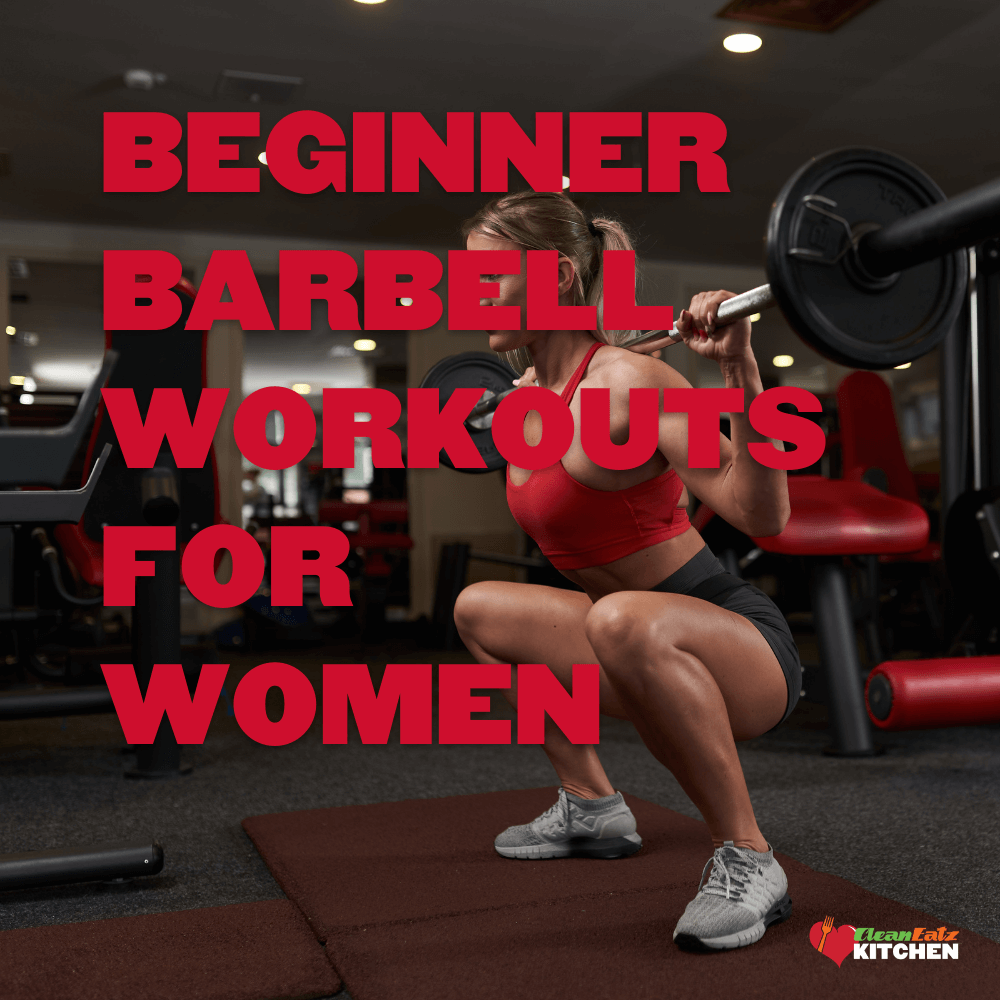
Stand with your feet about shoulder-width apart, brace your core, and sit down between your hips while keeping your heels grounded. Let your knees track naturally over your toes, then stand tall at the top. If mobility or confidence limits depth, goblet squats or front squats can be good alternatives.
Deadlift (Hinge)
Set the bar over the middle of your feet with your shins close to the bar. Keep your back neutral, brace your trunk, and push the floor away as you stand. Your hips and shoulders should rise together, and you should finish by standing tall and squeezing your glutes. If needed, a trap-bar deadlift or Romanian deadlift can be a more approachable starting variation.
Bench Press
Set up with your eyes under the bar, feet planted firmly on the floor, and shoulder blades gently pulled back. Lower the bar to the lower chest with control, then press it back up to the starting position. Use a spotter or safeties when available.
Overhead Press
Start with the bar at collarbone height, keeping your glutes and core engaged. Press the bar overhead in a straight path while moving your head slightly back to clear the bar, then bring it through at the top.
Barbell Row
Hinge at the hips with a flat back and stable torso, then pull the bar toward your mid-rib area. Lower it under control without losing position. If your lower back gets tired before your upper back does, a chest-supported dumbbell row can be a great substitute.
Beginner 8-Week Plan (A/B Days)
Train 3 days per week on non-consecutive days, such as Monday, Wednesday, and Friday, alternating Day A and Day B. If you are training 2 days per week, continue alternating A and B across weeks so that both sessions stay balanced over time.
Day A
Back Squat — 3×5 with 1–2 reps in reserve
Bench Press — 3×5 with 1–2 reps in reserve
Barbell Row — 3×6–8 with 1–2 reps in reserve
Plank — 3 sets of 20–40 seconds (see plank guide)
Optional: Farmer carry — 2×40–60 m
Day B
Deadlift — 1×5 top set, then 2×5 back-off sets at 10–15% lighter
Overhead Press — 3×5 with 1–2 reps in reserve
Hip Thrust or Glute Bridge — 3×8–10
Side Plank — 2 sets of 20–30 seconds per side
Progression (Weeks 1–8)
Use a simple progressive approach. When all sets and reps feel controlled and technically solid, increase the load the next session. In many cases, that means adding about 5 lb to lower-body lifts such as the squat, deadlift, and hip thrust, and about 2.5 lb to upper-body lifts such as the bench press, overhead press, and row.
From weeks 5–8, progress may slow slightly, which is normal. If a lift starts to feel heavy or your form becomes inconsistent, keep the same weight until it feels solid, or reduce the main lift to 3×3 for that session before building back up.
Keep the full workout to about 45–60 minutes. Rest around 90–180 seconds between work sets, depending on the exercise and how well you recover between sets.
How to Progress, Stall, or Deload
Progress should feel steady, not rushed. If all of your sets feel controlled and you finish with 1–2 reps still in reserve, you are likely ready to increase the load at the next session. For most beginners, that means adding about 5 lb to lower-body lifts and 2.5 lb to upper-body lifts.
If the last reps turn into a grind and you reach 0 reps in reserve, the weight is probably too heavy for now. Repeat the same load at the next workout or reduce it by about 5% and rebuild with better control.
If your form starts to break down, treat that as a skill issue rather than a reason to push harder. Lower the weight and focus on cleaner reps. Slower tempo work or brief pauses can help reinforce better technique.
If you have a low-energy week, feel unusually sore, or notice that recovery is lagging, a short deload can help. Reducing your training loads by about 10–15% for one week is often enough to recover without losing momentum.
Fuel, Recovery & Cardio Pairing
Your results do not come from training alone. Strength, body composition, and recovery all depend on how well your workouts are supported by nutrition, hydration, sleep, and overall activity.
Protein: Aim for about 0.8–1.0 g of protein per pound of body weight per day, divided across meals to support muscle recovery, strength progress, and body composition goals. Use our Protein Calculator to find a practical target.
Calories: Set your intake using the Calorie Calculator. If fat loss is the goal, a modest calorie deficit of around 300–500 kcal per day is often more sustainable than a very aggressive cut.
Hydration: Focus on consistent water intake throughout the day. Electrolytes may be useful on hot days, during longer sessions, or when sweat losses are high.
Cardio: Add 2 easy cardio sessions per week, such as 10–30 minutes of incline walking, cycling, or elliptical work. Keep the intensity low enough that it does not interfere with lifting quality or recovery.
Meals made easy: Keep convenient, protein-rich meals on hand with the High-Protein Box, or build a simple routine with the Build-a-Meal Plan.
Common Mistakes and Easy Fixes
Adding weight too quickly: This often leads to stalled progress, sore joints, or sloppy reps. Fix: Use small plate increases and keep most sets at 1–2 reps in reserve instead of pushing to failure.
Skipping warm-ups: Jumping straight into work sets can make your first lifts feel stiff and less controlled. Fix: Start with 5–7 minutes of light movement followed by a few ramp-up sets before your main lifts.
Relying only on machines or or non-progressive training: Cardio and machines can be useful, but avoiding progressive strength work can slow muscle and strength gains. Fix: Build your sessions around the main barbell lifts or beginner-friendly variations of squat, hinge, press, and row patterns.
Under-eating protein: Too little protein can make recovery harder and body composition progress slower. Fix: Aim for around 25–40 g of protein per meal and use protein powder when needed for convenience.
Judging progress by the scale alone: The scale does not show improvements in strength, muscle retention, or body recomposition. Fix: Also track your lifts, progress photos, energy, and how your clothes fit.
Related CEK Tools, Guides & Meals
Training: Restart Plan • 5-Day Routine • Plank Guide • How Many Exercises Per Muscle?
Calculators: Calories • Protein • Weight-Loss %
Meals: High-Protein Box • Build-a-Meal Plan • Weight-Loss Meal Plan
Frequently Asked Questions
Will lifting make me bulky?
No. Most beginners build strength faster than they build noticeable muscle size. Changes in body composition depend on your training, calorie intake, protein intake, and consistency over time.
How heavy should my first workout be?
Start with a weight you could lift for about 2 more reps at the end of each set, also known as RIR 2. When in doubt, start lighter and build gradually from there.
What if I'm nervous about deadlifts?
That is completely normal. You can begin with Romanian deadlifts or a trap-bar deadlift instead of a conventional barbell deadlift. Focus first on learning the hip hinge pattern, keeping a neutral back, and pushing the floor away.
Can I combine this with running or classes?
Yes. You can lift 2–3 times per week and still include running or classes. Try to keep cardio easy on lifting days, and place harder intervals or more demanding classes on a separate day when possible.
Any notes about cycles or pelvic floor?
Some women prefer to lower loads or adjust effort on lower-energy cycle days. If you have pelvic floor concerns, or are pregnant or postpartum, get individualized guidance from a qualified clinician.
Disclaimer: General fitness education, not medical advice. If you have injuries, are pregnant or postpartum, or manage medical conditions, consult a qualified clinician.
References
- Centers for Disease Control and Prevention. Adult Activity: An Overview | Physical Activity Basics. Updated December 20, 2023.
- National Institutes of Health, Office of Dietary Supplements. Dietary Supplements for Exercise and Athletic Performance. Updated: March 22, 2021.
- Morton RW, et al. A systematic review, meta-analysis and meta-regression of the effect of protein supplementation on resistance training-induced gains in muscle mass and strength in healthy adults. Br J Sports Med. 2018
- National Institute of Arthritis and Musculoskeletal and Skin Diseases (NIAMS). Exercise for Your Bone Health. Last reviewed: May 2023
- Niering M, et al. The Influence of Menstrual Cycle Phases on Maximal Strength Performance in Healthy Female Adults: A Systematic Review with Meta-Analysis. Sports (Basel). 2024
- Physical Activity and Exercise During Pregnancy and the Postpartum Period: ACOG Committee Opinion, Number 804. Obstet Gynecol. 2020