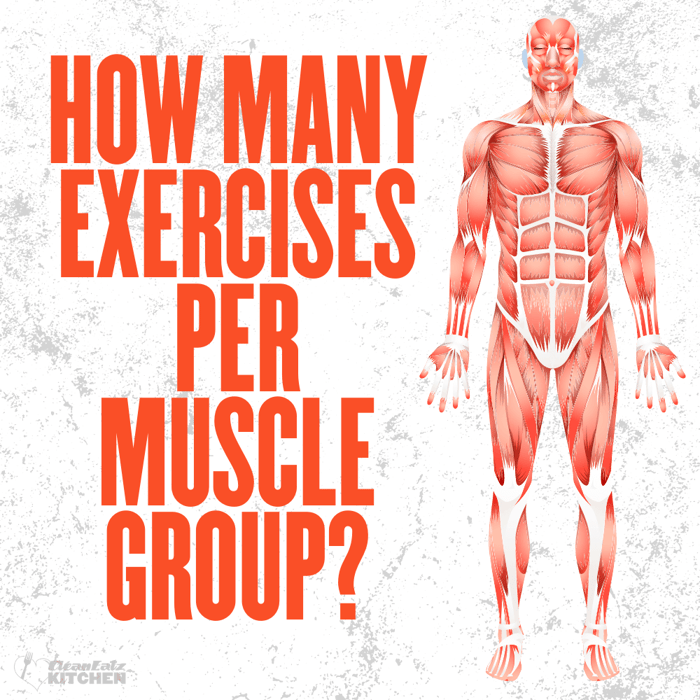

Quick Answer: Most lifters build muscle best with 2-3 exercises per large muscle group (chest, back, quads, glutes) and 1-2 for smaller muscles (biceps, triceps, calves) per workout. Across the week, aim for 10-20 total sets per major muscle and 8-16 for smaller ones, spread over 2-3 training days. The key insight: sets drive muscle growth—exercises are just how you divide them. Quality beats quantity every time.
Why Exercise Count Per Muscle Group Matters
Walk into any gym and you'll see people doing 6, 7, even 8 different exercises for a single muscle group. There's an assumption that more exercises equals more growth. But research tells a different story—and understanding it can save you hours of wasted effort while delivering better results.
The confusion comes from mixing up two distinct variables: exercises and volume. Your muscles don't count exercises. They respond to the total mechanical tension and metabolic stress you create—which is determined by how many hard sets you perform, not how many different movements you string together. A "hard set" means working within 1-3 reps of failure (what trainers call RIR 1-3, or "reps in reserve"). Sets that feel easy don't move the needle.
This is why someone doing 4 focused sets of bench press and 4 sets of incline dumbbell press can outgrow someone doing 3 sets each of six different chest exercises. The first person is accumulating quality volume. The second is spreading themselves thin and accumulating fatigue without proportional stimulus.
For a deeper dive into programming your entire training week—including cardio, recovery, and nutrition timing—check out our Complete Exercise Guide for Weight Loss, which covers evidence-based strategies for building an effective program.
Complete Exercise Guide.
Get our free guide — all the info you need on exercising, all in one place.
Per-Workout Exercise Guidelines
Here's a practical framework that aligns with what research and experienced coaches consistently recommend:
Large muscle groups (chest, back, quads, hamstrings, glutes): 2-3 exercises per session. Start with one compound movement as your "main lift"—think bench press, row, squat, or Romanian deadlift—then add 1-2 accessory movements that hit the muscle from a different angle or resistance curve.
Smaller muscle groups (biceps, triceps, side delts, rear delts, calves): 1-2 exercises per session. These muscles get indirect work from your compound lifts, so they don't need as much direct volume. One or two targeted movements after your main work is usually plenty.
The logic here is simple. Compound exercises recruit multiple muscle groups and allow heavier loading—they're your biggest bang-for-buck movements. Isolation exercises let you target weak points or add extra stimulus to muscles that didn't get fully worked by compounds. You need both, but compounds should form the foundation.
A practical example: On a "push" day focused on chest, you might do flat barbell bench (compound), incline dumbbell press (compound from a different angle), and cable flyes (isolation). That's three exercises covering the muscle from multiple vectors without excessive overlap. Your triceps get substantial indirect work from the pressing movements, so maybe you add one direct tricep exercise—pushdowns or overhead extensions—and call it done.
Weekly Set Volume: The Real Driver of Growth
If you take one thing from this article, let it be this: weekly set volume matters more than daily exercise variety. A 2025 meta-analysis published in SportRχiv analyzed the dose-response relationship between training volume and muscle growth, confirming that more weekly sets correlates with greater hypertrophy—though with diminishing returns as volume increases.
Here's what the research supports for most natural lifters:
Major muscle groups: 10-20 hard sets per week. This range accommodates different training histories, recovery capacities, and goals. Beginners thrive at 10-12 sets. Intermediate lifters often land around 12-16. Advanced trainees may push toward 20, but more isn't automatically better—some people grow optimally at moderate volumes.
Smaller muscle groups: 8-16 hard sets per week. Because arms, delts, and calves get indirect stimulation from compound lifts, they typically need less direct volume than chest or back.
The key word is "hard." Sets taken to RIR 1-3 (stopping with 1-3 reps left in the tank) count. Sets where you're going through the motions, chatting between reps, or stopping well short of challenging yourself? Those are "junk volume"—they accumulate fatigue without proportional growth stimulus.
If you're interested in how nutrition supports your training volume and recovery, our Complete Guide to Gaining Healthy Weight covers the caloric surplus and protein targets that fuel muscle growth.
Sample Training Splits
How you distribute your weekly volume depends on your schedule and preferences. Here are two proven approaches:
Full-Body Training (3 Days/Week)
Each session includes one squat or hinge movement, one press, one pull, one isolation pair for arms or delts, and optional core work. This structure naturally limits per-session volume while hitting each muscle multiple times per week. A typical session might look like: goblet squats, dumbbell bench, cable rows, lateral raises, and hammer curls—done in about 45-60 minutes.
Weekly result: roughly 8-12 sets per major muscle group, which sits perfectly in the research-supported range for most people. Add 2-3 light cardio sessions (walking, biking, elliptical) on off days to support recovery and overall fitness.
Upper/Lower Split (4 Days/Week)
Two upper days and two lower days per week. Upper sessions include pressing movements (bench plus incline), pulling movements (row plus pulldown), shoulder work (lateral and rear delts), and arm isolation. Lower sessions alternate between quad-focused days (squat patterns) and glute/hamstring-focused days (hinges, hip thrusts).
Weekly result: 12-18 sets for major muscles, 8-14 for arms, delts, and calves. This structure works well for intermediate lifters who want more volume and training variety while still recovering adequately between sessions.
The nutrition piece matters here too. Protein intake around 0.8-1.0 grams per pound of bodyweight daily, spread across 3-5 meals with 25-45 grams each, supports muscle protein synthesis. Use our Protein Calculator to dial in your targets, and stock up with our High-Protein Meal Plan to make hitting those numbers effortless.
Progression: How to Know It's Working
Exercise selection and volume matter, but without progressive overload, you're just maintaining. Here's how to ensure you're actually building:
Work at the right intensity. Most sets should land at RIR 1-3—hard enough that you're genuinely challenged, but not so brutal that your form breaks down. On one or two key lifts per session, you can push to RIR 0-1 (near or at failure) if recovery supports it.
Progress when you've earned it. When you hit the top of your rep range for all sets (say, 3x10 when your target was 8-10), add a small load the next session. Upper body lifts typically progress in 2.5-5 pound increments; lower body in 5-10 pounds. Small jumps compound over months into significant strength gains.
Deload when you need it. If your reps are dropping, form is deteriorating, or you're feeling beat up for 2+ weeks straight, reduce weekly sets by 2-4 per muscle or take a deload week at 30-40% less volume. Recovery is when adaptation happens—don't skip it.
Sleep matters enormously here. Growth hormone release peaks during deep sleep, and muscle protein synthesis accelerates overnight. Aim for 7-9 hours. Calories matter too—set your targets with our Calorie Calculator and adjust based on whether you're gaining, losing, or maintaining.
Common Mistakes to Avoid
Understanding what works also means recognizing what doesn't. Here are pitfalls that derail progress:
Confusing variety with volume. Doing 8 exercises for 2 sets each isn't better than doing 4 exercises for 4 sets each. You're adding complexity and fatigue without proportional muscle stimulus. Pick exercises you can progress on and milk them.
Counting warm-up sets as work sets. Your first few sets at lighter weights prepare your joints and nervous system—they're valuable, but they don't count toward your weekly volume. Track only hard, challenging sets.
Ignoring indirect work. Your biceps get hammered by rows and pulldowns. Your triceps work hard during pressing. Your core braces during squats and deadlifts. You don't need to add 10 sets of direct work on top of substantial indirect stimulation. Factor in what your compounds already provide.
Starting too high. Beginners don't need 20 sets per muscle. Start at 8-12 weekly sets for major muscles, master form, build consistency, and add volume as a response to stalled progress—not as a starting point.
Frequently Asked Questions
How many exercises should I do per muscle group per workout?
For large muscles like chest, back, and legs, 2-3 exercises per session works well. For smaller muscles like biceps, triceps, and calves, 1-2 exercises is usually sufficient. The goal is enough variety to stimulate the muscle from different angles without accumulating excessive fatigue.
How many sets per muscle group per week for muscle growth?
Research supports 10-20 hard sets weekly for major muscle groups and 8-16 for smaller ones. Start at the lower end and add volume only when you're recovering well and progress has stalled. Quality matters more than quantity.
Should I do different exercises every workout?
No—consistency beats novelty. Stick with the same core movements for 6-10 weeks, focusing on adding weight or reps. Rotation is appropriate after you've extracted the gains from your current exercise selection, not every session.
What's more important: exercises or sets?
Sets. Your weekly volume (total hard sets) drives growth. Exercises are simply how you distribute that volume. Whether you hit back with 2 exercises or 4, hitting your weekly set target matters more than exercise variety.
Can beginners do fewer exercises and still build muscle?
Absolutely. Beginners respond to lower training volumes—1-2 exercises per muscle and 8-12 weekly sets is plenty. Starting conservatively leaves room to add volume later when progress plateaus, and it lets you focus on learning proper form first.
The Bottom Line
Building muscle doesn't require complicated programs or an endless exercise menu. Most people thrive on 2-3 exercises per large muscle group, 1-2 for smaller muscles, and 10-20 hard sets weekly spread across 2-3 training sessions per muscle. Focus on compound movements, progress consistently, and let your nutrition support the work.
Ready to simplify the nutrition side? Our High-Protein Meal Plan delivers macro-balanced meals with 30+ grams of protein each, making it easy to fuel your training without meal prep headaches. And for more on structuring your complete fitness routine—cardio, recovery, and periodization included—explore our Complete Exercise Guide.
Disclaimer: This article provides general fitness information and isn't medical advice. If you have injuries or medical conditions, work with a qualified professional before starting any training program.