
Quick Summary: Portion control containers are pre-measured, often color-coded containers that help you manage serving sizes without calorie counting. Research shows they can modestly reduce food intake and support weight loss when used consistently. They work best as part of an overall healthy eating approach—not as a magic solution, but as a practical tool to retrain your eye for appropriate portions.
What Are Portion Control Containers?
If you’ve ever finished a meal and realized you ate far more than you intended, you’re not alone. Many people underestimate how much they’ve served—especially when portions are large or when we’re eating on autopilot. And it’s not just willpower: this is the portion size effect—when we’re offered bigger portions, we tend to eat more overall.
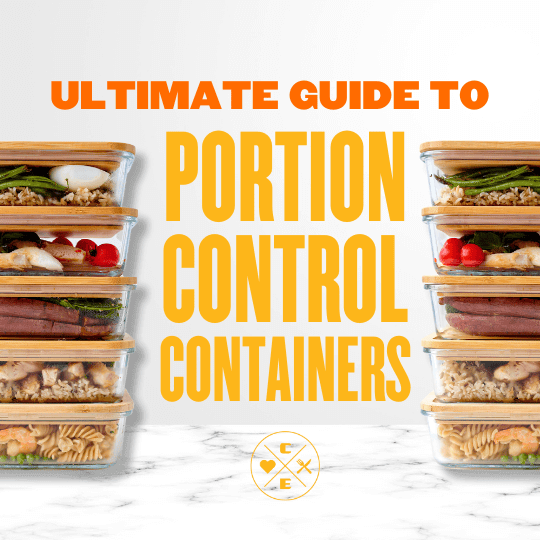
Portion control containers address this problem with a simple idea: pre-measured containers that take the guesswork out of serving sizes. Instead of eyeballing how much pasta or chicken you’re eating, you fill a container and have a consistent reference point. Most systems use color-coding to match containers with food groups—green for vegetables, red for proteins, yellow for carbs—making it easier to build balanced meals without logging everything or constantly checking portion charts.
The appeal is obvious: no food scale, no app, no macro math. Fill the container, eat what’s in it, and move on with your day. For people who find calorie counting tedious or unsustainable, this visual approach can be a practical way to retrain the eye for more realistic portions.
Meal prep doesn't have to be complicated.
Get our free guide — shortcuts, meal ideas, and a system that makes eating well the easy option.
Do They Actually Work?
The research on portion control tools is genuinely encouraging, though not without nuance. A comprehensive 2021 meta-analysis published in Nutrients published in Nutrients analyzed 36 publications and found a modest but statistically significant effect on reducing food intake overall; the strongest effects were seen when people used combinations like smaller serving bowls and spoons, while reduced-size plates alone showed little to no effect.
Supporting this idea, a 2023 crossover trial found that a calibrated plate with visual portion cues led people to self-serve and eat slightly smaller meals; some participants compensated for the reduced intake over the following 8 hours, suggesting benefits may be strongest with consistent use over time.
Interestingly, the analysis found that smaller plates by themselves didn’t have the dramatic effect that popular diet advice suggests. It’s the act of measuring and being mindful about portions that seems to drive results, not just eating from smaller dishes. The tools that worked best were ones that actively engaged people in the portioning process.
What the research can’t fully capture is what happens in real life over months and years. The studies showing positive effects typically lasted weeks to a few months. Long-term success depends on whether portion awareness becomes second nature or whether it remains an effortful practice that eventually gets abandoned. For many people, containers serve as training wheels—useful for recalibrating what “normal” portions look like, then gradually less necessary as better habits form.
Types of Portion Control Containers
The most popular approach uses color-coded container sets, with each color representing a different food group and a specific volume. The 21 Day Fix system popularized this method, and numerous similar products have followed. In these systems, you might have a green 1-cup container for vegetables, a red 3/4-cup container for proteins, a yellow 1/2-cup container for carbohydrates, and smaller containers for fats and dressings. The color system eliminates the need to remember which size goes with which food—you just match color to category.
Multi-section containers offer a different approach. Rather than separate containers for each food group, these use divided compartments within a single container. They're particularly popular for meal prep because you can portion out a complete lunch or dinner in one package. The dividers keep foods separate and provide built-in visual cues about how much of each food group to include.
Materials matter too. Plastic containers are lightweight and inexpensive, though they can stain and retain odors over time. Glass containers with snap-lock lids last longer and don't absorb smells, but they're heavier and more expensive. Stainless steel options work well for keeping foods at temperature but don't let you see what's inside. The best choice depends on how you'll use them—meal prepping at home calls for different features than packing lunches for the office.
How to Use Portion Containers Effectively
Getting started is straightforward, but a few strategies make the process smoother. First, figure out your daily container count based on your calorie goals. Most systems provide formulas or charts that translate calorie targets into specific numbers of each container color. Someone aiming for weight loss at 1,400 calories might use four green containers, three red containers, two yellow containers, and smaller amounts of the fat and seed containers throughout the day.
Meal prepping amplifies the benefits. When you batch-cook proteins and grains at the start of the week, portioning becomes almost automatic. You're not making decisions when you're hungry and tired—you're just grabbing a pre-portioned container and heating it up. This removes the friction that derails so many healthy eating intentions. For a deeper dive into making meal prep work for your lifestyle, our Complete Meal Prep Guide covers the strategies that actually stick.
The common mistake most beginners make is overfilling containers, especially with proteins and dense carbs. The food should fill the container without being compressed or mounded over the top. A level fill gives you the accurate portion the system was designed around. Some people find it helpful to practice with a food scale initially—weigh a few portions to see what the "right" fill looks like, then trust your eyes from there.
Adapting containers to different eating styles requires minor adjustments. Low-carb approaches reduce yellow container usage and may add an extra green or purple. Higher-protein diets increase red containers. Vegetarians might substitute some red containers for additional blue containers filled with plant proteins like beans, lentils, or tofu. The color system is flexible once you understand the underlying logic.
When Containers Make Sense (And When They Don't)
Portion containers work best for people who want structure without obsession. They appeal to those who find calorie counting tedious, who eat relatively consistent meals, and who do at least some cooking at home. They're excellent for learning what appropriate portions look like—many people use them for a few months, internalize the visual cues, then transition to intuitive eating with occasional check-ins.
They're less ideal for people who eat out frequently, who have highly variable schedules, or who find any form of food measurement triggering. If the containers feel like another diet rule to follow rather than a helpful tool, they might not be the right approach for you. The goal is making healthy eating easier, not adding another source of stress.
For those who want the benefits of portion control without the container system, pre-portioned meal delivery services offer an alternative. Clean Eatz Kitchen meals, for example, arrive already portioned in containers, typically ranging from 300-500 calories with balanced macros. You get consistent portions without any measuring required—the work is done for you. Our Weight Loss Meal Plan builds these principles into ready-to-eat meals.
Connecting Portions to Bigger Goals
Portion control is just one piece of sustainable weight management. The foods you choose matter as much as how much you eat. Filling your containers with nutrient-dense options—lean proteins, vegetables, whole grains, healthy fats—creates a very different outcome than filling them with processed foods that happen to fit the volume requirements.
For guidance on which foods to prioritize, our Best Foods for Weight Loss Complete Guide breaks down the science of what makes certain foods more conducive to weight loss. The combination of thoughtful food choices and appropriate portions creates a sustainable foundation.
Sleep, stress, and exercise all influence how well portion control strategies work. A sleep-deprived brain makes different food decisions than a well-rested one, and stress hormones can override even well-intentioned portion discipline. The importance of sleep for health extends directly to eating behaviors and weight management.
Frequently Asked Questions
Do portion control containers actually work for weight loss?
Research suggests they can help. A 2021 meta-analysis of 28 studies found that portion control tools had a modest but significant effect on reducing food intake, particularly when using calibrated bowls and serving utensils together. The key is consistent use as part of an overall healthy eating strategy—they're not a magic solution, but they can be a useful tool.
What do the different colors mean in portion control containers?
In most color-coded systems like the 21 Day Fix, green containers are for vegetables (1 cup), purple for fruits (1 cup), red for proteins (3/4 cup), yellow for carbohydrates (1/2 cup), blue for healthy fats (1/3 cup), and orange for seeds and dressings (2 tablespoons). The color-coding makes it easy to track food groups without memorizing volumes.
How many portion containers should I use per day?
This depends on your calorie goals and activity level. Most systems calculate daily container counts based on your target calorie intake. Someone eating 1,200-1,499 calories might use 3-4 green containers, 2-3 red containers, and 2 yellow containers daily. Higher calorie needs mean more containers across categories.
Are portion control containers better than calorie counting?
Neither approach is universally better—what matters most is consistency and finding what works for your lifestyle. Portion containers simplify the process by removing the need to weigh and log every food item. Some people find this more sustainable; others prefer the precision of counting. Many people use containers to learn appropriate portions, then transition to more intuitive eating.
Can I use regular containers instead of buying a portion control set?
Absolutely. Any container with a known measurement works. A standard measuring cup, small bowl, or even your hand can serve as a portion guide. The advantage of dedicated sets is the color-coding system that makes food group tracking easier, but the underlying principle works with any consistent measuring method.
The Bottom Line
Portion control containers offer a practical middle ground between obsessive calorie tracking and completely unstructured eating. They work by making appropriate portions visible and automatic, which research suggests can meaningfully reduce food intake over time. The most important factor isn't which container system you choose—it's whether you'll actually use it consistently.
For some people, buying a color-coded set and committing to the system for a few months provides the structure they need. For others, simply being more mindful about portions using hand-size comparisons or standard measuring cups achieves similar results. And for those who prefer to skip the measuring entirely, pre-portioned meal delivery services like Clean Eatz Kitchen provide the benefits of portion control with none of the prep work.
Whatever approach you choose, the goal is the same: developing a more accurate sense of how much food your body actually needs. Portion containers are one tool among many, and they're most effective when combined with thoughtful food choices, consistent meal timing, and the other habits that support long-term health.
References
- Vargas-Alvarez MA, Navas-Carretero S, Palla L, Martínez JA, Almiron-Roig E. Impact of Portion Control Tools on Portion Size Awareness, Choice and Intake: Systematic Review and Meta-Analysis. Nutrients. 2021
- Robinson E, McFarland-Lesser I, Patel Z, Jones A. Downsizing food: a systematic review and meta-analysis examining the effect of reducing served food portion sizes on daily energy intake and body weight. Br J Nutr. 2022
- Lucassen DA, Willemsen RF, Geelen A, Brouwer-Brolsma EM, Feskens EJM. The accuracy of portion size estimation using food images and textual descriptions of portion sizes: an evaluation study. J Hum Nutr Diet. 2021
- Vargas-Alvarez MÁ, Brunstrom JM, Díaz AE, Navas-Carretero S, Martínez JA, Almiron-Roig E. Portion control tableware differentially impacts eating behaviour in women with and without overweight. Appetite. 2023