
Protein shakes for weight loss
Are protein shakes good for weight loss?
Yes, as a tool. One shake a day can close a protein gap or stand in for a rushed meal. What the trials found, the calorie and protein targets to use, how to read a label and three shakes to make at home.
- Free Shipping on Every Meal PlanFree Shipping
- Up to 20% Off 30-Meal PlansUp to 20% Off
- Chef Cooked, Dietitian BuiltDietitian Built
- Heat & Eat in MinutesHeat & Eat

Protein shake benefits for weight loss
Do protein shakes help you lose weight?
Quick answer
They can, modestly. In a review of 23 trials and 7,884 adults, diets using meal replacements lost about 1.4 kg more at one year than other diets. Shakes help most by making calories and protein easy to count.
Protein shakes hold an odd spot in the weight loss toolkit. Unlike whole foods that need shopping, prepping and cooking, a shake takes about sixty seconds to make and delivers a precise dose of protein when you need it. That convenience alone makes them useful for people who struggle to hit their protein target consistently.
The research on structured programs backs this up, with a caveat about size. A 2019 systematic review of 23 trials and 7,884 adults found that diets incorporating meal replacements lost about 1.44 kg more at one year than other kinds of diets. A 2021 meta-analysis of 22 trials and 1,982 people called the effect small for standard low-calorie diets. A 90-day trial published in 2024 put numbers on a dinner swap: the meal replacement group lost 7.38 kg and the portion-reduced group 4.08 kg, on the same 1,200 to 1,300 calories a day. That trial had 19 people in each of those groups, so treat it as a signal rather than proof.
Two limits belong here. Those studies tested meal replacement products in general, not protein shakes specifically. And the reason they work is probably mundane: when you know exactly how many calories and grams of protein you're getting, there's less room for the estimation errors that derail a diet.
Higher protein intake during dieting also helps protect your muscle. A 2024 meta-analysis of 47 trials found that more protein significantly limited muscle mass loss in adults losing weight. Intakes above 1.3 g per kg of body weight a day were tied to gains in muscle mass, and intakes below 1.0 g were tied to a higher risk of losing it. More protein did not significantly protect strength or physical function, so it's no stand-in for training. A shake just makes that daily number easier to reach.
That said, a shake isn't a free pass. Liquids tend to be less filling than solid food. A 2020 meta-analysis found solid and thicker foods lowered hunger compared with liquid and thin ones, though the authors urged caution because the studies varied so much. The smartest approach is using shakes to hit your protein target while building the rest of your meals from whole foods. For the full picture of how different foods support weight loss, our Best Foods for Weight Loss guide breaks down the strategy.
Two ways to use protein shakes
Should a shake replace a meal or a snack?
Quick answer
Either works if it's built for the job. As a meal, aim for 300 to 450 calories, at least 30 grams of protein and 8 to 10 grams of fiber. As a snack, aim for 120 to 250 calories and 20 to 30 grams of protein.
The difference between these two is mostly fiber and calories. These targets are our working numbers, not trial results, and they're built around the point where a drink starts behaving like food.
| Use | Calories | Protein | Fiber |
|---|---|---|---|
| Meal replacement | 300 to 450 | 30 g or more | 8 to 10 g |
| High-protein snack | 120 to 250 | 20 to 30 g | 3 to 5 g or more |
Protein shake targets by use
A protein shake as a meal replacement
If you're swapping a shake for breakfast or lunch, once a day is the limit we'd set. The fiber is what turns a shake from a quick sweet drink into something that holds you over until your next meal. You can add it through fruit, vegetables (spinach blends in invisibly), chia seeds or ground flax.
This approach works especially well for busy mornings when cooking isn't realistic, or on-the-go lunches when the alternative might be fast food or the vending machine. Pair your shake with a piece of fruit or some raw vegetables to raise the fullness further. Chewing something helps.
A protein shake as a high-protein snack
For between-meal hunger, a lighter shake does the job. This hunger bridge is especially useful in the late afternoon, when cravings tend to hit hardest, or after a workout.
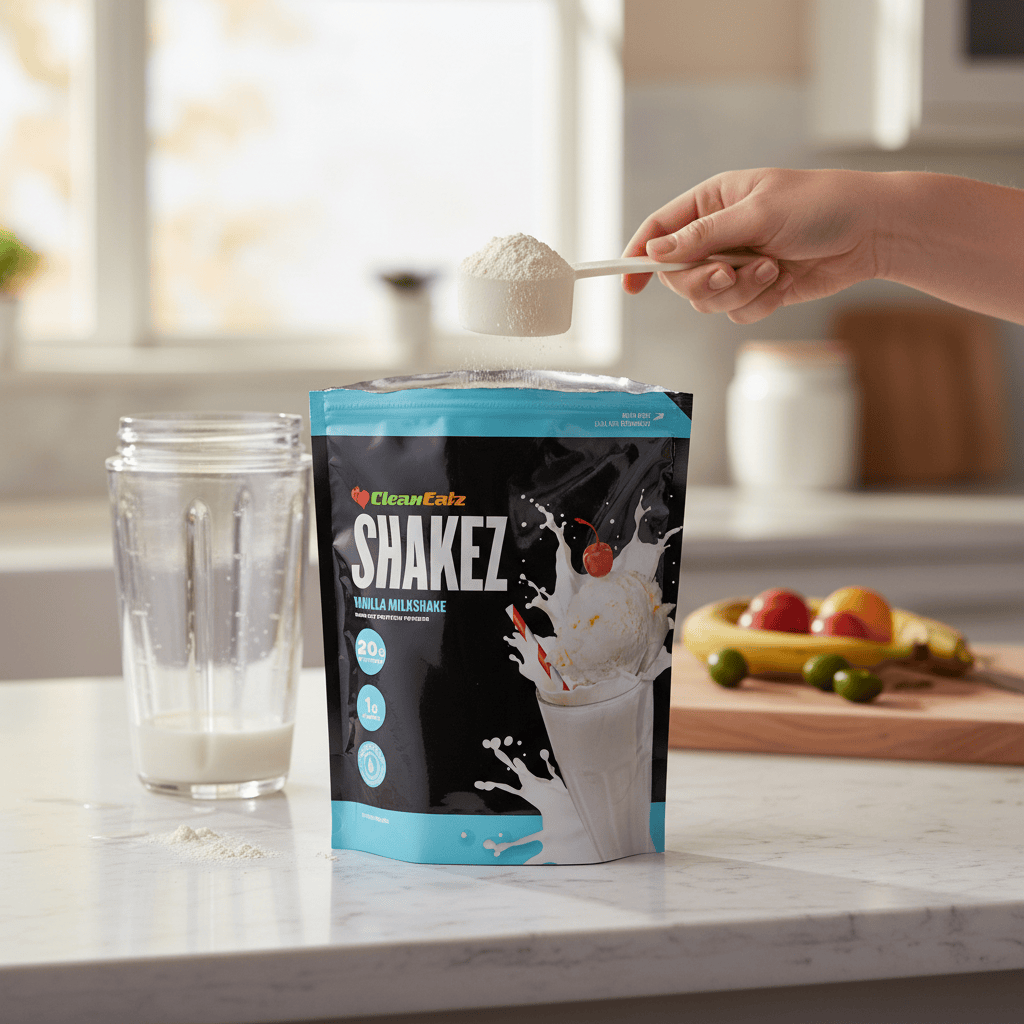
Our Clean Eatz Protein Powder, Shakez, was built for this gap. Each scoop has 20 grams of whey protein from concentrate and isolate, 1 gram of sugar with 0 grams added, and digestive enzymes. Credit where it's due: on its own, a scoop in water has no meaningful fiber, so you'd still add the fiber yourself.
Protein powder label checklist
What should you look for on the label?
Quick answer
Check four things: 20 to 40 grams of protein per serving, under 5 to 10 grams of added sugar, some fiber or thickness, and a third-party testing mark. A shake with 20 grams of sugar is a dessert with protein in it.
Protein powders differ more than the front of the tub suggests. Four checks cover most of it.
- Protein per serving. Look for 20 to 40 grams. That's the general dose in the International Society of Sports Nutrition position stand, which was written for exercising adults, so treat it as a useful range rather than a rule.
- Added sugar. Many commercial shakes lean on sweeteners, which works against you if you're trying to lose weight. Keep added sugar under 5 to 10 grams a serving. If a shake tastes great but has 20 grams of sugar, you're drinking a candy bar with protein sprinkled in.
- Fiber or thickness. Aim for at least 3 to 5 grams of fiber in the finished shake, either from the powder or from add-ins like fruit, oats or chia seeds. Thicker shakes tend to fill you up more than thin, watery ones.
- Third-party testing. Marks like NSF Certified for Sport, Informed Choice or USP Verified mean a product has been independently tested. That protects you from powders that contain less protein than advertised, or contaminants you don't want.
Best protein type for weight loss
Which type of protein should you choose?
Quick answer
Whey is the default for most people because it's rich in leucine and low in lactose as an isolate. Casein digests more slowly. Plant blends work if the dose is adequate, with a small edge to animal protein in some trials.
Whey isolate is the go-to for most people. It digests quickly, contains very little lactose and is rich in leucine, the amino acid most tied to muscle protein synthesis. Short-term studies suggest whey stimulates muscle protein synthesis more than soy or casein, and it suits a post-workout shake. Shakez uses whey concentrate and isolate, and concentrate keeps more lactose than isolate.
Casein digests more slowly, which is why some people prefer it in the evening or as a longer-lasting shake. The evidence here is mostly about overnight muscle protein synthesis, per the position stand, rather than about weight loss. We don't make a casein powder, so if you want one specifically, you'll be shopping elsewhere.
Plant blends, typically pea with rice or soy, are built to cover the amino acid gaps of a single plant source. If you're vegan or simply prefer plants, the news is decent. A meta-analysis of 9 studies found soy matched animal protein for strength and lean mass in people lifting weights. A larger review of 16 trials found no difference in absolute lean mass or strength, with a small edge to animal protein on lean mass in adults under 50, about 0.41 kg. That's close enough that total protein per serving matters more than the source.
Simple protein shake recipes
What's a good protein shake to make at home?
Quick answer
Start with one scoop, then add fiber and volume. A yogurt, berry, spinach and chia blend runs about 370 calories and 48 grams of protein. A lighter banana and flax version comes in near 250 calories.
All three totals below are estimated from USDA FoodData Central, and they assume a 20-gram protein scoop with about 120 calories. Check your own label, since scoops vary.
| Shake | What goes in | Calories | Protein | Fiber |
|---|---|---|---|---|
| High-satiety meal shake | 1 scoop protein, 1 cup nonfat Greek yogurt, 1/2 cup frozen blueberries, a handful of spinach, 1 tbsp chia, water or ice | About 370 | About 48 g | About 7 g |
| Lighter snack shake | 1 scoop protein, 1 cup unsweetened almond or soy milk, 1/2 banana, 1 tbsp ground flax | About 250 | About 23 g | About 4 g |
| Coffee shake | 1 scoop protein, chilled coffee, 1/2 frozen banana, 1/2 cup 2% milk, ice | About 235 | About 25 g | About 2 g |
Three protein shakes, with estimated totals
The high-satiety meal shake gets protein from more than one source, fiber from the chia and berries, and enough volume to feel like a real meal. At about 7 grams of fiber it falls a little short of the 8 to 10 gram target, so a second tablespoon of chia takes it to about 11 grams and about 430 calories.
The lighter snack shake is quick and won't derail your calorie budget. With soy milk, it picks up about 6 more grams of protein and about 40 more calories.
The coffee shake is for coffee people. You get your caffeine and your protein in one glass, and caffeine may offer a small metabolic boost of its own. Our coffee and weight loss article covers the research.
Don't want to make your own? Our Clean Eatz meal plans include calorie-controlled options that pair well with a shake, and you can check the macros for any meal on our Nutrition Info page.
Protein shake safety & quality
Are protein shakes safe to drink every day?
Quick answer
For most healthy adults, one shake a day looks fine. Higher protein intakes didn't change kidney function in healthy adults across 28 trials. If you have kidney disease or risk factors, ask your doctor first.
Sweeteners. The World Health Organization's 2023 guideline suggests not using non-sugar sweeteners as a way to control weight. WHO's summary says its review found no long-term benefit for body fat and flagged possible long-term risks, while rating the recommendation as conditional. Unsweetened or lightly sweetened powders are the simple way around the question. Shakes that swap sugar for a sweetener may still cut added sugar, but don't count on them for weight loss.
Lactose. Lactose sensitivity is common, but whey isolate is very low in lactose compared with concentrate. If dairy still bothers you, plant-based powders remove the issue.
Kidneys. In healthy adults, a 2018 meta-analysis of 28 trials and 1,358 people found the change in kidney filtration rate didn't differ between higher-protein and lower-protein diets. The authors noted an unclear risk of bias in the included trials, and the finding doesn't apply to people with kidney disease. If you have existing kidney disease or risk factors, work with your doctor to set your protein target.
Quality. Stick with products that carry third-party certification like NSF Certified for Sport, Informed Choice or USP Verified. The FDA doesn't approve dietary supplements before they're sold, and these marks are your best protection against a powder that doesn't deliver what it promises.
Using protein shakes in a weight loss plan
How should you start using protein shakes?
Quick answer
Pick one job for the shake, then stop there. One a day as a meal replacement, or one to two as snacks, is plenty. Everything else should come from whole foods. Check the fiber so the shake keeps you full.
Protein shakes are a practical tool, and no more than that. They make your protein target easier to hit, they're fast when you're busy, and they help you avoid the grab-whatever-is-convenient trap that sinks so many diets.
So pick the one meal or snack that goes wrong most often, usually a skipped breakfast or the 3 p.m. slump, and give the shake that job. One a day as a meal replacement, or one to two as snacks, with the rest of your nutrition coming from whole foods. If you want a powder, Clean Eatz Protein Powder comes in three flavors and costs $74.95. Pay attention to fiber so your shakes keep you full.
For more on building a complete eating strategy, our Best Foods for Weight Loss guide covers protein sources, carbs and meal timing. And if the hard part is everything around the shake, that's a workload problem, and workload problems have different solutions than knowledge problems. Our Weight Loss Meal Plan brings calorie-controlled, macro-balanced meals to your door, from $89.95 for 10.
 Make it easy withWeight Loss Meal PlanFrom $89.95View plan
Protein shakes for weight loss FAQ
Questions about protein shakes, answered
How many protein shakes should I drink per day for weight loss?
Usually one as a meal replacement, or one to two as snacks, is plenty. Let shakes fill the protein gaps rather than replace most of your meals. The rest of your nutrition should come from whole foods, which bring the fiber, vitamins and chewing that a shake doesn't.
What's the best time to drink a protein shake for weight loss?
Whenever it helps you stay consistent. Morning for a quick breakfast, after a workout or late afternoon as a hunger bridge to dinner all work. Sports nutrition guidance favors spreading 20 to 40 gram protein doses every 3 to 4 hours, so a shake helps most where your day has a gap.
Are plant-based protein shakes as effective as whey for weight loss?
Close to it, when you get enough total protein. Trials comparing soy or plant protein with animal protein mostly find no difference in strength or absolute lean mass, with a small edge to animal protein in some younger adults. Aim for 20 to 40 grams per shake regardless of the source.
Can protein shakes replace meals entirely?
One shake a day as a meal replacement can work well, especially on busy mornings or at lunch. Replacing several meals long term isn't ideal, though. Whole foods provide fiber, micronutrients and the satisfaction of eating that shakes can't fully replicate. Very low calorie shake-only diets need medical supervision.
Do I need to track calories if I'm using protein shakes?
Not necessarily. Shakes make portioning easy, because the nutrition is right on the label. If you prefer not to track, our portion control guide shows how that works, and you can stick to the calorie targets above. Just count what you blend in, since add-ins can double a shake.
More weight loss & nutrition guides
Keep reading
 Romaine Rusnak, RD, LDN · Oct 16, 2025
 Ellie Lopez, LDN, MS · Jul 24, 2022

Sources
On this page