How to Choose a Weight Loss Meal Delivery Service
How to choose a weight loss meal delivery service: A step-by-step guide
The right service makes a calorie deficit easier to keep. The wrong one quietly breaks it. Seven steps to compare any service on nutrition, flexibility, quality, true cost and logistics, then a plan for the months after.
- Free Shipping on Every Meal PlanFree Shipping
- Up to 20% Off 30-Meal PlansUp to 20% Off
- Chef Cooked, Dietitian BuiltDietitian Built
- Heat & Eat in MinutesHeat & Eat


Choose a weight loss meal delivery service by checking five things before you pay: full nutrition for every meal (aim for 350 to 500 calories and 20 to 25g of protein or more), how much you can choose, ingredient quality, the true cost per meal after shipping, and how long meals keep. Then test the smallest order for two weeks before committing.
The meal kit delivery market alone was worth about $29.4 billion in 2025, and one market report forecasts it to reach $124.8 billion by 2035. All those options have made the choice harder, not easier.
Services range from fully prepared, calorie-controlled meals to raw-ingredient kits that take 30 minutes or more to cook. Some lock you into weekly subscriptions. Others let you order when you want. Pick one that doesn't fit your life and it can undermine the consistency weight loss depends on.
This guide walks you through a structured decision, step by step. By the end, you'll know which criteria matter, how to score any service against them, and how to use delivery so it builds skills instead of replacing them.
Why meal delivery works for weight loss & where it falls short
Structure helps, skills last
The science isn't complicated, but it's worth understanding before you spend a dollar. Weight loss requires a sustained calorie deficit: eating fewer calories than your body burns. Pre-made, pre-portioned meals fit that job well.
The reason is structure. Pre-portioned meals remove two of the biggest obstacles to holding a deficit: portion creep and decision fatigue. When a 400-calorie meal arrives in a sealed container, there's no extra scoop of rice and no extra drizzle of oil.
What delivery doesn't do is teach you to cook, read a nutrition label, or order well at a restaurant. Long-term success depends on behaviors no box can ship:
- Self-monitoring. Keeping a food journal, tracking exercise or reviewing your routine makes portion sizes, balance and triggers visible. In the Weight Loss Maintenance trial, 1,685 adults in a 6-month program lost an average of 5.8 kg (about 13 pounds), and behaviors such as keeping food records explained most of the difference between people who lost more and less.
- Physical activity. Movement improves heart health, helps maintain muscle, and adds to the calories you burn. Structured workouts, walking, recreational sports and everyday movement all count, and the habit outlasts any meal service.
- Self-correction. Even disciplined routines break down with travel, stress or a schedule change. The skill is noticing the lapse and making a small adjustment to get back on track, instead of abandoning the goal.
A delivery service can support those behaviors. It can't replace them. Meal delivery is a powerful tool for building consistency, especially in the first several months while new habits form. It stops being useful the moment you treat it as a permanent substitute for knowing how to feed yourself.
How to choose a meal delivery service step by step
Seven checks before you pay
Work through the steps in order. The first decides the format, the next five score any service on what matters for weight loss, and the last tests your pick before you commit.
Step 1: Choose prepared meals or meal kits
Pick the format first
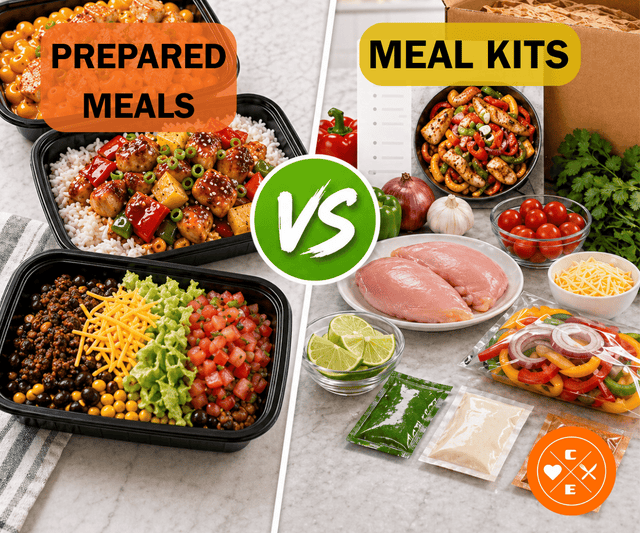
Fully prepared (heat-and-eat) meals arrive cooked and portioned. You heat them in a microwave or oven, often in under five minutes, and eat. The calorie count is fixed and the macros are printed on the label. There's no room to improvise, which is exactly the point for weight loss. This format suits you if your schedule is unpredictable, your cooking skills are limited, or past diets fell apart in the gap between planning healthy meals and actually eating them.
Meal kits ship raw, pre-measured ingredients with step-by-step recipes. You do the cooking, which usually takes 20 to 40 minutes. Calories are listed, but because you control the cooking, what you actually eat can drift. Kits suit people who enjoy cooking and want to build kitchen skills while losing weight. The risk is that many kits focus more on flavor and variety than on strict calorie control, and cooking invites unplanned extras.
Step 2: Check nutritional transparency & macro balance
No macros, no order
This one isn't up for debate. Any service worth considering publishes full nutrition for every meal before you order: calories, protein, carbohydrates, fat, fiber and sodium at a minimum.
For weight loss, look for at least 20 to 25 grams of protein per meal. Protein is the most filling macronutrient, and a 2020 review of high-protein diets found that eating more protein than the minimum helps reduce body weight and fat while preserving lean mass, which helps keep your resting metabolism from dropping as much as you lose.
A solid benchmark is 350 to 500 calories a meal, with protein supplying 30% or more of those calories. Check it with simple arithmetic: protein has 4 calories per gram, so 30 grams of protein in a 400-calorie meal is 120 calories, exactly 30%. If a service makes this information hard to find, treat that as a red flag.
Step 3: Check flexibility & customization
Your menu, not theirs
Look at how much control you have over what shows up at your door. Ask:
- Can you choose individual meals, or are you locked into pre-built bundles?
- Can you filter by dietary needs, like gluten-free, dairy-free, low-carb or vegetarian?
- Can you swap proteins or remove specific ingredients?
- Can you change the number of meals as your needs change?
Rigid, pre-selected weekly boxes can work if your tastes are flexible. If you have food allergies, strong preferences, or need to plan around travel and social events, look for a la carte ordering or plans you can customize.
Step 4: Judge ingredient quality & sourcing
Same calories, different meal
Calorie counts alone don't tell you what you're eating. Two 400-calorie meals can be nutritionally miles apart. Look for services that explain what goes into their food and where it comes from.
A meal built around lean chicken breast, roasted sweet potato and steamed broccoli will keep you fuller and better nourished than one built around a processed chicken patty, white rice and a corn syrup-sweetened sauce, even at the same calorie count. Read the ingredient list, not just the number.
Step 5: Work out the true cost per meal
Divide the whole bill
The per-meal price on a homepage rarely tells the whole story. To compare fairly, add everything to the order total: shipping fees, minimum order sizes, and plan discounts that only apply at the biggest sizes. Then divide by the number of meals.
Here's that arithmetic on our own plans, at October 2026 prices, so you can see how it works. Meal plan orders ship free, so the order price is the whole bill.
| Plan & size | Per meal | Order price | Shipping |
|---|---|---|---|
| Weight Loss, 10 | $9.00 | $89.95 | Free |
| Weight Loss, 20 | $8.28 | $165.50 | Free |
| Weight Loss, 30 | $7.56 | $226.75 | Free |
| High Protein, 6 | $10.50 | $63.00 | Free |
| High Protein, 18 | $8.82 | $158.76 | Free |
Our meal plans, true cost per meal (October 2026)
Then tally what you spend now on the meals the service would replace: groceries that go to waste, impulse takeout, and the time spent planning, shopping and cooking. A service that costs a little more than groceries can still cost less than the takeout it replaces.
Step 6: Check delivery logistics & shelf life
Freezer stock beats a deadline
Flash-frozen meals have a practical edge for weight loss: you can stock your freezer and have a sensible option on any night, including the nights you'd otherwise order pizza. Fresh meals skip the frozen step but have to be eaten within days, which can lead to food waste or eating on the box's schedule instead of yours.
If you travel often, keep an irregular schedule, or don't want weekly deliveries, look for services with no subscription and meals that keep for months. Ten meals in your freezer eaten over six weeks may serve you better than a fresh box every Monday that spoils before you get to it.
Step 7: Test a service before you commit
Two weeks, then decide
Committing too quickly can lead to disappointment if a service doesn't fit your tastes or your week. Test it first:
- Start with the smallest order. It keeps the test low-risk while giving you enough meals to judge. Ours start at 6 meals on the High Protein Meal Plan and 10 on the Weight Loss Meal Plan. Ask yourself whether the flavors are good enough to eat regularly, whether the portions leave you satisfied, and whether ordering and delivery fit your schedule.
- Judge taste, variety and satisfaction. Whether you enjoy the food decides whether you'll keep eating it. Notice whether the menu has enough range to prevent boredom.
- Track your meals for two weeks. Log each meal in an app, a notebook or a spreadsheet. Record calories, protein and how full you felt afterward on a scale of one to five. Note whether you needed extra snacks to stay satisfied.
- Compare the two periods. Before you start, spend about a week tracking how you eat now, what groceries and dining out cost, and how long you spend planning and cooking. After two weeks on the service, compare.
- Assess convenience. Check delivery reliability, packaging, freezer space and how easily the meals fit your day. If ordering, storing or heating becomes a hassle, the service won't last. It should support your routine, not create new friction.
Red flags in a weight loss meal delivery service
When to walk away
Exaggerated weight loss claims. A service promising a specific number, "Lose 10 pounds in your first month," is selling hope, not food. How fast you lose depends on your starting weight, activity, sleep, stress and much more. The CDC notes that people who lose weight gradually, about 1 to 2 pounds a week, are more likely to keep it off. A responsible service talks about supporting your goals, not guaranteeing outcomes.
Missing nutrition information. If you can't find full macro breakdowns before ordering, move on. Some services bury the nutrition facts or show only calories without protein, fat and carbs. You need the full picture to make informed choices.
A subscription you have to remember to cancel. Automatic weekly boxes are convenient until you travel, get sick or simply have leftovers. If a service is hard to pause or cancel, count that as part of its cost.
Building a long-term strategy around meal delivery
Use it, learn from it, step back
The best way to use delivery for weight loss changes over time. A phased approach gets the early structure without making you dependent on it.
Phase 1: Full replacement for weeks 1 to 8
Use the service for most of your meals. The goal isn't only calorie control. It's habit formation. You're training yourself to eat appropriate portions, to recognize what a balanced plate looks like, and to break the cycle of impulse eating. This is where delivery earns its keep, because it removes friction at the exact point where most diets fail.
Phase 2: Gradual transition for weeks 9 to 16
Replace two or three delivered meals a week with home-cooked meals that mirror what you've been eating: similar calories, similar protein-to-carb ratio, similar portion size. Use the delivered meals as your reference. Our current menu's median meal is 410 calories with 31.5 grams of protein, so a home-cooked dinner near those numbers is a fair target if that's what you've been eating.
Phase 3: On-demand support
Once you've built cooking skills and portion awareness, use delivery as a safety net. Keep frozen meals for busy weeks, travel recovery, or the days when cooking simply isn't happening. This is where a no-subscription model proves its value: you order what you need, when you need it, without paying for meals that go uneaten.
The research supports pairing structure with skills. Beyond the self-monitoring findings above, a study of 828 people from the same trial followed participants for up to 30 more months. Eating more fruits and vegetables, swapping fat for protein, and adding low-fat dairy were linked with more weight lost and kept off. Delivery jump-starts the process. Your own growing skills sustain it.
How Clean Eatz Kitchen meals fit these criteria
Our own scorecard
Since we sell meals, here's how Clean Eatz Kitchen stacks up against the steps above, weaknesses included.
- Nutrition: every meal's calories, protein, carbs, fat, fiber, sodium and allergens are listed on our Nutrition Info page. Our current menu of 32 meals runs 250 to 630 calories and 20 to 55 grams of protein, with a median of 410 calories and 31.5 grams.
- Flexibility: Build A Meal Plan lets you pick meals one by one, from $8.99 to $13.99 each. The Weight Loss Meal Plan and High Protein Meal Plan are chosen for you.
- Logistics: the meals are chef-cooked, flash-frozen and shipped on dry ice, typically in 2 to 3 business days. They keep in the freezer for up to 12 months, heat in a few minutes, and there's no subscription.
- Where we fall short: we ship only to the contiguous 48 states. Our meals are made on shared equipment, so we don't recommend them for anyone with celiac disease or a severe gluten reaction. Sodium runs 360 to 1,550 mg a meal, so check the list if you're watching it. And you'll need freezer space.
The bottom line on choosing a meal delivery service
The best fit wins
There's no single best weight loss meal delivery service. There's only the best one for your mix of goals, preferences, schedule and budget. The right service shows you full nutrition before you order. It gives you enough flexibility to eat around your life instead of rebuilding your life around a delivery day. It prices its meals fairly once shipping and minimums are counted. And it doesn't trap you in a subscription you'll forget to cancel.
Before you sign up for anything, go back through the steps in this guide and score each service you're considering. Weight loss is hard enough without fighting your food logistics. The right service makes consistency easier without adding another source of friction to your week.
Weight loss meal delivery FAQ
Quick answers
How much does a weight loss meal delivery service cost?
Divide the full order total, shipping included, by the number of meals. Our Weight Loss Meal Plan runs from $89.95 for 10 meals, about $9.00 each, to $226.75 for 30, about $7.56 each, with free shipping. Compare that with what you spend now on groceries you waste and takeout you buy.
Are prepared meals or meal kits better for weight loss?
Prepared meals give tighter calorie control, because the portion and the recipe are fixed. Meal kits build cooking skills, but what you actually eat can drift with extra oil or bigger servings. If your past diets failed on follow-through, start with prepared meals. If you love cooking, a kit may suit you better.
How long should I use meal delivery to lose weight?
There's no fixed rule. A sensible pattern is most of your meals for the first 8 weeks while habits form, then replacing two or three a week with home cooking through about week 16, then keeping frozen meals as a backup. The goal is skills that outlast the service.
Do I need a subscription to use meal delivery for weight loss?
No. Some services require one, but many let you order once and reorder when you want. We don't use subscriptions. One-time orders suit weight loss well, because a week off the plan doesn't leave you paying for a fridge full of meals you didn't eat.
More meal delivery & weight loss guides
Keep reading
Weight lossMeal Kits vs. Prepared Meals for Weight Loss: Which Format Actually Delivers Results?
Dorothy M. Shirnyl, RND · Feb 22, 2026
Weight lossWhat Happens After Weight Loss Meal Delivery Stops: Building Habits That Outlast Your Subscription
SaVanna Shoemaker, MS, RDN, LD · Feb 25, 2026
Weight lossHow Meal Delivery Supports Sustainable Weight Loss (2026)
Ellie Lopez, LDN, MS · Jan 28, 2025Sources
- Acumen Research and Consulting: Meal kit delivery services market size and forecast, 2026 to 2035
- Moon J, Koh G. Clinical evidence and mechanisms of high-protein diet-induced weight loss. J Obes Metab Syndr 2020 (PubMed)
- Hollis JF et al. Weight loss during the intensive intervention phase of the Weight-Loss Maintenance trial. Am J Prev Med 2008 (PubMed)
- Champagne CM et al. Dietary intakes associated with successful weight loss and maintenance during the Weight Loss Maintenance trial. J Am Diet Assoc 2011 (PMC)
- CDC: Losing weight
On this page