
Muscle building mistakes to avoid
Muscle building mistakes to avoid (& what to do instead)
Most stalled gains come from a few fixable habits, not genetics or a missing supplement. The training, nutrition and recovery mistakes that stop muscle growth, what the research says and what to change first.
- Free Shipping on Every Meal PlanFree Shipping
- Up to 20% Off 30-Meal PlansUp to 20% Off
- Chef Cooked, Dietitian BuiltDietitian Built
- Heat & Eat in MinutesHeat & Eat

Most muscle-building stalls come from a few fixable mistakes: no progressive overload, too few or too many sets, too little protein and short sleep. Do at least 10 hard sets per muscle a week, stop most sets 1 to 2 reps short of failure, add weight or reps over time, eat about 0.7 to 1 gram of protein per pound and sleep at least 7 hours.
You show up to the gym, put in the work, eat what you think is enough protein, and your lifts still won't move. It is frustrating, and it is common. Most muscle-building plateaus come from a few fixable training and nutrition mistakes, not genetics.
This guide covers the most common mistakes, why each one stalls growth and the fix to try this week. Every number here comes from a study or review you can open, and where a figure is a coaching rule of thumb rather than a study result, we say so.
Training mistakes that stall muscle growth
Most stalls start in the gym
Start with what happens in the gym, because that is where most people hold themselves back without realizing it.
Program hopping & progressive overload
Stay with one plan long enough
Switching your routine every week or two feels productive, like you are keeping your muscles guessing. Your muscles don't need confusion. They need a challenge that grows a little at a time, and when you hop between programs you never stay long enough to see whether you are getting stronger.
Progressive overload, adding weight, reps or sets over time, drives muscle growth. Load is not the only lever. In an 8-week study of 43 trained lifters, one group added weight while the other added reps at the same weight, and both built similar muscle and strength. What matters is that something goes up and that you write it down.
Commit to one structured program for 8 to 12 weeks before judging it. If fat loss is also a goal, our guide to the best exercises for weight loss covers how strength training fits alongside cardio and walking.
Workout logbook for tracking progress
Write it down or you're guessing
If you're not tracking your workouts, you're guessing. You might think you're lifting more than last month, but without a record you can't know, and you can't plan the next step.
Keep it simple. Write down the exercise, weight, sets, reps and how hard each set felt. When you hit all your target reps with clean form, add weight next session. A common rule of thumb is 2.5 pounds for upper-body lifts and 5 pounds for lower-body lifts. If the plates don't allow it, add a rep instead.
Training to failure on every set
Stop one or two reps short
Many lifters believe every set has to end when the bar won't move. The research doesn't support it. A 2022 meta-analysis of 15 studies found no significant difference in strength or muscle growth between training to failure and stopping short, and a 2023 review found no evidence that going all the way to momentary failure builds more muscle.
Failure does cost something: it piles up fatigue, which can cut into how often and how much you can train. A smarter default is reps in reserve, or RIR. End most sets with 1 to 2 reps left in the tank. The last rep should be hard and a little slower than the first, but your form shouldn't break down.
Save true failure for the last set of isolation moves like curls or lateral raises, where the fatigue carries over less to the rest of your session.
Weekly training volume per muscle group
Enough sets, not endless sets
Training volume, the number of hard sets per muscle group per week, is one of the strongest predictors of growth. A meta-analysis of 15 studies found a graded dose-response: each extra weekly set was linked to a little more muscle, and groups doing 10 or more sets per muscle tended to grow the most.
More is not endlessly better, because recovery becomes the limit. Too few sets and the stimulus is weak. Too many and fatigue builds faster than muscle. The ranges below are coaching starting points, not cutoffs from a study, so adjust them to how you recover.
More is not endlessly better, because recovery becomes the limit.
Jason Nista
| Muscle group | Start here | Upper range if recovering well |
|---|---|---|
| Large: quads, back, chest | 10 to 14 sets | 18 to 22 sets |
| Medium: shoulders, hamstrings, glutes | 10 to 14 sets | 16 to 18 sets |
| Small: biceps, triceps, calves | 6 to 12 sets | 14 to 16 sets |
Weekly hard sets per muscle group: coaching starting points
How you split those sets across the week matters less than many people think. A review of 25 studies on training frequency found that when weekly volume was equal, training a muscle once, twice or three times a week built similar muscle. Spreading sets over 2 or 3 sessions is still practical, because 20 sets for one muscle in a single workout is a slog.
How do you know you're recovering? Soreness clears before you train that muscle again, your reps hold steady or improve week to week, and you don't feel ground down. If joints ache or performance drops, cut sets. For more detail on structuring this, see our guide on exercises and sets per muscle group.
Exercise selection for muscle growth
Compounds first, then isolation
You don't need to overcomplicate this, but you do need to cover the basic movement patterns. Every program should include a squat, a hinge like a deadlift or Romanian deadlift, a horizontal push like the bench press, a horizontal pull like a row, a vertical push like the overhead press and a vertical pull like a pulldown or pull-up.
After that, add 1 or 2 isolation exercises per muscle group for areas that lag. The compound lifts come first because they train the most muscle with the most load.
Deload weeks & training fatigue
Plan the easy week
Training hard week after week without planned easier periods lets fatigue build up and hide your real strength. You feel weaker, more beat up and less motivated, even if the muscle is there.
Experienced lifters plan for this. In a 2024 survey of 246 competitive strength and physique athletes, every one of them used deloads, typically about a week long and about every 5 to 6 weeks, cutting sets and load and leaving more reps in reserve. A common approach is every 4 to 8 weeks, or when you notice lasting fatigue, achy joints or stalled lifts, halve your sets and drop your weights by 10 to 20%. Research on deloads is still mostly surveys like this one, but many lifters find their numbers bounce back afterward.
Nutrition mistakes that prevent muscle growth
Food supplies the raw material
Training provides the signal for growth. Food provides the raw material. Get this part wrong and more gym time won't make up for it.
Protein intake for building muscle
Protein is the first fix
Not eating enough protein is the most common nutrition mistake. Protein supplies the amino acids your body uses to repair and build muscle, and without enough of it you limit what your training can do.
In a meta-analysis of 49 trials with 1,863 people, gains in lean mass from strength training leveled off at about 1.6 grams of protein per kilogram of body weight a day, which is about 0.7 grams per pound. Going up to 2.2 g/kg, about 1 gram per pound, covers people for whom that average is too low. For a 180-pound person, that is about 131 to 180 grams a day.
Spread it out. A review by Schoenfeld and Aragon suggests about 0.4 grams per kilogram per meal across at least four meals. For the same 180-pound person, that is about 33 to 45 grams per meal.
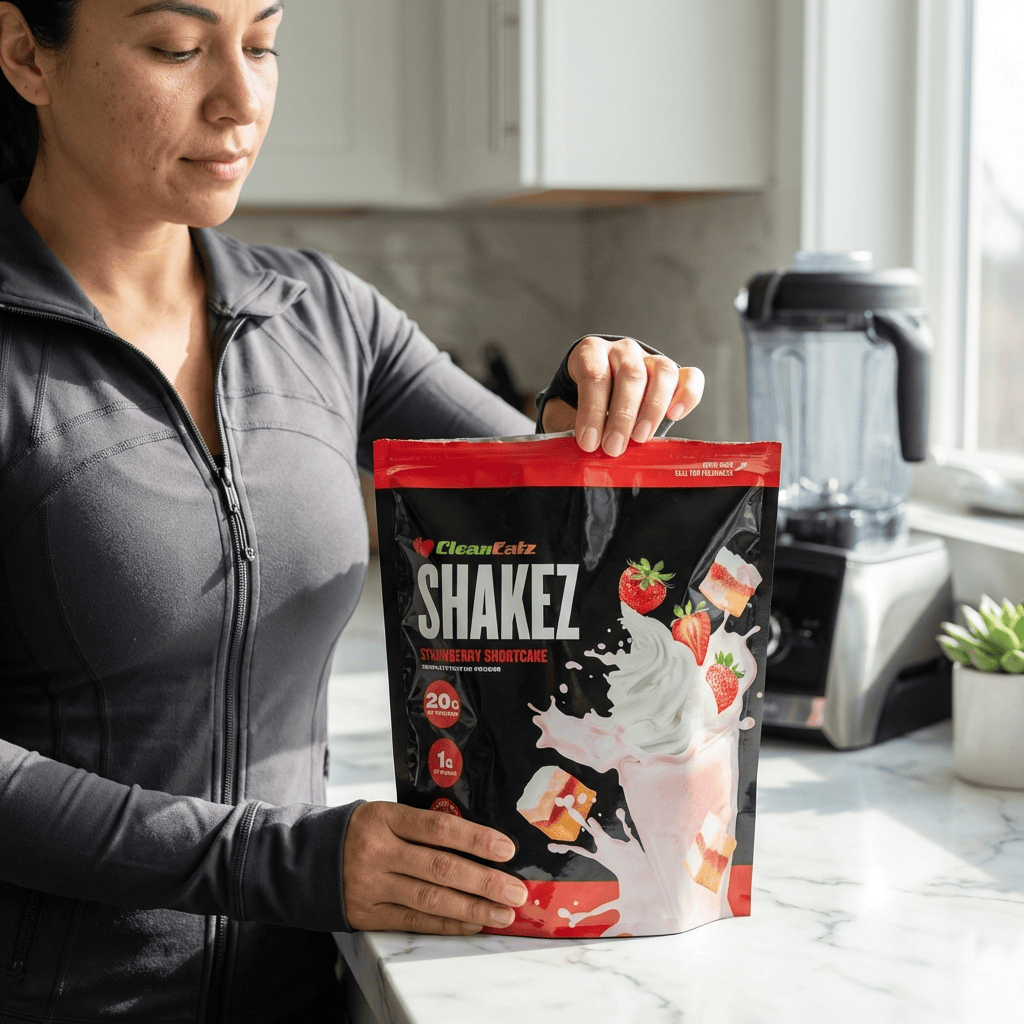
Not sure where you stand? Use our Protein Calculator to set your target. If whole foods leave you short, a scoop of Shakez Protein Powder adds 20 grams of whey protein.
Calorie surplus for muscle gain
A small surplus is enough
Building new tissue takes energy, so most people build muscle best in a small calorie surplus. It doesn't need to be large. A review of off-season nutrition for natural bodybuilders recommends about 10 to 20% above maintenance, aiming to gain about 0.25 to 0.5% of body weight a week. For a 180-pound person, that is roughly 0.5 to 0.9 pound a week. Start at the low end if you want to limit fat gain, which many lifters call a lean bulk.
If you're newer to training or carrying extra body fat, you can often build muscle at maintenance calories or even in a slight deficit. This is called body recomposition. It's slower, but you stay leaner along the way.
Either way, you need your numbers. Use our Calorie Calculator to find your baseline.
Carbs for strength training
Carbs matter more as volume climbs
Carbohydrates fuel hard exercise, but for lifting the effect is smaller than many people think. A 2022 systematic review of 49 studies found that for lifters who had eaten, more carbohydrate didn't improve performance in workouts of up to about 10 sets per muscle. It was more likely to help in higher-volume sessions and when people trained fasted.
So you don't need to load up, but cutting carbs very low can still hurt if your sessions are long or you train on an empty stomach. Oats, rice, potatoes and fruit before or after training are an easy way to cover it.
Meal planning for busy days
Have the next meal ready
Life gets hectic. Without a plan it is easy to miss meals, fall short on protein or grab whatever is closest, which usually doesn't fit your goals.
Ready-made meals remove the decision. When a protein-rich meal is already in the freezer, you eat it. Our Meal Plan Generator can help you map out the week. Or our High Protein Meal Plan adds 2 extra ounces of meat to each meal, about 10 more grams of protein than our regular recipes, starting at $63.00 for 6 chef-cooked, flash-frozen meals with free shipping.
Recovery mistakes that sabotage muscle gains
Muscle grows between sessions
Muscle doesn't grow during the workout. It grows as you recover from it. Shortchange recovery and you shortchange the result.
Sleep & muscle recovery
Seven hours is the floor
Sleep is where a lot of quiet work happens. In a small study of 13 healthy adults, one night without sleep cut muscle protein synthesis by 18% the next day, raised cortisol by 21% and lowered testosterone by 24%.
Short sleep also changes what you lose when you diet. In a two-week study of 10 adults on the same calorie-reduced diet, sleeping 5.5 hours instead of 8.5 cut the share of weight lost as fat by 55% and raised the loss of fat-free mass, which includes muscle, by 60%.
The American Academy of Sleep Medicine recommends adults sleep at least 7 hours a night. Protect it with a dark room, a steady bedtime and fewer screens before bed. Our complete sleep and health guide covers the rest.
Daily steps outside the gym
Walk more, train the same
More gym time isn't the same as more activity. Walking adds movement with very little fatigue, so it doesn't eat into the recovery your lifting needs. It is also one of the best habits for long-term health.
A meta-analysis of 15 cohorts with 47,471 adults found the risk of death kept falling as daily steps rose, leveling off around 8,000 to 10,000 steps a day for adults under 60 and 6,000 to 8,000 for adults 60 and older. Somewhere in that range is a sensible daily target.
Hydration for lifting performance
Small fluid losses cost strength
Being underhydrated makes you weaker than you are. A review of hydration and muscular performance found that losing body water reduced strength by about 2%, power by about 3% and high-intensity endurance by about 10%.
Make water your default drink. On hot days or during long, hard sessions, a drink with light electrolytes can help you keep up.
Breaking through a muscle-building plateau
Change one thing first
When progress stalls, resist the urge to change everything at once. Find the most likely bottleneck and fix that. These are coaching rules of thumb, not study protocols.
| What you notice | Likely cause | First change |
|---|---|---|
| Reps and weights stuck for 2 to 3 weeks | Load too heavy or too little volume | Drop the weight about 5% and rebuild, or add 2 to 4 sets a week if you are recovering |
| Constantly sore, tired or beat up | Too much fatigue | Take a deload week: halve your sets, cut loads 10 to 20% |
| Flat sessions and low energy | Under-fueled, especially on long sessions | Add 25 to 50 grams of carbs around training, or about 150 calories a day |
| Scale climbing fast, waist growing | Surplus too large | Trim 100 to 200 calories a day, keep protein the same |
Plateau signs & what to change first
Fix one bottleneck at a time, then give it two to three weeks before judging it.
Fix one bottleneck at a time, then give it two to three weeks before judging it.
Jason Nista
If you change everything at once, you won't know which change worked, and you will be guessing again the next time you stall.
Muscle building mistakes bottom line
Fundamentals, done for months
Building muscle isn't complicated, but it takes consistency. Do at least 10 hard sets per muscle each week, spread over 2 or 3 sessions. Add weight or reps over time and log them. Eat enough protein and calories, and protect your sleep. Fix the mistakes above and give each change time to work.
If nutrition is the sticking point, if you know what to eat but struggle to do it consistently, ready meals help. Build A Meal Plan lets you pick meals one by one, priced $8.99 to $13.99 each, with a protein filter for 20 to 30, 31 to 40 and 41-plus grams. They are flash-frozen and heat in a few minutes in the microwave.

The author's take
Pick the one mistake on this list you are most sure you are making and fix only that for the next month. For most people it is the logbook or protein. Write every set down, hit your protein most days, and check the numbers in four weeks. Progress you can see is the best reason to keep going.
Jason Nista · Fitness Contributor
 Make it easy withHigh Protein Meal PlanFrom $63.00View plan
Muscle building FAQ
Quick answers
What is the biggest muscle building mistake beginners make?
Program hopping, switching routines every week or two instead of sticking with one plan for 8 to 12 weeks. Without consistency you can't track progressive overload, and without progressive overload you won't keep building muscle. Pick a solid program, log your lifts and add a little weight or a rep or two over time.
How many sets per muscle group per week should I do to build muscle?
Research supports at least 10 hard sets per muscle group per week, with more sets linked to a bit more growth as long as you recover. A practical start is 10 to 14 sets for most muscles, adding sets only if soreness clears before your next session and your performance keeps improving.
Should I train to failure for muscle growth?
You don't need to. Reviews of 15 studies each found no clear muscle-building advantage for training to failure over stopping short, and failure adds fatigue. End most sets with 1 to 2 reps in reserve, and save true failure for the last set of isolation moves like curls or lateral raises.
How much protein do I need to build muscle?
A meta-analysis of 49 trials found gains leveled off at about 1.6 grams per kilogram a day, about 0.7 grams per pound, with up to 2.2 g/kg, about 1 gram per pound, as a safe upper target. Spread it across at least four meals of about 0.4 grams per kilogram each.
Why am I not building muscle even though I'm lifting weights?
The usual causes are no progressive overload, too little protein, short sleep and either too little effort or too much fatigue. Log your workouts and add weight or reps over time, hit your protein most days, sleep at least 7 hours and end most sets 1 to 2 reps short of failure.
More muscle & protein guides
Keep reading
 Fitness
Best Foods for Muscle Growth: What Science Says
 Romaine Rusnak, RD, LDN · Oct 16, 2022
 Fitness
Protein Distribution Across Meals: The 30-Gram-Per-Meal Method
 SaVanna Shoemaker, MS, RDN, LD · Jul 31, 2026
 Fitness
The Benefits of Strength Training & How To Get Started
Romaine Rusnak, RD, LDN · May 14, 2023
Sources
- Plotkin D et al. Progressive overload without progressing load? The effects of load or repetition progression on muscular adaptations. PeerJ 2022 (PubMed)
- Grgic J et al. Effects of resistance training performed to repetition failure or non-failure on muscular strength and hypertrophy: a systematic review and meta-analysis. J Sport Health Sci 2022 (PubMed)
- Refalo MC et al. Influence of resistance training proximity-to-failure on skeletal muscle hypertrophy: a systematic review with meta-analysis. Sports Med 2023 (PubMed)
- Schoenfeld BJ et al. Dose-response relationship between weekly resistance training volume and increases in muscle mass. J Sports Sci 2017 (PubMed)
- Schoenfeld BJ et al. How many times per week should a muscle be trained to maximize muscle hypertrophy? J Sports Sci 2019 (PubMed)
- Rogerson D et al. Deloading practices in strength and physique sports: a cross-sectional survey. Sports Med Open 2024 (PubMed)
- Morton RW et al. A systematic review, meta-analysis and meta-regression of the effect of protein supplementation on resistance training-induced gains in muscle mass and strength. Br J Sports Med 2018 (PubMed)
- Schoenfeld BJ, Aragon AA. How much protein can the body use in a single meal for muscle-building? J Int Soc Sports Nutr 2018 (PubMed)
- Iraki J et al. Nutrition recommendations for bodybuilders in the off-season: a narrative review. Sports 2019 (PubMed)
- Henselmans M et al. The effect of carbohydrate intake on strength and resistance training performance: a systematic review. Nutrients 2022 (PubMed)
- Lamon S et al. The effect of acute sleep deprivation on skeletal muscle protein synthesis and the hormonal environment. Physiol Rep 2021 (PubMed)
- Nedeltcheva AV et al. Insufficient sleep undermines dietary efforts to reduce adiposity. Ann Intern Med 2010 (PubMed)
- Watson NF et al. Recommended amount of sleep for a healthy adult: a joint consensus statement of the American Academy of Sleep Medicine and Sleep Research Society. Sleep 2015 (PubMed)
- Paluch AE et al. Daily steps and all-cause mortality: a meta-analysis of 15 international cohorts. Lancet Public Health 2022 (PubMed)
- Judelson DA et al. Hydration and muscular performance: does fluid balance affect strength, power and high-intensity endurance? Sports Med 2007 (PubMed)
On this page