
DASH diet for blood pressure
What is the DASH diet? (How it lowers blood pressure)
An NIH-funded eating plan. Across 30 trials, it lowered systolic pressure by about 3 mm Hg. What to eat, how much sodium to allow, what the research found and who should check with a doctor first.
- Free Shipping on Every Meal PlanFree Shipping
- Up to 20% Off 30-Meal PlansUp to 20% Off
- Chef Cooked, Dietitian BuiltDietitian Built
- Heat & Eat in MinutesHeat & Eat

What the DASH diet is
What is the DASH diet?
Quick answer
DASH stands for Dietary Approaches to Stop Hypertension. It's a plant-forward eating plan rich in vegetables, fruit, whole grains, beans, nuts and low-fat dairy, with a sodium limit of 2,300 mg or 1,500 mg a day. It's designed to lower blood pressure.
DASH is an NIH-backed eating plan from the National Heart, Lung, and Blood Institute (NHLBI). It emphasizes minimally processed foods such as vegetables, fruits, whole grains, legumes, nuts, seeds, lean proteins and low-fat dairy. It also limits sodium, added sugars, sweets, red and processed meats, and foods high in saturated fat.
People use it both to prevent and to manage high blood pressure, and many also see modest improvements in LDL cholesterol. There's no special food to buy and no phase to get through. It's a pattern, not a protocol.
It isn't a replacement for treatment, either. If you've been prescribed blood pressure medication, DASH goes alongside it, and any change to the medication is a decision for you and your doctor.
Why the DASH diet works
Why does the DASH diet lower blood pressure?
Quick answer
It raises potassium, magnesium, calcium and fiber while cutting sodium and saturated fat. Potassium helps offset sodium by relaxing blood vessel walls and helping the kidneys clear excess sodium. Adding lower sodium strengthens the effect, as the DASH-Sodium trial showed.
No single nutrient explains DASH. In the original trial, a diet rich in fruits and vegetables alone lowered systolic pressure by 2.8 mm Hg, and adding low-fat dairy with less saturated and total fat took that to 5.5 mm Hg. The pattern did more than the produce.
Potassium, magnesium & calcium
DASH foods are naturally rich in potassium, magnesium and calcium, and lower in saturated fat than a typical Western diet. Potassium is the one that gets the most attention, because it helps counterbalance the blood-pressure-raising effects of sodium. That's why the plan leans on potassium-rich foods like leafy greens, bananas, potatoes and beans.
Pairing that nutrient-dense pattern with lower sodium adds to the benefit.
Fiber & satiety on DASH
The fiber in DASH also plays a part. High-fiber foods slow digestion, support gut health and help you feel satisfied longer. All of that helps you maintain a healthy weight, which is another factor in blood pressure.
DASH daily servings & sodium targets
How much of each food does DASH call for?
Quick answer
On 2,000 calories a day, NHLBI lists 4 to 5 servings each of vegetables and fruit, 6 to 8 of grains, 2 to 3 of low-fat dairy and 6 ounces or less of lean meat, with sodium capped at 2,300 mg or 1,500 mg.
These are the typical 2,000-calorie targets from NHLBI. Adjust portions up or down for your calorie needs. The serving sizes matter as much as the counts, because a DASH serving is smaller than most people assume.
| Food group | Goal | One serving | Examples |
|---|---|---|---|
| Vegetables | 4 to 5 a day | 1 cup raw leafy or 1/2 cup cut-up | Leafy greens, broccoli, carrots, tomatoes |
| Fruits | 4 to 5 a day | 1 medium fruit or 1/2 cup | Berries, citrus, melons, apples |
| Grains, mostly whole | 6 to 8 a day | 1 slice bread or 1/2 cup cooked | Oats, brown rice, whole-wheat bread |
| Low-fat or fat-free dairy | 2 to 3 a day | 1 cup milk or yogurt | Low-fat yogurt, milk, kefir |
| Lean meats, poultry, fish | 6 oz or less a day | 1 oz cooked or 1 egg | Skinless poultry, fish, lean cuts |
| Nuts, seeds, legumes | 4 to 5 a week | 1/3 cup nuts or 1/2 cup legumes | Beans, lentils, almonds, peanuts |
| Fats & oils | 2 to 3 a day | 1 tsp oil or 2 tbsp dressing | Olive or canola oil, light dressings |
| Sweets, added sugars | 5 or fewer a week | 1 tbsp sugar or jam | Small portions, low-fat options |
DASH servings on a 2,000-calorie diet, per NHLBI
Run the vegetable and fruit lines and you get 8 to 10 servings a day, which sounds like a lot until you see it's about 4 to 5 half-cups each. A cup of berries at breakfast and a big salad at lunch cover nearly half of it.
DASH sodium targets
Choose a level that fits your health needs: the standard 2,300 mg a day, or the lower 1,500 mg a day for extra blood pressure reduction. Ask your clinician which target is right for you.
For scale, 2,300 mg is about the sodium in 1 teaspoon of table salt, and 1,500 mg is about two-thirds of a teaspoon. That's the whole day, including what's already in the food.
Reducing salt on the DASH diet
How do you cut salt on the DASH diet?
Quick answer
Start with packaged and restaurant food, not the salt shaker. The FDA says over 70% of the sodium Americans eat comes from packaged and prepared foods. Compare labels, choose no-salt-added versions, rinse canned beans and season with herbs, garlic and citrus.
Reducing salt is less about giving up flavor than about changing where the sodium comes from. Over 70% of it comes from packaged and prepared foods, so the shaker is the smallest part of the problem. Don't try to remove it all at once. Pick one or two high-sodium habits and replace them with choices you can repeat every day.
Reading sodium labels
- Compare products side by side, using sodium per serving rather than front-of-package claims.
- Look for "low sodium" on the label. Under the FDA definition, that means 140 mg or less per serving. It's a useful target for individual foods when you can get it.
- Choose "low sodium," "reduced sodium" or "no salt added" versions, especially for canned vegetables, beans, broths, soups, sauces and dressings.
- Watch for hidden sodium in foods that don't taste salty. Bread, cheese, deli meats, snack foods and some breakfast items can add up to a large share of your day.
Low-sodium cooking at home
- Rinse canned beans or vegetables under water to remove some of the surface sodium.
- Get flavor from herbs, spices, garlic, onion, lemon, lime, vinegar and salt-free seasoning blends.
- Cook more meals from scratch, so you decide how much salt goes into each dish.
- Use fresh or frozen vegetables without added sauce, and plain grains instead of seasoned mixes.
- Swap salty condiments for lower-sodium alternatives.
Many people find food starts to taste satisfying with less salt after a few weeks of consistent changes. Give it that long before you judge it.
Lower-sodium restaurant orders
Ask for sauces and dressings on the side, request that food be prepared without added salt, and choose grilled or roasted items over breaded or heavily seasoned dishes.
DASH diet research & evidence
What does the DASH research show?
Quick answer
Blood pressure is the strong finding. Across 30 trials and 5,545 people, DASH lowered systolic pressure by 3.2 mm Hg and diastolic by 2.5 mm Hg. Effects were larger in people with hypertension in the original trial. Cholesterol changes are small.
The direction is consistent. The size isn't, because it depends on who was studied, what they ate before and how tightly the food was controlled.
| Study | Who | Result |
|---|---|---|
| Original DASH trial, 1997 | 459 adults, 8 weeks, all food supplied | 5.5 / 3.0 mm Hg lower. With hypertension, 11.4 / 5.5 |
| DASH-Sodium, 2001 | 412 adults, 30 days at each sodium level | DASH with low sodium: 7.1 mm Hg lower, 11.5 with hypertension |
| Saneei meta-analysis, 2014 | 17 trials, 2,561 people | 6.74 / 3.54 mm Hg lower |
| Filippou meta-analysis, 2020 | 30 trials, 5,545 people | 3.2 / 2.5 mm Hg lower |
| Lari meta-analysis, 2021 | 54 trials, chronic disease | Total cholesterol 5.12 mg/dL lower, LDL 3.53 lower |
Key DASH trials & reviews
DASH & blood pressure
The original DASH feeding trial held sodium and body weight steady, so the 5.5 mm Hg systolic drop came from the food pattern alone. The 133 participants with hypertension saw about three times the effect of the 326 without it, at 11.4 against 3.5 mm Hg.
The DASH-Sodium trial then tested diet and sodium together. Both lowered blood pressure, with greater effects combined than either alone. It's the strongest case for doing both, and the authors added the limit themselves: long-term benefit depends on people keeping these changes up.
Meta-analyses confirm a real average reduction, though the estimates differ by about double. Saneei and colleagues found 6.74 mm Hg systolic and Filippou and colleagues, with more trials, found 3.2 mm Hg. Filippou found the systolic effect was larger in trials with sodium above 2,400 mg a day. That doesn't mean sodium stops mattering. It fits DASH-Sodium, where the gap between DASH and the control diet narrowed at low sodium. The reviews also disagree on who gains most: Saneei found a bigger drop in people with hypertension, and Filippou found hypertension status made no difference.
DASH & cholesterol
A 2021 meta-analysis of 54 trials in people with chronic conditions found total cholesterol 5.12 mg/dL lower and LDL 3.53 mg/dL lower on DASH, with no significant change in HDL or triglycerides. Those are modest numbers. Helpful, but cholesterol isn't the reason to choose this plan.
DASH & heart disease outcomes
Evidence shows improvements in cardiovascular risk factors, while evidence for hard outcomes like heart attacks and strokes is still evolving. An umbrella review covering 15 cohort studies and 942,140 people found about 20% less cardiovascular disease among those eating closest to a DASH pattern. The reviewers rated that evidence low certainty. These are observational studies, so they can't prove the diet caused the difference, since people who eat this way often differ in other ways too.
How to start the DASH diet
How do you start the DASH diet?
Quick answer
Make half your plate produce, swap refined grains for whole grains, choose low-fat dairy and lean protein most of the time, and check sodium on labels. Change one meal or habit at a time, and use NHLBI's free 7-day sample menu.
- Make half your plate produce: fresh, frozen or no-salt-added canned all count.
- Swap refined grains for whole grains: oats, brown rice, whole-wheat pasta.
- Pick low-fat dairy most of the time. Try yogurt or kefir if you prefer.
- Choose lean proteins for most meals: fish, poultry, beans and lentils.
- Check labels for sodium. Aim for 140 mg or less per serving when you can.
- Plan your week. NHLBI publishes a free 7-day DASH sample menu. If meal planning feels overwhelming, our Complete Meal Prep Guide walks through batch cooking strategies that work with any eating pattern, including DASH.
Practical tips for DASH adherence
How do you stick with the DASH diet?
Quick answer
Treat it as a set of repeatable habits, not a perfect diet. Start with the easiest change, keep frozen vegetables, canned beans and plain yogurt on hand, build on meals you already like, and allow occasional less-ideal choices without abandoning the pattern.
DASH is easier to follow when it isn't all-or-nothing. Start with the changes that take the least effort and pay off the most. You might add fruit to breakfast, swap refined grains for whole grains, or make vegetables a permanent part of lunch and dinner.
- Keep convenience in mind. Frozen vegetables, canned beans, plain yogurt and simple pantry staples make DASH meals much easier on busy days.
- Plan ahead a little. A few planned meals, some extra portions and healthy snacks on hand make it less likely you'll fall back on fast food when you're tired.
- Build on what you already eat. Familiar foods are more likely to become routine than unfamiliar recipes.
- Make the salad bigger when you eat out. Choose grilled or baked options and keep sauces on the side.
- Read labels until it's automatic. It gets faster, and you'll start to spot hidden sodium on your own.
Give yourself room as well. One salty dinner doesn't cancel the pattern, because a pattern is what you do most of the time. Small, steady changes are the easiest to keep, and eventually they stop feeling like a diet.
DASH diet safety & further reading
Who should talk to a doctor before starting?
Quick answer
Anyone with chronic kidney disease or a history of high potassium, since many DASH foods are high in potassium. Also check first if you take blood pressure medication or have diabetes. Your clinician can adapt the plan and monitor any changes.
If you take blood pressure medication, have diabetes or have kidney concerns, your provider can help you apply these recommendations safely. Don't change or stop a medication based on a diet you've started. Bring your home readings to the appointment instead.
DASH diet resources
The best place to start is trusted medical and public health sources:
- NHLBI: the plan itself, with food groups, sodium targets and sample meals.
- MedlinePlus: patient-friendly background on DASH and related heart health topics.
- American Heart Association: sodium limits and heart-healthy eating patterns.
When you look further, favor materials that cite medical evidence, separate general advice from personal guidance, and include practical tools like sample menus, sodium trackers and serving guides. Those are also the ones most likely to cover vegetarian, dairy-free and budget-friendly versions of the plan.
Clean Eatz Kitchen meals & DASH
Where do prepared meals fit with DASH?
Quick answer
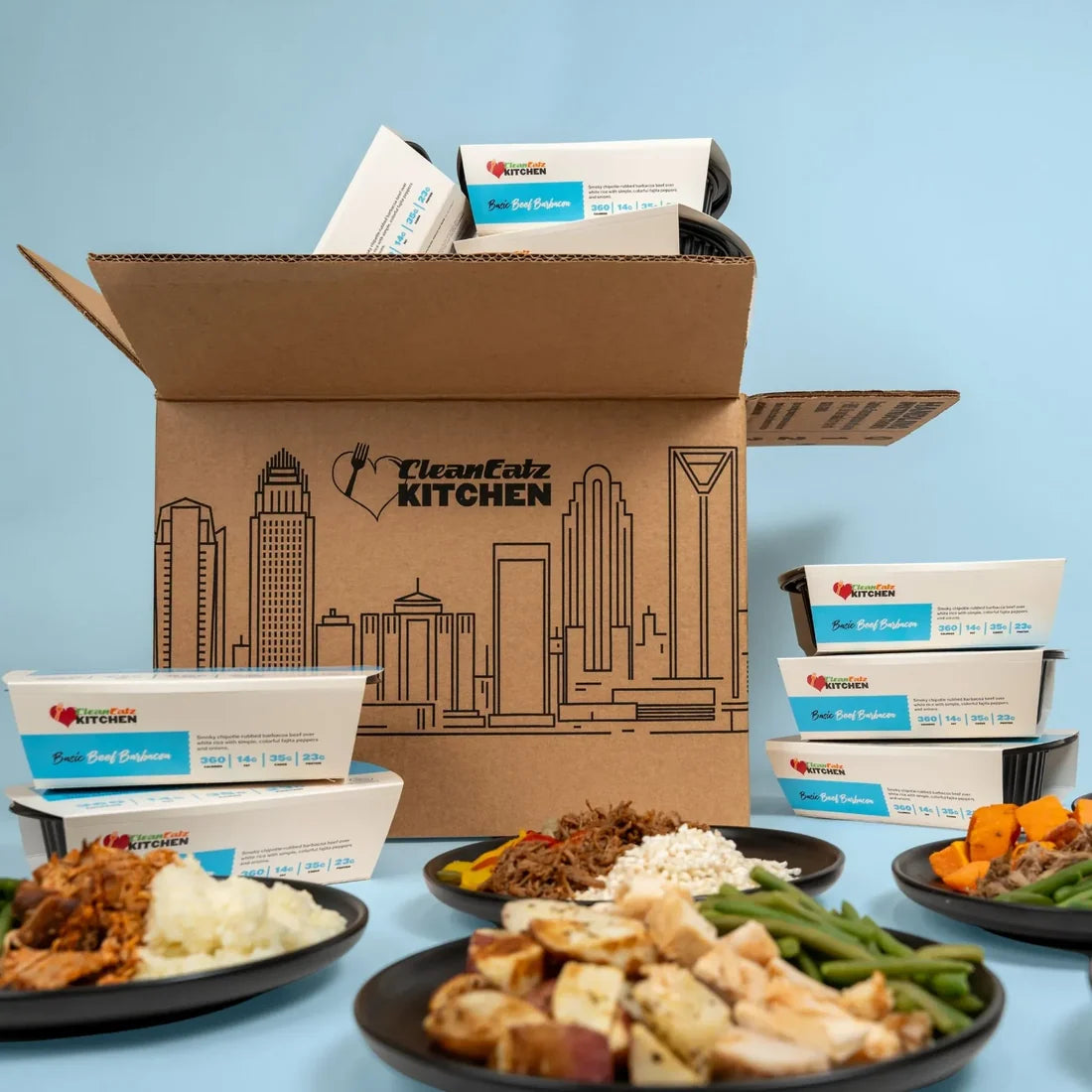
They can save cooking on busy days, but our meals aren't a DASH plan or low-sodium. Sodium on our menu runs 360 to 1,550 mg a meal, median 750, so check each meal against your daily target on our Nutrition Info page.
Hitting DASH goals is easier when meals are planned, and we'd like to help with that part. Still, you should have the numbers before deciding. A median meal on our current menu has 750 mg of sodium, which is half of a 1,500 mg day and about a third of a 2,300 mg day. Three of those a day comes to 2,250 mg, with only 50 mg left for everything else.
So they're a better fit at the 2,300 mg level, used for a meal or two rather than all three. Two meals are the exception: Basic Diced Chicken & Red Potatoes at 360 mg and Basic Chicken Strips & Rice at 380 mg meet the FDA's low-sodium main dish rule. Three meals top 1,000 mg. Our Nutrition Info page lists sodium, fiber, cholesterol and calories for every meal, and you can sort by them.
If the hard part is cooking on a Tuesday rather than knowing what DASH asks for, our meal plans are portioned and take a few minutes in the microwave. Build A Meal Plan lets you pick meals one by one, with goal filters that include Heart Healthy. Check the sodium on each meal it shows. Add a side of vegetables or fruit to move toward your DASH servings, and check the sodium on any of our snacks too. Your clinician's target wins over any of this.
 Make it easy withWeight Loss Meal PlanFrom $89.95View plan
This article is for educational purposes only and doesn't replace medical or personalized nutrition advice.
DASH diet FAQ
Questions about DASH, answered
Is DASH for weight loss?
It wasn't designed as a weight-loss diet, and the original trial held weight steady on purpose. People may lose weight when it's combined with a calorie deficit and regular activity, and a 2021 meta-analysis in people with chronic conditions found body weight about 1.59 kg lower. For more on calories and balance, see our guide to macronutrient ratios.
How low should I go on sodium?
The first goal is to get to 2,300 mg a day or less. Many people with hypertension see additional reductions at about 1,500 mg a day. Your ideal target depends on your health status and your clinician's guidance.
Can I do DASH if I'm a vegetarian or dairy-free?
Yes. DASH is flexible. Lean proteins can be plant-based, like tofu, tempeh, beans and lentils, and dairy can be replaced with fortified alternatives. Check those alternatives for added sugars and sodium. A dietitian can help you check that you're still getting enough calcium.
What if I have chronic kidney disease (CKD)?
DASH-style eating can still help, but some DASH foods are high in potassium. If you have moderate-to-advanced CKD or a history of hyperkalemia, talk to your clinician or dietitian before using salt substitutes or significantly increasing high-potassium foods. They can tailor a lower-potassium version for you.
How is DASH different from Mediterranean?
Both are plant-forward. DASH more explicitly emphasizes low-fat dairy and sets specific sodium targets, while Mediterranean features more olive oil, fish and nuts. Either is heart-healthy when it's built around minimally processed foods, so choose the one you're more likely to keep up.
More heart health & sodium guides
Keep reading
 Nutrition
Low Sodium Foods: What to Eat & Why It Matters (2026 Guide)
 Tina Sassine, RD, MPH · Aug 29, 2023
 Nutrition
Why Does Weight Loss Lower Blood Pressure? The Science
 Romaine Rusnak, RD, LDN · Jun 4, 2023
 Nutrition
10 Ways to Improve Heart Health: What Actually Works (2026 Guide)
 Crystal Zabka-Belsky MS, RDN, CSSD, LMNT, LDN · Oct 7, 2022
Sources
On this page