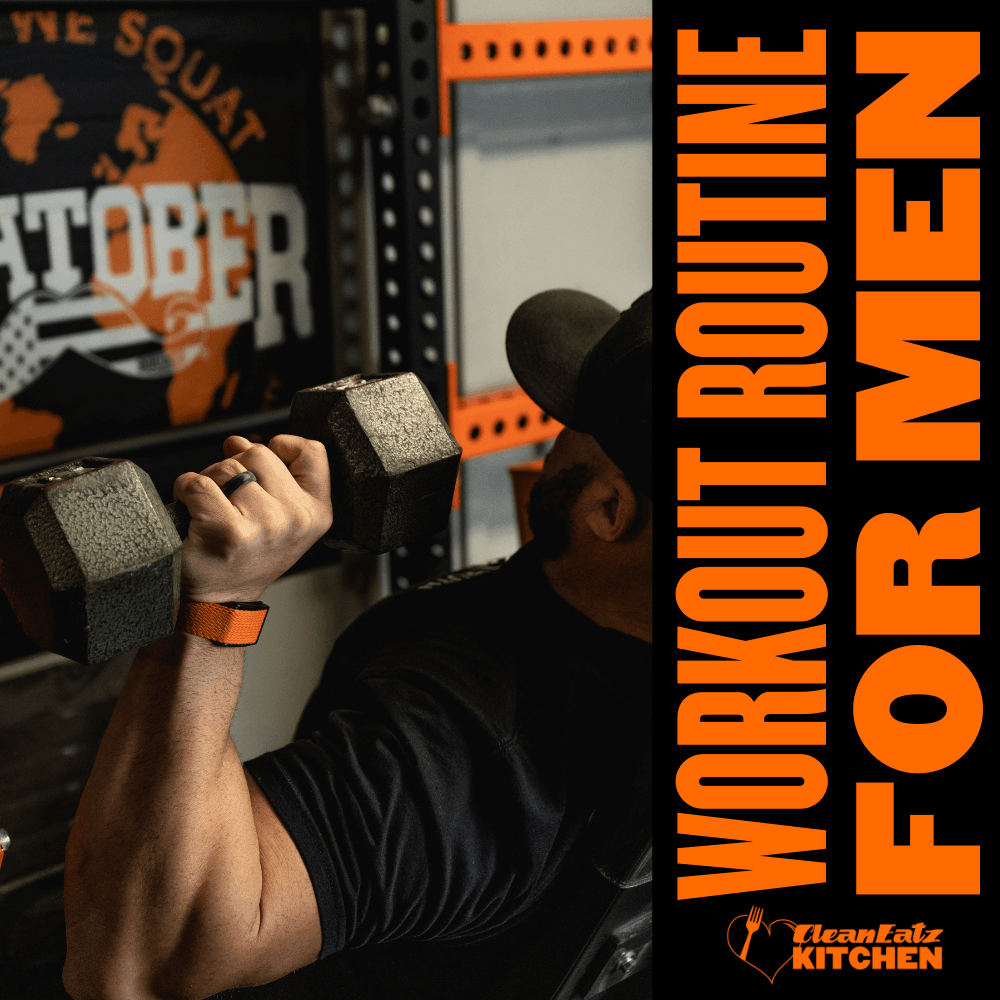

Quick Answer: A good 5-day workout routine is built around compound lifts, supported by enough accessory work to drive muscle growth and strength without making recovery harder than it needs to be. The best plan is the one that matches your goal, training level, and equipment. Choose one of the routines below, apply the progression guidelines consistently, and pair your training with enough protein, calories, sleep, and hydration to support results.
Last updated: March 16, 2026
Table of Contents
Who this is for
How to use these plans
Plan A — 5-Day Hypertrophy (PPL + Upper/Lower)
Plan B — 5-Day Strength Bias
Minimal-Equipment 5-Day (Dumbbells + Bands)
Warm-up, loads & progression
Cardio & conditioning (without killing gains)
Recovery, mobility & core
Nutrition for results
FAQs
References
Who This Is For
This guide is designed for men who want to build muscle, improve strength, and get leaner while training five days per week for about 45–75 minutes per session.
The plans can also work for other adults with similar goals, as long as loads, exercise selection, and training volume are adjusted to individual needs, experience level, and available equipment.
Gaining Weight the Easy Way
Get our free guide — the foods, supplements, and strategies that actually work to pack on the pounds, all in one place.
How to Use These Plans
Choose the plan that best matches your main goal.
Plan A is geared more toward hypertrophy and overall muscle gain.
Plan B places more emphasis on strength while still including enough volume to support muscle growth.
If you train at home or have limited equipment, use the Minimal-Equipment version.
Train five days per week in the order shown, and place 1–2 rest days or light cardio days where they fit best with your schedule and recovery.
Most working sets should finish with about 1–3 reps in reserve (RIR), meaning you stop the set with 1–3 good reps still left. Pushing to RIR 0–1 can be useful on a small number of sets, but it should be used selectively rather than as the default.
Progress the plan over time by adding reps, load, or sets when recovery and exercise quality remain solid. See the progression section below for practical guidelines.
To support results, make sure your nutrition matches your goal. Use the Protein Calculator and Calorie Calculator to estimate your intake, and explore our meal planning tools if you want a more convenient way to stay consistent.
Plan A — 5-Day Hypertrophy (PPL + Upper/Lower)
Goal: maximize muscle gain with balanced volume. Rest 60–120 seconds on accessories, 2–3 minutes on compounds.
Day 1 — Push (Chest/Shoulders/Triceps)
Barbell or DB Bench Press — 4×6–8
Incline DB Press — 3×8–10
Seated DB Shoulder Press — 3×8–10
Cable or Machine Fly — 3×10–12
Lateral Raise — 4×12–15
Triceps Pressdown — 3×10–12
Optional finisher: Push-ups AMRAP — 1 set
Day 2 — Pull (Back/Biceps)
Deadlift or Trap-bar Deadlift — 3×4–6
Weighted Pull-up or Lat Pulldown — 4×6–10
Barbell or Chest-Supported Row — 3×6–10
Single-Arm DB Row — 3×8–10/side
Face Pull or Rear-Delt Fly — 3×12–15
EZ-Bar Curl — 3×8–12
Day 3 — Legs (Quads/Glutes/Hams)
Back Squat or Front Squat — 4×5–8
Romanian Deadlift — 3×6–10
Leg Press — 3×10–12
Walking Lunges — 3×10–12/leg
Leg Curl — 3×10–12
Standing Calf Raise — 4×10–15
Day 4 — Upper (Volume/Detail)
DB Bench (slight incline) — 3×8–12
One-Arm Cable Row — 3×10–12/side
Dips or Machine Press — 3×6–10
Lat Pulldown (wide or neutral) — 3×8–12
High-Incline DB Press or Arnold Press — 3×8–12
Cable Lateral Raise — 3×12–15
Alternating DB Curl — 3×10–12
Day 5 — Lower (Glutes/Hams Focus + Core)
Hip Thrust — 4×6–10
Front-foot Elevated Split Squat — 3×8–10/leg
Good Morning or Back Extension — 3×8–12
Hack Squat or Goblet Squat — 3×10–12
Seated Calf Raise — 4×10–15
Core: Hanging Leg Raise — 3×8–12; Cable Pallof Press — 2×12/side
Plan B — 5-Day Strength Bias
Goal: drive the big lifts while keeping enough hypertrophy volume. Rest 2–4 minutes on the main lift, 60–120 seconds on accessories.
Day 1 — Heavy Squat + Quads
Back Squat — 5×3–5 @ ~80–87% 1RM
Paused Squat — 3×3–5
Leg Press — 3×8–10
Leg Extension — 3×10–12
Core: Weighted Plank — 3×30–45s
Day 2 — Heavy Bench + Chest/Triceps
Bench Press — 5×3–5 @ ~80–87%
Close-Grip Bench — 3×5–8
Incline DB Press — 3×8–10
Chest Fly — 3×10–12
Triceps Pressdown — 3×10–12
Day 3 — Power/Back
Deadlift — 5×2–4 @ ~80–85%
Barbell Row — 4×5–8
Weighted Pull-up — 3×5–8
Rear-Delt Row — 3×10–12
Barbell or DB Curl — 3×8–12
Day 4 — Overhead & Shoulders
Overhead Press — 5×3–5
Incline Press — 3×6–8
Lateral Raise — 4×12–15
Face Pull — 3×12–15
Dip (weighted if strong) — 3×6–10
Day 5 — Posterior Chain + Hamstrings
Romanian Deadlift — 4×5–8
Front Squat or Goblet Squat — 3×6–10
GHR or Nordic Curl — 3×6–8 (controlled)
Back Extension — 3×10–12
Calves — 4×10–15
Minimal-Equipment 5-Day (Dumbbells + Bands)
Great for home or travel. Move slowly, push close to failure on the last set.
Day 1 Push: DB floor press 4×8–12; incline push-up 3×AMRAP; DB shoulder press 3×8–12; band fly 3×12–15; band triceps 3×12–15
Day 2 Pull: 1-arm DB row 4×8–12; band pulldown 3×10–15; rear-delt fly 3×12–15; DB curl 3×10–12; hammer curl 2×12–15
Day 3 Legs A: Goblet squat 4×8–12; DB RDL 3×8–12; reverse lunge 3×10–12/leg; calf raise 4×12–20
Day 4 Upper Volume: DB bench 3×8–12; 1-arm row 3×10–12; Arnold press 3×8–12; lateral raise 3×12–20; push-ups 2×AMRAP
Day 5 Legs B + Core: Bulgarian split squat 4×8–12/leg; hip hinge (band) 3×12–15; step-ups 3×10–12/leg; hollow body hold 3×20–40s; side plank 2×30s/side
Warm-Up, Loads & Progression
Warm-Up (8–12 minutes)
Start with 3–5 minutes of easy cardio, such as walking, cycling, or rowing, to raise body temperature and get moving. Then add a few dynamic mobility drills for the joints you’ll be training most—typically hips, shoulders, ankles, or thoracic spine.
Before your first main lift, perform 2–3 ramp-up sets to prepare for your working weight. A simple approach is to build up gradually with lighter sets before your first work set rather than jumping straight into your top load.
Load Targets
Choose a weight that allows you to stay within the target rep range while finishing most sets with about 1–3 reps in reserve (RIR). In other words, the set should feel challenging, but not like an all-out grind every time.
When you can complete all prescribed sets at the top of the rep range with solid form and still have about 1–2 reps left in reserve, increase the load the following week using the smallest practical jump.
Weekly Progression
Week 1: Establish working weights and stay around RIR 2–3.
Weeks 2–3: Add reps, load, or both where appropriate.
Week 4: Push a small number of key lifts a bit harder, with the final set occasionally reaching RIR 0–1 if technique stays solid.
Week 5: Deload by reducing total volume. A simple option is to cut sets by about half or reduce overall workload while keeping movement quality high.
Cardio & Conditioning (Without Compromising Recovery)
Cardio can support heart health, work capacity, and body-composition goals without necessarily interfering with muscle or strength progress—provided total training volume stays recoverable. A practical starting point is 2–3 light-to-moderate sessions per week, around 20–30 minutes each.
Lower-impact options like incline walking, cycling, or elliptical training are often easiest to recover from. If strength or hypertrophy is the priority, do cardio after lifting or on separate days when you can. Keep interval work limited around heavy leg sessions, and scale back cardio if recovery, training quality, or lower-body performance noticeably drops.
For a deeper dive on how exercise fits into a weight loss strategy, see our complete exercise guide for weight loss.
Recovery, Mobility & Core
Sleep: Sleep plays a major role in recovery, performance, and body-composition outcomes. If you train hard but sleep poorly, it becomes much harder to recover well, maintain training quality, and stay consistent over time. For most adults, aiming for consistent, sufficient sleep is one of the highest-value recovery habits.
Mobility: Mobility work does not need to be long to be useful. Spending 5–10 minutes after training on the joints and tissues most relevant to your lifting—often hips, thoracic spine, ankles, and shoulders—can help support movement quality and comfort.
Core add-ons (2–3× per week): Core training should complement your lifting, not interfere with it. Focus on movements that build stability, bracing, and control, such as hanging leg raises, ab-wheel rollouts, dead bugs, Pallof presses, and side planks. For technique details, check our guide on crunches.
Nutrition for Results
Training is only part of the equation. Your nutrition helps determine whether that work turns into muscle gain, strength progress, improved body composition—or stalls out because recovery, fueling, or consistency are off.
Protein: Aim for a daily intake that supports your training and body size. For most active adults, that usually means a high-protein intake spread across 3–5 meals during the day. A practical target is around 25–45g of protein per meal, depending on your needs. Use our Protein Calculator to estimate a starting range.
Calories: Your calorie intake should match your goal. A small calorie surplus can support muscle gain, while a modest deficit may help with fat loss without compromising training too much. Use the Calorie Calculator to set an appropriate target.
Carbs around training: Carbohydrates can help support performance and recovery, especially on hard training days. Foods like oats, rice, potatoes, fruit, or bread can work well before and after lifting, depending on your routine and digestion. See our rice guide and carb basics for more detail.
Hydration: Drink fluids consistently throughout the day rather than trying to catch up all at once. On hot days, longer sessions, or high-sweat workouts, adding electrolytes may be helpful.
Need a simpler option? If meal prep is the biggest barrier, ready-made meals can make consistency easier. Our High-Protein Box, Build-a-Meal Plan, and Weight-Loss Meal Plan are designed to help you hit your nutrition targets with less day-to-day effort.
Frequently Asked Questions
How long are the workouts?
Most sessions take 45–75 minutes, including warm-up. Short on time? Keep the main lifts and trim 1–2 accessories.
Can I swap exercises?
Yes. Keep the same movement pattern. For example, swap back squat for front squat or leg press, and bench press for DB bench or machine press.
What if I miss a day?
Just continue with the next scheduled workout. There’s usually no need to double up or try to “make up” the missed session. Long-term consistency matters more than following the plan perfectly every week.
How soon will I see results?
Many people notice strength gains in a few weeks. Visible muscle changes usually take longer and depend on training, nutrition, sleep, and consistency
What should I eat around workouts?
Have protein + carbs before or after training. Hitting your total daily intake matters more than perfect timing. Use our Meal Plan Generator to build your schedule.
Disclaimer: This guide is general information, not medical advice. If you have injuries or medical conditions, work with a qualified professional.
References
- American College of Sports Medicine. American College of Sports Medicine position stand. Progression models in resistance training for healthy adults. Med Sci Sports Exerc. 2009
- Jäger R, et al. International Society of Sports Nutrition Position Stand: protein and exercise. J Int Soc Sports Nutr. 2017
- Currier BS, et al. Resistance training prescription for muscle strength and hypertrophy in healthy adults: a systematic review and Bayesian network meta-analysis. Br J Sports Med. 2023
- Schoenfeld BJ, Ogborn D, Krieger JW. Dose-response relationship between weekly resistance training volume and increases in muscle mass: A systematic review and meta-analysis. J Sports Sci. 2017
- Morton RW, et al. A systematic review, meta-analysis and meta-regression of the effect of protein supplementation on resistance training-induced gains in muscle mass and strength in healthy adults. Br J Sports Med. 2018
- Nunes EA, et al. Systematic review and meta-analysis of protein intake to support muscle mass and function in healthy adults. J Cachexia Sarcopenia Muscle. 2022
- Schumann M, et al. Compatibility of Concurrent Aerobic and Strength Training for Skeletal Muscle Size and Function: An Updated Systematic Review and Meta-Analysis. Sports Med. 2022
- Lopez P, et al. Resistance Training Load Effects on Muscle Hypertrophy and Strength Gain: Systematic Review and Network Meta-analysis. Med Sci Sports Exerc. 2021