Quick Summary: Portion control doesn’t have to mean obsessive measuring or calorie counting. Simple visual tools—like hand estimates, plate guides, and pre-portioned meals—can help people better understand serving sizes and build more balanced meals over time. Research supports the broader idea that larger portions tend to increase intake, while portion tools may help some people reduce intake modestly when used consistently as part of a wider healthy eating routine.
Reviewed & updated: March 18, 2026
Why Portion Control Actually Works
One of the most consistent findings in nutrition research is that people tend to eat more when they’re offered larger portions. This pattern has been shown across different settings, and it helps explain why portion awareness can be useful for people trying to eat more intentionally.
The flip side is also helpful: when meals are portioned more deliberately, intake often goes down without requiring constant mental effort. A 2021 systematic review and meta-analysis found that portion control tools had a small overall effect on food intake and a modest effect on weight-related outcomes, although the results varied depending on the tool used. Notably, the benefit was not driven by smaller plates alone.
That distinction matters. Portion control is best presented as a practical support strategy—not as a magic fix. Tools such as calibrated tableware, serving utensils, pre-portioned meals, and simple visual guides may help people make more consistent choices, especially when combined with meal planning and overall diet quality.
Meal prep doesn't have to be complicated.
Get our free guide — shortcuts, meal ideas, and a system that makes eating well the easy option.
The Hand Method: Your Built-In Measuring Tool
One of the simplest portion guides requires no printout at all—just your hand. For many people, this method feels practical because it’s portable, easy to remember, and simple to use in everyday situations.
As a rough visual guide, the palm of your hand can help estimate about 3 ounces of protein foods such as chicken, fish, or tofu. A fist is often used to visualize about 1 cup, which can be a helpful reference for vegetables, fruit, or other bulky foods. A cupped hand is commonly used as a guide for about 1/2 cup, and the size of the thumb can help estimate about 1 tablespoon. These are best used as practical approximations rather than exact measurements.
This method isn’t perfectly precise, but it can still be useful for building portion awareness without turning meals into a measuring exercise. Research on portion-control tools suggests they may help some people improve awareness and make more consistent choices, although the effects vary depending on the tool and how it is used.
Visual Guides Using Everyday Objects
For quick portion estimates, comparing food to familiar objects can be a practical shortcut. This can be especially helpful when eating out or at social events, where measuring food isn’t realistic. The key is to treat these as rough visual cues rather than exact measurements.
A deck of cards or the palm of your hand is a common reference for about 3 ounces of meat, poultry, or fish. A baseball or an average-sized fist can help visualize about 1 cup, while a tennis ball or small scooped handful is often used as a guide for about 1/2 cup. The Academy of Nutrition and Dietetics uses these comparisons as simple ways to estimate portions when measuring cups and spoons aren’t available.
Other commonly used visual references include a thumb for about 1 tablespoon and the tip of the pointer finger to the first joint for about 1 teaspoon. In the NHLBI portion guide, 2 tablespoons of peanut butter are compared to a ping-pong ball, and 3 ounces of meat, fish, or poultry are compared to a deck of cards.
Over time, these kinds of cues can make portion estimation feel more intuitive. They’re most useful when paired with other simple strategies, such as checking the Nutrition Facts label, using the hand method, or serving food onto a plate instead of eating straight from a package.
The Plate Method: Simplifying Balanced Meals
If remembering different object comparisons feels like too much, the plate method offers a simpler framework. Both USDA MyPlate and Harvard’s Healthy Eating Plate use a visual approach to help people build more balanced meals. Instead of focusing on exact measurements, they offer an easy way to think about meal structure at a glance.
A simple starting point is to fill about half the plate with vegetables and fruits. This can help increase fiber, color, and overall nutrient density while leaving less room for more energy-dense foods.
The remaining plate is often divided between protein-rich foods and grain or starch choices. A protein portion might include fish, poultry, beans, eggs, or tofu, while the carbohydrate portion may come from whole grains or other minimally processed starches, depending on the meal.
Harvard’s version places more emphasis on food quality, encouraging whole grains, healthy protein choices, and healthy oils as part of the overall pattern. Even without tracking exact amounts, using a plate framework can make balanced eating and portion awareness feel more practical.
For a deeper dive into balanced eating and meal planning, the Complete Meal Prep Guide walks through how to build these principles into a practical weekly routine.
Printable Resources Worth Bookmarking
Several organizations offer free portion guides and visual resources you can print and keep in your kitchen.
The NHS Eatwell Guide (nhs.uk) provides a simple visual framework for building balanced meals and understanding how different food groups fit into an overall healthy eating pattern.
Harvard's Healthy Eating Plate (Harvard T.H. Chan School of Public Health) is another helpful visual tool, with added emphasis on food quality alongside portion balance. It can be especially useful for readers who want a practical guide to building balanced meals without overcomplicating the process.
For readers who want a clearer understanding of serving sizes and portion awareness, the FDA’s guide to serving sizes on the Nutrition Facts label and NIDDK’s food portions resource can both be useful references.
For families with children, the Academy of Nutrition and Dietetics' Kids Eat Right resources (eatright.org) offer age-appropriate guidance and visuals that can help make portion education more accessible for younger readers.
Portion Control and Meal Prep: A Natural Pairing
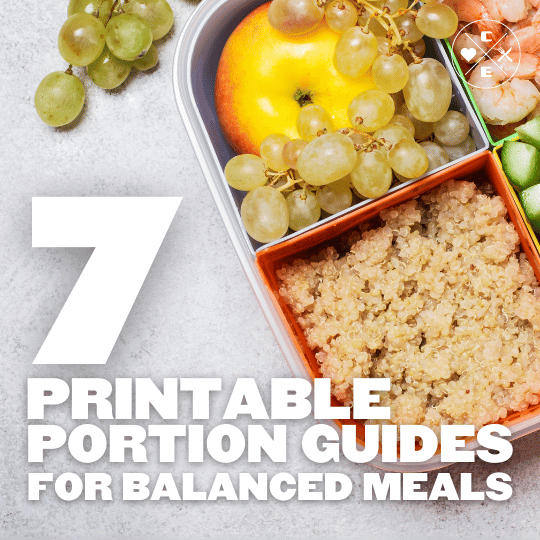
Understanding portions is one thing. Putting them into practice consistently is another. This is where meal prep can be especially helpful—not as a social media trend, but as a practical strategy that may make portion awareness easier to maintain.
When meals are portioned in advance, some of the decision-making happens earlier, rather than in the moment when you’re tired, rushed, or especially hungry. Research suggests that planning and pre-portioning meals may help people manage serving sizes more consistently than serving directly from large containers or shared dishes.
One concept that may help explain this is “unit bias”—our tendency to see the amount in front of us as a natural amount to eat. Pre-portioning meals into individual containers may make it easier to keep portions more consistent without relying as much on willpower in the moment.
If full meal prep doesn’t feel realistic, pre-portioned options can also be helpful. Clean Eatz Kitchen's meal plans may offer a convenient option for people who want more structure around balanced meals and portion size. For some readers, having meals already portioned can make balanced eating feel more manageable and provide a clearer visual sense of serving size.
For those who prefer to prepare their own meals, the Best Foods for Weight Loss guide offers ideas on which foods to prioritize and how portion awareness can support healthy weight management.
Making Portion Control Stick
The most effective portion guide is the one you can use consistently in real life. Some people prefer more structured measurements, while others do better with simple visual cues. Either way, a few practical habits can make portion awareness easier to maintain.
Start with awareness before trying to change anything. Spend a few days noticing what your usual portions look like. How does your typical serving of pasta compare with a visual guide? How much protein are you actually putting on your plate? Building that awareness first often feels more realistic—and more sustainable—than jumping straight into strict measuring.
Smaller plates or bowls may help some people feel more mindful of portion size, but they’re not a magic fix. A more reliable strategy is to pay attention to how much food is being served in the first place. When larger amounts are placed in front of us, it’s easy to eat more without fully noticing.
Pre-plate your food when you can. Rather than serving meals family-style at the table, portion your plate in the kitchen before sitting down. This simple habit can make meals feel more intentional and can reduce the tendency to keep adding extra food automatically.
It’s also worth being more conscious when eating out, since restaurant portions are often larger than what many people would serve themselves at home. Sharing a dish, choosing a starter as your main meal, or setting part of the meal aside for later can all be practical ways to make portions feel more manageable without turning the meal into a stressful experience.
Frequently Asked Questions
How can I estimate portions without a food scale?
A simple way to estimate portions is to use visual guides. Your hand, your plate, or the serving size listed on a food label can all help you build more awareness around how much you’re eating. It won’t be as precise as weighing food, but for many people it’s a practical and sustainable place to start.
What’s the difference between a portion and a serving size?
A serving size is a standardized amount listed on the Nutrition Facts label. A portion is the amount you actually choose to eat at one time. Sometimes they match, but often a portion is larger or smaller than the labeled serving.
Do portion-control plates help with weight loss?
They may help some people, especially as part of a broader effort to build more balanced meals and improve portion awareness. The research suggests they can be useful tools, but they work best as one part of an overall eating pattern rather than as a stand-alone solution.
How do I teach kids about portion sizes?
Keep it simple and low-pressure. Visual comparisons, balanced plates, and involving children in meal prep can all help them become more familiar with reasonable portions. The goal is to build confidence and awareness, not to make eating feel rigid or overly controlled.
Can I use portion control guides when eating out?
Yes. Portion guides can be especially helpful in restaurants, where serving sizes are often larger than expected. Practical strategies include sharing a dish, ordering a starter as a main, or setting part of the meal aside before you begin eating.
The Bottom Line
Portion control isn’t about eating as little as possible. It’s about building a more realistic sense of what a balanced amount of food looks like in a world where large servings have become the norm. Visual tools like the hand method, plate guides, and simple portion references can make that process feel easier and more practical.
The goal isn’t perfection. It’s awareness, consistency, and a way of eating that feels manageable over time. The most helpful portion strategy is usually the one that fits naturally into your routine and supports balanced meals without adding unnecessary stress.
For readers who want extra structure, the Complete Meal Prep Guide offers practical support for building sustainable eating habits. Clean Eatz Kitchen's portion-controlled meal plans can also be a convenient option when having balanced meals planned in advance feels helpful.
References
1. Rolls BJ, et al. "Portion size of food affects energy intake in normal-weight and overweight men and women." American Journal of Clinical Nutrition. 2002.
2. Vargas-Alvarez MA, et al. "Impact of Portion Control Tools on Portion Size Awareness, Choice and Intake: Systematic Review and Meta-Analysis." Nutrients. 2021;13(6):1978. https://pubmed.ncbi.nlm.nih.gov/34207492/
3. Jayawardena R, et al. "Impact of portion-control plates (PCP) on weight reduction: A systematic review and meta-analysis of intervention studies." Obesity Research & Clinical Practice. 2021;15(2):106-113. https://www.sciencedirect.com/science/article/abs/pii/S1871403X21000089
4. Rolls BJ. "What is the role of portion control in weight management?" International Journal of Obesity. 2014;38:S1-S8. https://pmc.ncbi.nlm.nih.gov/articles/PMC4105579/
5. Poelman MP, et al. "PortionControl@HOME: Results of a Randomized Controlled Trial Evaluating the Effect of a Multi-Component Portion Size Intervention." Obesity Facts. 2015. https://pmc.ncbi.nlm.nih.gov/articles/PMC4335123/
6. Hetherington MM, Cunningham K, Dye L, Gibson EL, et al. Understanding the science of portion control and the art of downsizing. Proc Nutr Soc. 2018
7. Jia SS, et al. The Use of Portion Control Plates to Promote Healthy Eating and Diet-Related Outcomes: A Scoping Review. Nutrients. 2022.