7 Printable Portion Control Guides

Seven free portion guides you can print, from Harvard's plate to the newest USDA servings chart. What each one shows, who it suits, and how to pair it with your hand, your plate and meals portioned ahead.

Ellie Lopez, LDN, MS
Ellie Lopez, LDN, MSLicensed Dietitian · Jan 22, 2025
Clean Eatz Kitchen Weight Loss Meal Plan box with portioned meals
Quick answer

The most useful free printable portion guides are Harvard's Healthy Eating Plate, the USDA's 2026 Daily Servings chart, the UK Eatwell Guide and the Academy of Nutrition and Dietetics' everyday object comparisons. Use a plate guide to shape each meal and a servings chart to plan the day. In one study, adults ate 30% more when served twice as much, so seeing a portion clearly matters.

Portion control doesn't have to mean obsessive measuring or calorie counting. Simple visual tools, like hand estimates, plate guides and meals portioned ahead of time, help you see what a serving looks like and build more balanced meals over time. The research backs the broad idea: larger portions lead people to eat more, and portion tools can trim intake a little when you use them consistently as part of a wider healthy eating routine.

Below are seven free guides you can print and keep in the kitchen, each from a public health body or a university. We say what each one shows, who it suits best and where it falls short. Two older favorites have changed since this post first ran. USDA's MyPlate printables were taken down in early 2026, so the newer Daily Servings chart takes their place, and the NHLBI serving size card is no longer on NHLBI's site, though an archived copy still exists. After the list, we cover the hand method, the plate method, how meal prep fits in, and how to make the habit stick.

Why portion control works

One of the most consistent findings in nutrition research is that people eat more when they're offered more. In a 2002 study by Rolls and colleagues, 51 adults were served macaroni and cheese for lunch once a week in portions from 500 to 1,000 grams. They ate 30% more energy from the largest portion than from the smallest, about 160 extra calories at one meal. It made no difference whether the food came on a plate or whether people served themselves from a dish. A 2018 review by Hetherington and colleagues calls this portion size effect robust, reliable and enduring, in children and adults alike.

The flip side helps too: when meals are portioned deliberately, intake often drops without constant willpower. A 2021 systematic review and meta-analysis by Vargas-Alvarez and colleagues pooled 36 publications on portion tools. Smaller bowls and spoons cut how much people ate, though the effect was small. Smaller plates alone made no measurable difference. Tools had a small effect on weight, driven mostly by calibrated tableware, meaning plates and bowls marked with portion zones.

Portion control plates look a little stronger in weight trials. A 2021 meta-analysis by Jayawardena and colleagues pooled five studies and found the plates cut body weight by about 2 kg and BMI by 0.87 on average. A 2022 scoping review by Jia and colleagues of 23 intervention studies found the plates helped people pick better portions, but most trials paired them with other help, so the plate's effect on its own is uncertain.

That distinction matters. Portion control is a practical support strategy, not a magic fix. In the PortionControl@HOME trial of 278 adults with overweight or obesity, portion habits improved at 3, 6 and 12 months, but the effect on BMI showed up only at 3 months and faded once the program ended. And as Rolls notes in a 2014 review, what you eat matters as much as how much. Filling more of the plate with low energy-dense foods like vegetables lets you eat satisfying portions while managing your weight.

1

Harvard Healthy Eating Plate

Best all-round
Free to print · 25+ languages · half the plate vegetables & fruits

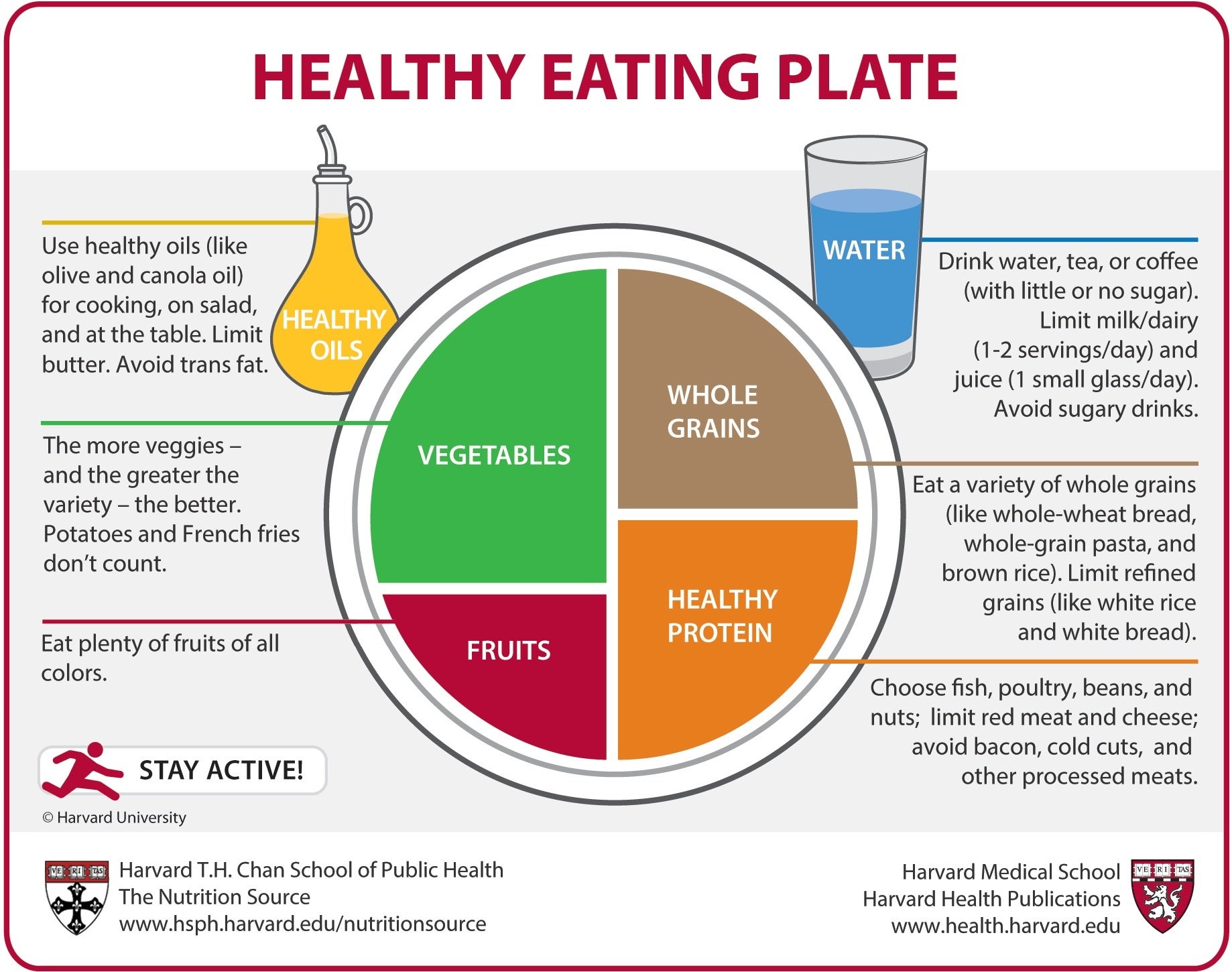
The Healthy Eating Plate from the Harvard T.H. Chan School of Public Health is the one to tape to the fridge if you only print one. Harvard offers a printable copy of the plate plus translations in more than 25 languages, free for educational and other noncommercial use with credit.

The layout is simple. Make half the plate vegetables and fruits, and note that potatoes and French fries don't count as vegetables here. Fill a quarter with whole grains, like brown rice, whole-wheat pasta, quinoa or oats, and a quarter with healthy protein: fish, poultry, beans and nuts, with less red meat and cheese and no bacon or cold cuts. Cook with healthy oils like olive and canola oil, and limit butter.

The plate also covers drinks, which most portion guides skip. Harvard says to drink water, tea or coffee with little or no sugar, to limit milk and dairy to 1 to 2 servings a day and juice to one small glass, and to avoid sugary drinks.

Best for: anyone who wants one picture that shapes every meal. Where it falls short: it tells you how to divide the plate, not how big the plate or the servings should be, so pair it with the hand method below.

View the guide
2

USDA daily servings by calorie level

Newest US guide
12 calorie levels · 1,000 to 3,200 calories a day

The Daily Servings by Calorie Level chart came out in January 2026 with the Dietary Guidelines for Americans, 2025 to 2030, published on RealFood.gov. It's a two-page PDF, and page one is the part worth printing: a single table that tells you how many servings of each food group to eat at 12 calorie levels.

The chart also defines a serving for each group, which makes it a portion guide as much as a menu plan. One serving of protein foods is 3 ounces of cooked meat, poultry or seafood, 1 egg, half a cup of beans, peas or lentils, 1 ounce of nuts or 2 tablespoons of nut butter. One dairy serving is a cup of milk, three quarters of a cup of yogurt or 1 ounce of cheese. Vegetables count as a cup raw or cooked, or 2 cups of leafy greens. Fruit is a cup raw or half a cup dried. A whole grain serving is half a cup of cooked oats, brown rice or quinoa, a slice of bread or a tortilla. Healthy fats are counted by the teaspoon of olive oil or butter.

At 2,000 calories a day, the chart calls for:

• Protein foods: 3 to 4 servings

• Dairy: 3 servings

• Vegetables: 3 servings

• Fruits: 2 servings

• Whole grains: 2 to 4 servings

• Healthy fats: 4.5 servings

At 1,600 calories the chart drops to 2.5 to 3.5 servings of protein foods, 2.5 of vegetables, 1.5 of fruit, 1.75 to 3.25 of whole grains and 3.5 of healthy fats, with dairy steady at 3. At 2,400 calories it rises to 3.5 to 4.5 servings of protein foods, 3.5 of vegetables, 2.75 to 5.25 of whole grains and 5 of healthy fats, with fruit at 2 and dairy at 3.

The chart's own notes say the calories you need depend on your age, sex, height, weight and activity, and that smaller portions may suit people with lower needs, such as young children or some older adults. The new guidelines also set a protein target of 1.2 to 1.6 grams per kilogram of body weight a day.

Best for: planning a full day, especially if you already know roughly how many calories you eat. Where it falls short: it's a table, not a picture, so it's less useful at the stove than a plate graphic.

View the guide
3

UK Eatwell Guide

Whole-day view
1-page color PDF · 12-page booklet

The NHS Eatwell Guide is the UK government's picture of a balanced diet, drawn as one plate split by food group. The GOV.UK page offers it as a one-page color PDF and as a 12-page booklet, both free to download and print.

Its proportions differ a little from a dinner plate guide because they describe everything you eat in a day. Fruit and vegetables should make up just over a third of the food you eat, with at least 5 portions a day. Starchy foods like potatoes, bread, rice and pasta should make up just over a third too, ideally higher-fiber or wholegrain versions. The rest is dairy or alternatives, and protein from beans, pulses, fish, eggs and meat, with at least 2 portions of fish a week (140 grams each), one of them oily, and less red and processed meat.

Two details are handy for portion control. It caps fruit juice and smoothies at a combined 150ml a day, and it suggests 6 to 8 cups or glasses of fluid daily. It also says you don't need this balance at every meal, only across a day or even a week, which takes the pressure off a single plate.

Best for: people who think in daily totals rather than meal by meal. Where it falls short: it's British, so portions are in grams and milliliters and some food names differ from US labels.

View the guide
4

Eatright portion size comparisons

No scale needed
Fist about 1 cup · palm about 3 ounces

The Academy of Nutrition and Dietetics, the professional body for registered dietitians, publishes a short guide on serving size vs. portion size on eatright.org, last reviewed in February 2026. It isn't a PDF, but it prints cleanly from a browser, and its core is a list of everyday objects to compare food against when measuring cups aren't handy.

• A baseball or an average-sized fist is about 1 cup, a fit for raw or cooked vegetables, whole fruit or 100% juice.

• A tennis ball or a small scooped handful is about half a cup, or a 1-ounce equivalent of pasta, rice or oatmeal.

• A deck of cards or the palm of your hand is about 3 ounces of fish, chicken, beef or other meat.

• Your thumb is about 1 tablespoon, a fit for peanut butter or other nut butters.

• A postage stamp, or the tip of your pointer finger to the first joint, is about 1 teaspoon of oil or other fats.

The Academy pairs these with sensible advice: measure foods regularly for a while so you learn what servings look like, eat from a plate rather than the package, and listen to your body. If you're still hungry after one serving, you likely need more, and if you're full on less, that's fine too.

Best for: eating out, parties and anywhere a scale isn't realistic. Where it falls short: hands vary in size, so treat every comparison as a rough estimate, not a measurement.

View the guide
5

FDA Nutrition Facts serving sizes

On every package
Lasagna example: 1 cup is 280 cal · 2 cups is 560

The portion guide you already own is printed on most packaged food. The FDA's page on serving size on the Nutrition Facts label explains the one thing most people miss: by law, serving sizes are based on how much people typically eat and drink, not on how much they should. The serving size is not a recommendation.

The label tells you the serving size in a household measure, like a cup or a slice, followed by grams, with servings per container just above it. One package often holds more than one serving. In the FDA's lasagna example, a serving is 1 cup at 280 calories, so eating 2 cups doubles everything to 560 calories and 1,700mg of sodium. Some packages now show a second column for the whole container.

Some serving sizes changed with the updated label to better match how people really eat. Per the NIDDK, a serving of ice cream went from half a cup to two thirds of a cup, and yogurt went from 8 ounces to 6. For handouts on reading the label, the FDA's Education Resource Library is a catalog of printable materials in PDF form.

Best for: calibrating your eye. Measure one labeled serving of cereal, pasta or nuts into the bowl you normally use, once, and you'll know what it looks like. Where it falls short: it only covers packaged food.

View the guide
6

NIDDK Just Enough for You guide

Best for habits
9 tips at home · 7 for eating out · a sample food tracker

The National Institute of Diabetes and Digestive and Kidney Diseases (NIDDK) page Food Portions: Choosing Just Enough for You is the most practical guide on this list. It has a print button, and it covers the difference between a portion and a serving, how to read the label, and how to manage portions at home, eating out and on a tight budget.

Its sample food tracker is the part worth printing. It logs what you eat, when, where, why and how much. The example day adds up to 2,916 calories, including five cookies eaten out of boredom at work and a large restaurant meal at 8 p.m., eaten while very hungry. Seeing a day written down like that shows where portions drift.

The home tips are realistic. Take one serving from the label and eat it off a plate, not from the box or bag. Avoid eating in front of the TV or while driving. Eat slowly, since your brain may need at least 15 minutes to register that you're full. Freeze extra food in single-size or family-size servings so you aren't tempted to finish the batch, and split big bags of snacks into single servings when you get home.

Best for: building habits. NIDDK says you don't need to measure everything for the rest of your life, only long enough to learn typical serving and portion sizes. Where it falls short: it's a web page, so print the sections you'll use.

View the guide
7

Kid's Healthy Eating Plate & Kids Eat Right

For families
Preschool servings about half a cup · meat about 2 ounces

For families, two resources work well together. Harvard's Kid's Healthy Eating Plate uses the same idea as the adult version: fill half the plate with colorful vegetables and fruits, and split the other half between whole grains and healthy protein. Water is the drink of choice with every meal and snack, and juice is limited. Harvard offers a downloadable guide and a color-your-own-plate page, which makes the lesson a craft rather than a lecture.

The Academy's Kids Eat Right program on eatright.org adds the numbers. Its guide to how much your child should eat says preschoolers ages 3 to 5 need servings of about half a cup of fruits, vegetables and grains, meat about the size of the child's hand or about 2 ounces, and half a cup of milk or a third of a cup of yogurt. A typical toddler meal is 1 to 4 tablespoons each of a few foods.

The tone matters as much as the amounts. The Academy says to let children decide whether and how much to eat, to use child-sized dishes and cups so plates aren't overfilled, and to skip the "just one more bite" pressure, which teaches kids to ignore their own fullness cues. The Hetherington review notes that children are still learning what a normal portion looks like, which makes these early habits worth the effort.

Best for: teaching kids without making food rigid. Where it falls short: amounts change fast with age, so check the guide for your child's age group.

View the guide

Printable portion guides compared

  • Harvard Healthy Eating Plate: Format Printable image · Best for Shaping each meal
  • USDA daily servings: Format 2-page PDF · Best for Planning the day
  • UK Eatwell Guide: Format PDF and booklet · Best for Daily totals
  • Eatright comparisons: Format Web page · Best for Eating out
  • FDA serving sizes: Format Web page and PDFs · Best for Packaged food
  • NIDDK Just Enough for You: Format Web page · Best for Building habits
  • Kid's plate and Kids Eat Right: Format Guide and web page · Best for Families

If you print only two, pick one picture and one set of numbers: Harvard's plate for the fridge and the USDA chart for planning. Add the others as your needs change, like the kids' resources when little ones start serving themselves.

Hand method for portion sizes

One of the simplest portion guides needs no printout at all, just your hand. It's portable, easy to remember and simple to use anywhere. As a rough visual guide, the palm of your hand is about 3 ounces of protein foods such as chicken, fish or tofu. A fist is about 1 cup, a good reference for vegetables, fruit or other bulky foods. A cupped hand is about half a cup, and your thumb is about 1 tablespoon. Use them as practical estimates, not exact measurements.

Comparing food to familiar objects works the same way and helps when eating out or at social events. The Academy's comparisons are above. An older printable from the National Heart, Lung, and Blood Institute, a cut-out Serving Size Card, made similar ones: 2 tablespoons of peanut butter is a ping-pong ball, 3 ounces of meat, fish or poultry is a deck of cards, 1.5 ounces of cheese is 4 stacked dice and a pancake is a compact disc. NHLBI no longer hosts the card, and its old link now redirects, but the archived copy still prints.

  • Fist or baseball: About 1 cup · Good for Vegetables, whole fruit, cereal
  • Cupped hand or tennis ball: About 1/2 cup · Good for Rice, pasta, oatmeal
  • Palm or deck of cards: About 3 oz · Good for Chicken, fish, beef, tofu
  • Ping-pong ball: About 2 tbsp · Good for Peanut butter, nut butters
  • Thumb: About 1 tbsp · Good for Peanut or almond butter
  • Fingertip or postage stamp: About 1 tsp · Good for Oil, butter

This method isn't precise, but it builds portion awareness without turning meals into a measuring exercise. Over time, these cues make estimating feel automatic. They work best alongside the other habits on this page, like checking the Nutrition Facts label and serving food onto a plate instead of eating straight from the package.

Plate method for balanced meals

If remembering object comparisons feels like too much, the plate method is simpler. Instead of exact measurements, it gives you meal structure at a glance. Fill about half the plate with vegetables and fruits, which adds fiber, color and nutrients while leaving less room for energy-dense foods. Split the rest between protein, like fish, poultry, beans, eggs or tofu, and a grain or starch, ideally a whole grain or another minimally processed choice.

Harvard's version puts extra weight on food quality: whole grains, healthy proteins and healthy oils. USDA's MyPlate used the same visual idea for years, and its printables are what many people still picture, but the federal printable today is the Daily Servings chart in the list above. The Jia scoping review found that most portion control plates use the same split, half vegetables, a quarter protein and a quarter carbohydrates.

One caution from the research: plate size alone doesn't do much. In the Vargas-Alvarez meta-analysis, smaller plates didn't change how much people ate, while plates marked with portion zones did help with weight. So the lines on the plate matter more than its diameter. A sectioned plate or meal prep container gives you those lines for free.

For a deeper dive into balanced eating and meal planning, the Complete Meal Prep Guide shows how to build these principles into a practical weekly routine.

Portion control & meal prep

Understanding portions is one thing. Putting them into practice every day is another. This is where meal prep helps, not as a social media trend, but as a practical way to make portion awareness easier to keep up. When meals are portioned in advance, the decision happens early, not in the moment when you're tired, rushed or very hungry.

One idea that helps explain why is unit bias, our tendency to treat whatever amount is in front of us as the natural amount to eat. In a 2006 study by Geier, Rozin and Doros, people took far more candy and pretzels by weight when each unit was bigger, and ate more candy when it came with a larger serving spoon. One container, one meal, is the same bias working in your favor. Rolls's 2014 review adds that randomized trials of preportioned foods, both meal replacements and regular foods, have shown they work for weight loss and keeping weight off.

If full meal prep doesn't feel realistic, preportioned meals are the shortcut. At Clean Eatz Kitchen, every meal is chef-cooked, portion-controlled and built by a registered dietitian, and every meal's calories, protein, carbs, fat and allergens are on our Nutrition Info page. Our current menu (October 2026) runs from 250 to 630 calories a meal, with a median of 410, so you can see exactly what a balanced portion looks like before you eat it.

Pick meals one by one in Build A Meal Plan, at $8.99 to $13.99 a meal, or start with the Weight Loss Meal Plan, which is portion-controlled and calorie-controlled, from $89.95 for 10 meals, about $9 a meal. For those who prefer to cook, our Best Foods for Weight Loss guide covers which foods to prioritize and how portion awareness supports healthy weight management.

Making portion control stick

The most effective portion guide is the one you actually use. Some people prefer structured measurements, others do better with visual cues. Either way, a few habits make portion awareness easier to maintain.

  • Start with awareness. Spend a few days noticing what your usual portions look like. How does your typical serving of pasta compare with the tennis ball? How much protein do you actually put on your plate? Measuring for a short stretch, as NIDDK suggests, teaches your eye faster than any chart.
  • Change the bowl and spoon, not just the plate. Smaller bowls and serving spoons cut intake in the Vargas-Alvarez meta-analysis, while smaller plates alone didn't. Pay attention to how much food goes out in the first place.
  • Plate food in the kitchen. Rolls found people ate more from bigger portions whether they served themselves or not, so the amount you put out matters most. Portion your plate at the stove, then put the rest away or freeze it before you sit down.
  • Plan for restaurants. Restaurant portions are often larger than what you'd serve at home. Share a dish, order a starter as your main or take half home, all tips NIDDK recommends.
  • Keep the structure in place. In the PortionControl@HOME trial, habits held for a year but the BMI benefit faded after the program ended. Guides on the fridge and portioned meals in the freezer keep the structure going after the motivation fades.

None of this needs to be stressful. Sharing a dish or saving half for tomorrow keeps a meal out enjoyable while still keeping portions in check.

Printable portion control guides: the bottom line

Portion control isn't about eating as little as possible. It's about building a realistic sense of what a balanced amount of food looks like in a world where large servings have become normal. Visual tools like the hand method, plate guides and these seven printables make that easier and more practical.

The goal isn't perfection. It's awareness, consistency and a way of eating that feels manageable over time. The most helpful portion strategy is usually the one that fits naturally into your routine and supports balanced meals without adding stress.

For extra structure, the Complete Meal Prep Guide offers practical support for building sustainable eating habits. Our portion-controlled meals in Build A Meal Plan are a convenient option when having balanced meals ready ahead of time helps.

This article is for general education and isn't medical advice. Talk with your doctor or a registered dietitian before major diet changes, especially if you have a medical condition.

Sources

  1. Rolls, Morris & Roe, Portion size of food affects energy intake in normal-weight and overweight men and women, Am J Clin Nutr 2002
  2. Vargas-Alvarez et al., Impact of portion control tools on portion size awareness, choice and intake: systematic review and meta-analysis, Nutrients 2021, 13(6):1978
  3. Jayawardena et al., Impact of portion-control plates (PCP) on weight reduction: a systematic review and meta-analysis of intervention studies, Obes Res Clin Pract 2021, 15(2):106-113
  4. Rolls, What is the role of portion control in weight management? Int J Obes 2014, 38:S1-S8
  5. Poelman et al., PortionControl@HOME: results of a randomized controlled trial evaluating the effect of a multi-component portion size intervention, Ann Behav Med 2015, 49(1):18-28
  6. Hetherington et al., Understanding the science of portion control and the art of downsizing, Proc Nutr Soc 2018, 77(3):347-355
  7. Jia et al., The use of portion control plates to promote healthy eating and diet-related outcomes: a scoping review, Nutrients 2022
  8. Geier, Rozin & Doros, Unit bias: a new heuristic that helps explain the effect of portion size on food intake, Psychol Sci 2006
  9. Harvard T.H. Chan School of Public Health: Healthy Eating Plate
  10. Harvard T.H. Chan School of Public Health: Healthy Eating Plate, printable copy
  11. Harvard T.H. Chan School of Public Health: Healthy Eating Plate translations
  12. Harvard T.H. Chan School of Public Health: Kid's Healthy Eating Plate
  13. USDA: Dietary Guidelines for Americans, 2025 to 2030, Daily Servings by Calorie Level (PDF)
  14. USDA and HHS: RealFood.gov, Dietary Guidelines for Americans, 2025 to 2030
  15. NHS: The Eatwell Guide
  16. Office for Health Improvement and Disparities, GOV.UK: The Eatwell Guide (PDF and booklet)
  17. Academy of Nutrition and Dietetics: Serving size vs. portion size, is there a difference?
  18. Academy of Nutrition and Dietetics: eatright.org
  19. Kids Eat Right: How much should my child eat? A guide to serving sizes from infancy to preschool
  20. FDA: Serving size on the Nutrition Facts label
  21. FDA: HFP Education Resource Library
  22. NIDDK: Food portions, choosing just enough for you
  23. NHLBI: Serving Size Card (archived copy, Internet Archive)

Frequently asked questions

How can I estimate portions without a food scale?

Use visual guides. Your fist is about 1 cup, your palm about 3 ounces of protein, a cupped hand about half a cup and your thumb about 1 tablespoon. A plate guide and the serving size on a food label help too. It won't be as precise as weighing food, but it's a practical, sustainable place to start.

What's the difference between a portion & a serving size?

A serving size is a standardized amount listed on the Nutrition Facts label, based on how much people typically eat, not a recommendation. A portion is the amount you actually choose to eat at one time. Sometimes they match, but your portion is often larger or smaller than the labeled serving.

Do portion-control plates help with weight loss?

They can help some people. A 2021 meta-analysis of five studies found portion control plates cut body weight by about 2 kg on average. Most trials paired the plates with other support, though, and simply using a smaller plate didn't reduce intake in another review. They work best as one part of an overall eating pattern.

How do I teach kids about portion sizes?

Keep it simple and low-pressure. Harvard's Kid's Healthy Eating Plate and its color-your-own-plate page make balance visual, and the Academy's Kids Eat Right guide gives amounts by age, such as about half a cup of fruits, vegetables and grains for preschoolers. Involve kids in meal prep and let them decide how much to eat.

Can I use portion control guides when eating out?

Yes. Portion guides are especially helpful in restaurants, where servings are often larger than expected. The hand and object cues travel with you. Practical moves include sharing a dish, ordering a starter as your main, or setting part of the meal aside to take home before you start eating.

Which printable portion guide should I start with?

Start with one picture and one number. Print Harvard's Healthy Eating Plate for the fridge to shape each meal, and keep the USDA Daily Servings chart for planning the day. If you want to build habits, add the NIDDK food tracker for a week or two. Families can add Harvard's kid's plate.

Tap a meal count to add

30 meals work out to $7.56 a meal

View plan details

Tap a meal count to add

18 meals work out to $8.82 a meal

View plan details