
Beginner barbell workouts for women
Beginner barbell workouts for women: 8-week plan & form tips
Start with 2 to 3 full-body sessions a week built on the squat, hinge, press and row. What weight to start with, how to warm up, the 5 main lifts, an A/B plan for 8 weeks and how to eat around it.
- Free Shipping on Every Meal PlanFree Shipping
- Up to 20% Off 30-Meal PlansUp to 20% Off
- Chef Cooked, Dietitian BuiltDietitian Built
- Heat & Eat in MinutesHeat & Eat

How to start barbell training
How should a beginner start barbell training?
Quick answer
Do 2 to 3 full-body sessions a week built on the squat, hinge, press and row. Use a weight you control for 5 to 8 reps with 1 to 2 reps in reserve, then add small amounts as your technique improves.
For many complete beginners, that may mean starting with a training bar, dumbbells or machine variations before moving to a standard barbell. That isn't a lesser version of the plan. It's the plan working.
The key principles:
- Frequency: 2 to 3 full-body sessions a week on non-consecutive days. The CDC's guideline for adults calls for muscle-strengthening work on at least 2 days a week, plus 150 minutes of moderate aerobic activity, so this covers the strength half.
- Progression: add weight gradually, typically 5 lb for lower-body lifts and 2.5 lb for upper-body lifts, when all your sets feel strong and controlled.
- Effort: finish most sets with 1 to 2 reps in reserve, or RIR. That means you could have done 1 or 2 more with good form. Avoid grinding out reps.
- Rest: 90 to 180 seconds between work sets, depending on the lift and your recovery.
- Protein: aim for about 0.8 to 1.0 g per pound of body weight a day, split across meals. Our Protein Calculator gives you a target.
Barbell training for fat loss & toning
Is barbell training good for fat loss & toning?
Quick answer
Yes, when it's paired with a modest calorie deficit and enough protein. Lifting helps preserve muscle while you diet and supports bone health. In practice, toned usually means more muscle definition combined with lower body fat.
Barbell training can be a very effective way to support fat loss, improve strength and build or maintain lean muscle. Barbells train large muscle groups and let you progress in small steps over time, which helps you hold on to muscle while dieting.
It's good for your skeleton too. The NIAMS guide to bone health lists resistance training alongside weight-bearing exercise, noting that the stress it puts on bones can make them stronger. Your bones need that loading for the long term, whatever the scale says.
"Toned" isn't a separate kind of muscle. It usually means having more muscle definition combined with lower body fat, and those come from two different jobs. Lifting builds the first. Your calories decide the second.
So for fat loss, pair strength training with a modest calorie deficit and enough protein rather than relying on exercise alone. For a broader look at how exercise supports weight loss, see our complete exercise guide for weight loss.
Beginner barbell starting weights
What weights should a beginner start with?
Quick answer
Start with the lightest load that lets you move well through the full range of motion with a few reps left in reserve. That may be a training bar, a 35 lb women's bar or dumbbells before a standard 45 lb barbell.
There's no single correct starting weight. A beginner should start with a weight that allows good technique, full control and a few reps in reserve at the end of each set.
For many beginners, that means a training bar, a 35 lb women's bar or even dumbbells before moving up to a standard 45 lb barbell. If you're unsure, start lighter than you think you need and build gradually. An easy first session costs you nothing. A sore back in week one can cost you a lot more.
No barbell available? Dumbbells, kettlebells or machine variations can be excellent starting options before you transition to barbell lifts later.
Barbell warm-up & lifting safety
How do you warm up & lift safely?
Quick answer
Do 5 to 7 minutes of easy cardio, then a few mobility drills for 30 to 60 seconds each, then 2 to 3 lighter ramp-up sets before your first main lift. Effort is normal. Sharp, sudden or worsening pain isn't.
Start with 5 to 7 minutes of easy cardio, such as walking, rowing or cycling, to raise your body temperature and get blood flowing.
Then move into a few simple mobility and activation drills for about 30 to 60 seconds each:
- Bodyweight squats
- Hip hinges
- Band pull-aparts
- Shoulder circles
- Ankle rocks
Before your first main lift, do 2 to 3 ramp-up sets with lighter weights to prepare your body and practice the movement. For example, use the empty bar for 5 reps, then add a small amount of weight for 3 to 5 reps before your work sets.
Best beginner barbell lifts
What are the best beginner barbell lifts?
Quick answer
The back squat, deadlift, bench press, overhead press and barbell row. Together they train the squat, hinge, press and row patterns. Each has an easier variation, so you can progress with good technique from day one.
The best beginner lifts are the ones that train the main movement patterns well and allow steady progress with good technique. For most beginners, that means these five.
Back squat form
Stand with your feet about shoulder-width apart, brace your core and sit down between your hips while keeping your heels grounded. Let your knees track naturally over your toes, then stand tall at the top.
Easier option: if mobility or confidence limits your depth, goblet squats or front squats can be good alternatives.
Deadlift form
Set the bar over the middle of your feet with your shins close to the bar. Keep your back neutral, brace your trunk and push the floor away as you stand. Your hips and shoulders should rise together. Finish by standing tall and squeezing your glutes.
Easier option: a trap-bar deadlift or Romanian deadlift can be a more approachable place to start.
Bench press form
Set up with your eyes under the bar, feet planted firmly on the floor and shoulder blades gently pulled back. Lower the bar to your lower chest with control, then press it back up to the start. Use a spotter or safeties when available.
Overhead press form
Start with the bar at collarbone height, keeping your glutes and core engaged. Press the bar overhead in a straight path, moving your head slightly back to clear it, then bring your head through at the top.
Barbell row form
Hinge at the hips with a flat back and a stable torso, then pull the bar toward your mid-rib area. Lower it under control without losing your position.
Easier option: if your lower back gets tired before your upper back does, a chest-supported dumbbell row is a great substitute.
Beginner 8-week barbell plan
What does the 8-week plan look like?
Quick answer
Train 3 days a week on non-consecutive days, alternating Day A and Day B. Each session runs 45 to 60 minutes. Add about 5 lb to lower-body lifts and 2.5 lb to upper-body lifts when every set feels controlled.
Train 3 days a week on non-consecutive days, such as Monday, Wednesday and Friday, alternating Day A and Day B. So week one is A, B, A and week two is B, A, B. If you're training 2 days a week, keep alternating A and B across weeks so both sessions stay balanced over time.
Barbell workout day A
| Exercise | Sets & reps |
|---|---|
| Back squat | 3 x 5 |
| Bench press | 3 x 5 |
| Barbell row | 3 x 6 to 8 |
| Plank | 3 sets of 20 to 40 seconds |
| Farmer carry (optional) | 2 x 40 to 60 m |
Day A, with 1 to 2 reps in reserve on the main lifts
New to planks? See our plank guide.
Barbell workout day B
| Exercise | Sets & reps |
|---|---|
| Deadlift | 1 x 5 top set, then 2 x 5 at 10% to 15% lighter |
| Overhead press | 3 x 5 |
| Hip thrust or glute bridge | 3 x 8 to 10 |
| Side plank | 2 sets of 20 to 30 seconds per side |
Day B, with 1 to 2 reps in reserve on the main lifts
Progression for weeks 1 to 8
Keep it simple. When all your sets and reps feel controlled and technically solid, increase the load at the next session. In many cases that means adding about 5 lb to lower-body lifts such as the squat, deadlift and hip thrust, and about 2.5 lb to upper-body lifts such as the bench press, overhead press and row.
| Weeks | What to do |
|---|---|
| 1 to 4 | Learn the lifts. Add weight whenever every set feels controlled. |
| 5 to 8 | Progress may slow, which is normal. Hold the weight until it feels solid, or drop the main lift to 3 x 3 for that session and build back up. |
| Every session | Keep the workout to 45 to 60 minutes, with 90 to 180 seconds of rest between work sets. |
What to expect across the 8 weeks
How to progress, stall or deload
When should you add weight or back off?
Quick answer
Add weight when every set is controlled with 1 to 2 reps in reserve. At 0 reps in reserve, repeat the load or drop about 5%. For a low-energy or unusually sore week, cut loads by 10% to 15% for a week.
Progress should feel steady, not rushed. Here's how to read each session:
| What happened | What to do next |
|---|---|
| All sets controlled, 1 to 2 reps in reserve | Add about 5 lb to lower-body lifts or 2.5 lb to upper-body lifts |
| The last reps were a grind, 0 reps in reserve | Repeat the same load, or drop it about 5% and rebuild |
| Form is breaking down | Lower the weight and focus on cleaner reps |
| Low energy, unusually sore or recovery lagging | Deload: cut loads by about 10% to 15% for one week |
How to adjust the next session
If your form starts to break down, treat it as a skill issue rather than a reason to push harder. A slower tempo or brief pauses can help reinforce better technique.
A deload isn't failure. One lighter week is often enough to recover without losing momentum.
Fuel, recovery & cardio for lifting
How should you eat & recover while lifting?
Quick answer
Aim for about 0.8 to 1.0 g of protein per pound of body weight a day, a modest deficit of 300 to 500 calories if fat loss is the goal, steady water and 2 easy cardio sessions a week of 10 to 30 minutes.
Your results don't come from training alone. Strength, body composition and recovery all depend on how well nutrition, hydration, sleep and overall activity support your workouts.
Protein. Aim for about 0.8 to 1.0 g per pound of body weight a day, divided across meals. Use our Protein Calculator to find a practical target. That range comes with a useful bit of evidence. A meta-analysis of 49 trials and 1,863 people found that gains in fat-free mass from protein plateaued at about 1.6 g per kilogram, or about 0.73 g per pound, with the upper bound of the estimate near 2.2 g per kilogram, or about 1 g per pound. So our range sits at the safe end of the data. For a 150 lb lifter, 0.8 to 1.0 g per pound works out to 120 to 150 grams a day, or about 30 to 38 grams at each of 4 meals.
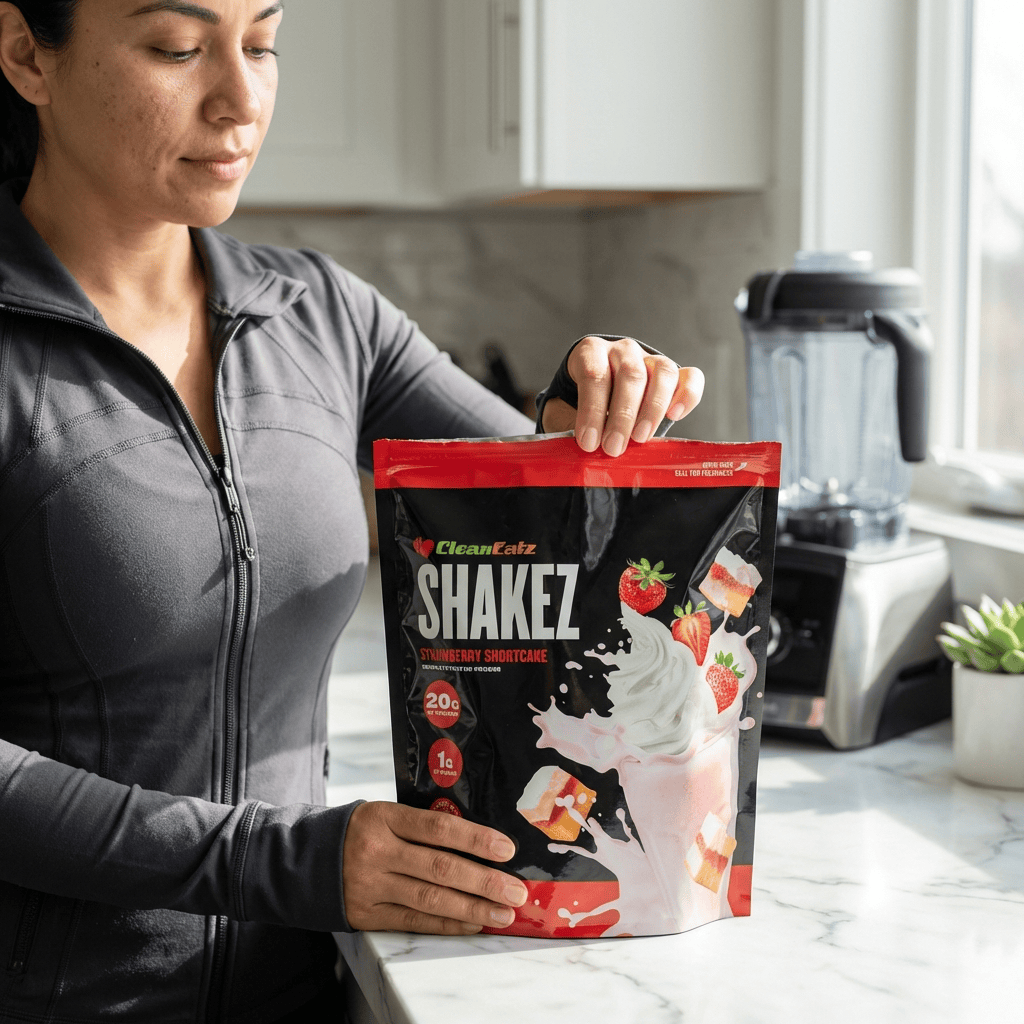
If that's hard to hit, a powder can help, but keep it in proportion. The same analysis found the added gain from protein supplements was real and small: about 0.3 kg of fat-free mass and 2.5 kg on a one-rep max. Most gains come from training and food. A powder such as our Shakez Protein Powder, at 20 grams of whey a scoop, is just a convenient way to close a gap. The NIH also has a sheet on performance supplements if you want to read further.
Calories. Set your intake with the Calorie Calculator. If fat loss is the goal, a modest deficit of about 300 to 500 calories a day is often more sustainable than a very aggressive cut. That works out to about 0.6 to 1 lb a week. Cut much harder and your lifts tend to suffer first.
Hydration. Focus on steady water intake through the day. Electrolytes may be useful on hot days, during longer sessions or when you sweat heavily.
Cardio. Add 2 easy cardio sessions a week, such as 10 to 30 minutes of incline walking, cycling or elliptical work. Keep the intensity low enough that it doesn't interfere with lifting quality or recovery.
Meals. Hitting a protein number three or four times a day is the part that falls apart on a busy Tuesday. Keep convenient, protein-rich meals on hand with the High Protein Meal Plan, which adds 2 extra ounces of meat per meal, or set up a simple routine with Build A Meal Plan, which has a High Protein filter.
 Make it easy withHigh Protein Meal PlanFrom $63.00View plan
Common barbell mistakes & easy fixes
What mistakes do beginner lifters make?
Quick answer
The big five are adding weight too quickly, skipping warm-ups, avoiding progressive strength work, eating too little protein and judging progress only by the scale. Each has an easy fix, and most come down to slowing down and tracking your lifts.
Adding weight too quickly. This often leads to stalled progress, sore joints or sloppy reps. Fix: use small plate increases and keep most sets at 1 to 2 reps in reserve instead of pushing to failure.
Skipping warm-ups. Jumping straight into work sets can make your first lifts feel stiff and less controlled. Fix: start with 5 to 7 minutes of light movement, followed by a few ramp-up sets before your main lifts.
Relying only on machines or non-progressive training. Cardio and machines can be useful, but avoiding progressive strength work can slow your muscle and strength gains. Fix: build your sessions around the main barbell lifts or beginner-friendly versions of the squat, hinge, press and row.
Under-eating protein. Too little protein can make recovery harder and body composition progress slower. Fix: aim for about 25 to 40 grams of protein per meal, and use protein powder when you need the convenience.
Judging progress by the scale alone. The scale doesn't show improvements in strength, muscle retention or body composition. Fix: track your lifts, progress photos, energy and how your clothes fit, too.
Barbell training next steps
Where should you go after this plan?
Quick answer
Finish the 8 weeks, keep what's working and add a little weight or volume only when your form holds. If you're coming back after a long break, start with our restart plan, and use the calculators to set your protein and calories.
Eight weeks is enough to learn the lifts and see your numbers climb. These guides, tools and meals can help with what comes next.
- Training: Restart plan, 5-day routine, Plank guide and How many exercises per muscle?
- Calculators: Calories, Protein and Weight loss percentage
- Meals: High Protein Meal Plan, Build A Meal Plan and Weight Loss Meal Plan
Beginner barbell FAQ
Questions about lifting, answered
Will lifting make me bulky?
No, not without years of training and eating for it. Most beginners build strength faster than noticeable size. A meta-analysis found women and men gain muscle at similar relative rates, but women start from a smaller base, so the absolute change is smaller. Your calories, protein and consistency decide what happens.
How heavy should my first workout be?
Start with a weight you could lift for about 2 more reps at the end of each set, also known as RIR 2. For many people, that's a training bar, a 35 lb bar or dumbbells. When in doubt, start lighter and build gradually. You can always add weight next session, and the early weeks are for learning.
What if I'm nervous about deadlifts?
That's completely normal. You can begin with Romanian deadlifts or a trap-bar deadlift instead of a conventional barbell deadlift. Focus first on learning the hip hinge, keeping a neutral back and pushing the floor away. Add weight only once that feels natural, and film a set if you want to check your form.
Can I combine this with running or classes?
Yes. You can lift 2 to 3 times a week and still include running or classes. Try to keep cardio easy on lifting days, and put harder intervals or more demanding classes on a separate day when possible. If your lifts start to stall, the extra hard sessions are the first place to look.
Any notes about cycles or pelvic floor?
Some women prefer to lower loads on low-energy cycle days. A 2024 review found only a small effect of cycle phase on dynamic strength, so go by how you feel. With pelvic floor concerns, or if you're pregnant or postpartum, get guidance from a qualified clinician. ACOG encourages exercise in most uncomplicated pregnancies.
More strength training & fitness guides
Keep reading
 Dorothy M. Shirnyl, RND · Jun 18, 2023
 Romaine Rusnak, RD, LDN · May 14, 2023
 Ellie Lopez, LDN, MS · Oct 9, 2026
Sources
On this page