
Lion Diet rules & risks
What is the Lion Diet? Rules, risks & alternatives
Ruminant meat, salt and water, with no trials behind it and zero fiber in it. The rules, what the closest research shows, why dietitians object and a safer way to look for food triggers.
- Free Shipping on Every Meal PlanFree Shipping
- Up to 20% Off 30-Meal PlansUp to 20% Off
- Chef Cooked, Dietitian BuiltDietitian Built
- Heat & Eat in MinutesHeat & Eat

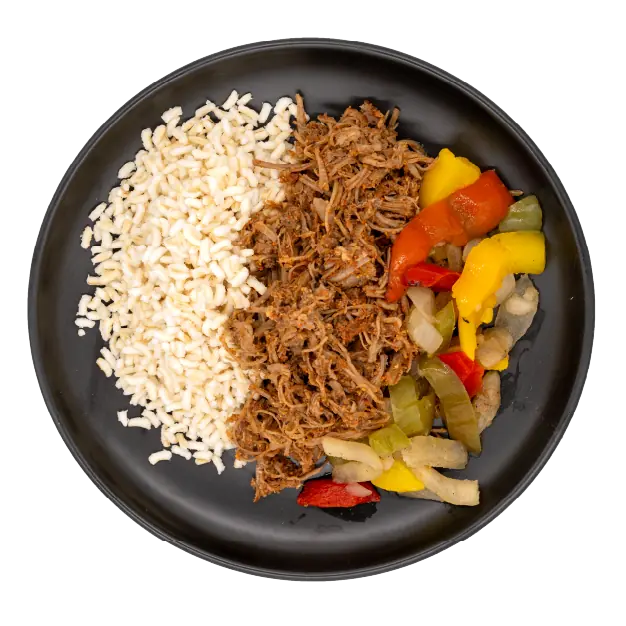
What the Lion Diet is
What can you actually eat on the Lion Diet?
Quick answer
Only ruminant meat, such as beef, lamb, goat, bison, elk and deer, plus salt and water. No plants, no other animal foods, no coffee or tea. It has no standard protocol or set duration, and no clinical trials have studied it.
The Lion Diet was popularized by Mikhaila Peterson, a lifestyle blogger and podcast host who says the approach relieved her autoimmune symptoms. Her father, psychologist Jordan Peterson, has also said he follows it, which helped the diet spread on social media.
The broader carnivore diet allows all animal products, including poultry, fish, eggs and dairy. The Lion Diet narrows that to meat from ruminant animals, plus their fat and drippings. Everything else is out: all plants, all seasoning beyond salt, coffee, tea and even other animal foods.
| Diet | Allowed | Fiber |
|---|---|---|
| Lion Diet | Ruminant meat, salt, water | Zero |
| Carnivore | All animal products | Zero |
| Keto | Very low carb, higher fat, can include vegetables, nuts and dairy | Some, depending on food choices |
How the Lion Diet compares with carnivore and keto
The theory is that stripping your diet to the most basic foods lets you reset your system, then reintroduce other foods one by one to find triggers. There's no standardized clinical protocol, no set duration and, critically, no clinical trials of the Lion Diet itself. According to Cleveland Clinic registered dietitian Maria Garcia Luis, "most of the claims out there are anecdotal and based on individual testimonials." Cleveland Clinic says it typically runs a few weeks and isn't intended for long-term use.
Lion Diet research
What does the research actually show?
Quick answer
Almost nothing about the Lion Diet directly. The closest evidence is a 2021 survey of 2,029 self-selected carnivore dieters, who reported high satisfaction and few side effects, along with a median LDL cholesterol of 172 mg/dL. Those followers weren't on Lion rules.
Credit where due: people on these diets report feeling good, and the largest study says so. A 2021 survey in Current Developments in Nutrition found that 2,029 carnivore followers recruited through social media reported high satisfaction and few adverse effects, with individual symptoms ranging from under 1% to 5.5%.
That needs three qualifiers. Everything was self-reported by people who chose the diet and stuck with it, so those who felt bad and quit aren't in the sample. It covered carnivore eating, not the narrower Lion rules. And LDL cholesterol was markedly elevated, with a median of 172 mg/dL against 126 mg/dL reported before the diet. The authors wrote that "the generalizability of these findings and the long-term effects of this dietary pattern require further study."
Harvard T.H. Chan School of Public Health's Walter Willett has been more direct, reportedly calling the carnivore diet "basically a terrible idea" because it removes fiber, carotenoids and polyphenols, compounds linked to lower risk of chronic diseases like type 2 diabetes and certain cancers. The Lion Diet, being more restrictive, carries those same concerns and more.
Take fiber. The Academy of Nutrition and Dietetics recommends 25 to 38g a day for adults, and the Lion Diet provides zero. "Without fiber, you reduce the microbial diversity in your gut," Garcia Luis explains, and that matters for digestive health. Our Ultimate Guide to Dietary Fiber covers its role in gut health, heart health and weight management.
Red meat & colorectal cancer risk
Does all that red meat raise cancer risk?
Quick answer
It likely pushes the odds the wrong way. In a study of 542,778 UK women, each 30g a day of red and processed meat was linked to 8% higher colorectal cancer risk. Guidelines cap red meat at 12 to 18 ounces a week, which a meat-only diet would far exceed.
The International Agency for Research on Cancer (IARC) classifies processed meat as a Group 1 carcinogen, meaning there's sufficient evidence it causes cancer, and red meat as Group 2A, probably carcinogenic.
A 2025 prospective study in Nature Communications, covering 542,778 women and 12,251 colorectal cancer cases over 16.6 years, found red and processed meat was the only dietary factor besides alcohol positively associated with colorectal cancer risk, at 8% higher risk per 30g a day. To size that, it's an observational study, so it can't prove cause, and the strongest finding in the paper was actually for alcohol and for calcium, which looked protective. None of the women were eating anywhere near a meat-only diet, so we can't say what the risk looks like at Lion Diet intakes. Nobody has measured it.
The World Cancer Research Fund and American Institute for Cancer Research recommend no more than about three portions of red meat a week, 12 to 18 ounces cooked, and very little processed meat, if any. Here's the arithmetic for a Lion Diet. Cooked 85% lean ground beef has about 250 calories per 100g, so 2,000 calories a day takes about 800g, or about 28 ounces. That's about 197 ounces a week, roughly 11 times the upper limit.
Lion Diet heart & kidney concerns
What are the other health risks?
Quick answer
Higher LDL cholesterol is the clearest concern, because the diet is high in saturated fat. Harvard Health also links carnivore-style eating with kidney stones, gout and osteoporosis, and very high protein intake can impair kidney function in some people.
The saturated fat raises a further flag. "This diet is high in saturated fats and cholesterol and that leads to an increase in your" LDL, or bad cholesterol, warns Garcia Luis. The carnivore survey above points the same way, with its median LDL of 172 mg/dL.
Harvard Health notes that carnivore-style diets are associated with increased risk of kidney stones, gout and osteoporosis, and that very high protein intake can impair kidney function in some people.
A 2025 review in Nutrition and Health looked at the protein paradox in carnivore diets and concluded that while meat works for muscle building and short-term energy, "a carnivore diet holds too many adverse long term side effects to be considered a staple for a longevity-based diet."
Who should avoid the Lion Diet
Who should definitely avoid this diet?
Quick answer
Anyone with cardiovascular risk factors, high LDL, kidney disease, gout or a history of kidney stones. Also anyone with or at risk for disordered eating, pregnant or breastfeeding people, children and teens. People on certain medications should check with a doctor first.
- Heart & kidney risk: cardiovascular risk factors, elevated LDL cholesterol, kidney disease, gout or a history of kidney stones.
- Disordered eating: anyone with or at risk for it should avoid highly restrictive protocols that could trigger unhealthy patterns.
- Pregnancy & breastfeeding: these stages need the nutritional variety this diet removes.
- Children & teens: the same goes for anyone still growing.
Lion Diet alternatives for food triggers
Is there a safer way to find food triggers?
Quick answer
Yes: a structured elimination diet with guided reintroduction. The Autoimmune Protocol keeps vegetables and fruit, and it has trial data, though thin. In one uncontrolled study, 11 of 15 people with active IBD reached clinical remission by week 6. Do it with a dietitian.
If you're trying to identify food sensitivities, you don't have to remove whole nutrient categories. The Autoimmune Protocol (AIP) is one option with some clinical trial data behind it.
A review in Metabolism Open, published at the end of 2024, describes AIP as a structured framework: an elimination phase that removes potential triggers (grains, legumes, nightshades, nuts, seeds, dairy, eggs, coffee, alcohol, refined sugars, oils and additives), followed by systematic reintroduction to identify individual sensitivities. Unlike the Lion Diet, it keeps vegetables, fruit and other nutrient-dense foods throughout.
The results are promising and small. In one study of AIP for inflammatory bowel disease, 73% of participants with active disease reached clinical remission by week 6. That's 11 of 15 people, at a single center, with no control group, and the authors called for randomized trials. The Metabolism Open review is frank about the field: "all studies are grossly underpowered, using subjective rather than objective measures," and there are no long-term data on the maintenance phase.
You may also see a modified AIP, which adds back foods such as rice, legumes other than soy, and seeds. It's described in a 2026 book, The New Autoimmune Protocol, and we didn't find a trial testing that version. It's still far less restrictive than a meat-only diet, but don't read it as proven.
AIP is still a restrictive diet, and it shouldn't be started on your own to manage a diagnosed condition. For a look at foods that support weight management and overall health without extreme restriction, our Complete Guide to the Best Foods for Weight Loss goes through the evidence-backed options, and What Foods Are Good for Weight Loss? is the shorter version.
Next steps after the Lion Diet
What should you do instead?
Quick answer
If you have unexplained symptoms, see a registered dietitian about a structured elimination protocol. If you want to lose weight, a calorie-appropriate diet with plenty of protein and fiber is safer and easier to keep up. Neither requires giving up plants.
The Lion Diet's premise is simple: eat only meat, feel better. For some people, at least short term, it may provide symptom relief. Whether that comes from removing specific triggers, reducing overall food variety or a placebo effect is impossible to know without controlled studies.
What we do know is that medical professionals don't recommend it. It lacks clinical evidence, removes essential nutrients and runs counter to established guidance on red meat. As Garcia Luis puts it, "I'll always advocate for a more balanced, evidence-based approach to nutrition."
If you're dealing with unexplained symptoms and want to explore dietary factors, work with a registered dietitian who can guide you through a structured elimination protocol, one that doesn't sacrifice your nutritional foundation in the process.
And if what appeals to you is the simplicity of not having to think about food, that part is solvable with vegetables still on the plate. Our meal plans are portion-controlled, with no subscription, and you can pick each meal in Build A Meal Plan. Our current menu runs 20g to 55g of protein a meal, with a median fiber of 5g, and every meal's macros, fiber and sodium are on our Nutrition Info page.
 Make it easy withHigh Protein Meal PlanFrom $63.00View plan
Related reads: What Is the Dr. Now Diet?, Top 10 Healthy Lunch Ideas and Best & Worst Snack Foods.
Lion Diet FAQ
Questions about the Lion Diet, answered
Will the Lion Diet make me lose weight?
Probably at first. Many people lose weight on highly restrictive diets because food choices are limited and protein is high. Sustainability is low, though, and the long-term tradeoffs, including elevated LDL cholesterol and zero fiber, matter. For durable fat loss, a calorie-appropriate, high-protein, high-fiber approach is safer and easier to keep up.
Is the Lion Diet safe long-term?
No. Cancer research groups recommend limiting red meat to 12 to 18 ounces a week and emphasize fiber-rich plant foods. The Lion Diet far exceeds that limit while providing zero fiber. Cleveland Clinic says it isn't intended for long-term use, and no trials have tested its long-term effects.
Is the Lion Diet different from keto?
Yes. Keto manipulates macros, with very low carbs and higher fat, but it can include vegetables, nuts, dairy and other foods besides meat. The Lion Diet removes everything except ruminant meat, salt and water, which makes it far more restrictive and leaves it with no fiber at all.
What's a safer alternative for identifying food triggers?
A structured elimination diet with guided reintroduction, such as the Autoimmune Protocol (AIP). It removes potential triggers while keeping vegetables and fruit. Early trials in conditions like IBD are promising, but they're small and uncontrolled, so don't treat it as proven. Work with a registered dietitian for personalized guidance.
More diet explainers & healthy eating guides
Keep reading
 Nutrition
Dr. Now Diet: The 1,200-Calorie Plan, Foods, & Who It's For
 Ellie Lopez, LDN, MS · Jun 8, 2023
 Weight loss
Best Foods for Weight Loss: 100-Food Complete Guide
 Romaine Rusnak, RD, LDN · Oct 16, 2025
 Nutrition
Top 10 Healthy Lunch Ideas (High-Protein, Make-Ahead)
Romaine Rusnak, RD, LDN · Jan 1, 2023Sources
On this page