
Smoothies for weight loss
Are smoothies good for weight loss? What actually works
Yes, when one replaces a meal. Aim for 30 grams of protein and thick enough to need a spoon. The 3-2-1 formula, a recipe you can freeze for the week, the mistakes that undo it and what the research found.
- Free Shipping on Every Meal PlanFree Shipping
- Up to 20% Off 30-Meal PlansUp to 20% Off
- Chef Cooked, Dietitian BuiltDietitian Built
- Heat & Eat in MinutesHeat & Eat

Smoothies & weight loss
Are smoothies good for weight loss?
Quick answer
Yes, when they replace a meal instead of joining one. Four things decide it: at least 30 grams of protein, whole fruit instead of juice, a texture thick enough to need a spoon and a calorie count you measured.
Take a typical virtuous blend: two bananas, a cup of mango, pineapple juice as the base, a drizzle of agave and a half scoop of protein powder because the tub was almost empty. That's about 570 calories and maybe 17 grams of protein. It is a dessert with spinach in it.
The problem isn't the calories on their own. A thin drink like that can empty from your stomach fast, leave you hungry by mid-morning and never quite feel like it counted as breakfast. So you eat breakfast. Now the 570 calories are added rather than swapped, and the scale moves in the wrong direction while you are, by your own account, eating clean.
Hit the four variables and the smoothie has a real chance of carrying you to your next meal. Miss them and you've added more than 500 liquid calories to a day that already had breakfast in it.
What makes a smoothie filling
What makes a smoothie actually filling?
Quick answer
Protein first, then thickness, then whole fruit. Aim for about 30 grams of protein, a soft-serve texture that takes ten minutes to finish, and fruit with its fiber still in it rather than juice.
Protein in weight loss smoothies
Protein, specifically enough of it
Many commercial smoothies carry ten to fifteen grams of protein. That isn't a meal. A review in the American Journal of Clinical Nutrition found that protein generally raises satiety more than carbohydrate or fat does. Gut hormones such as GLP-1 are among the proposed reasons, though not every trial sees them move.
The more useful finding for smoothie building is that there appears to be a threshold rather than a smooth curve. A review of the breakfast literature found that breakfasts with at least 30 grams of protein, eaten as solid food, produced a bigger appetite and fullness response than skipping breakfast. That is why I am unhelpfully rigid about the number.
Size that claim properly, though. In a crossover trial of 30 young women, a dairy-based, high-protein breakfast raised fullness and lowered hunger over the next 3 hours compared with a matched high-carb breakfast. Calories at lunch and across the day didn't differ. So protein makes the morning easier. It doesn't automatically cut what you eat later.
Protein also carries a real metabolic cost to digest, in the range of 15 to 30 percent of its calories, and it helps protect lean mass while you're in a deficit. Don't oversell the first part. On a 2,000-calorie day, moving from 20% to 30% protein burns only about 14 more calories, by that review's math. Neither effect matters as much as simply not being hungry at 10 a.m.
Smoothie thickness & fullness
Thickness is stranger than it sounds
Texture is the variable people skip, and it does more work than they expect.
In a randomized crossover trial in the American Journal of Clinical Nutrition, 15 healthy men drank dairy shakes that were thin or thick, at either 100 or 500 calories, and researchers tracked stomach emptying by MRI. Calories did more to slow emptying than thickness did. Thickness was the stronger driver of how full people felt: the thick 100-calorie shake scored higher on fullness at 40 minutes than the thin 500-calorie one. They called the effect phantom fullness. It's a fullness your stomach hasn't entirely earned, and for anyone trying to eat less it's free.
Fifteen men over 90 minutes is a small window, so treat it as a strong signal rather than proof. Separate work on food viscosity, also in 15 men, found that a thicker version of the same semi-solid meal was eaten more slowly and produced less hunger and more fullness. It didn't change how much they ate at the next meal, and the authors note the effect may be short-lived. Eating rate is doing part of the job here. A smoothie you finish in ninety seconds outruns your own satiety signaling.
Practically: soft-serve consistency. If a straw works comfortably, it's too thin. You should need a spoon and ten minutes.
Whole fruit vs juice in smoothies
Whole fruit, for boring reasons
The usual claim is that juice is metabolically dangerous and whole fruit is protective. The evidence is more mundane than that, and more useful.
A 2024 JAMA Pediatrics systematic review and meta-analysis found that in adults, the association between 100% fruit juice and weight gain showed up in studies that didn't adjust for total calories and went away in the ones that did. Randomized trials in adults found no significant effect on body weight, though with a wide margin of error. In children, each daily serving was associated with a small BMI increase.
So the honest version is this: juice isn't poison. It's just extremely easy to drink 250 calories of it without noticing, and it brings no fiber and no bulk. Whole fruit gives you volume and fiber for the same money. In a smoothie, where you're deliberately engineering fullness, that's the entire point. For the full picture on how fiber does this, our ultimate guide to dietary fiber goes deeper than I can here.
Smoothie weight loss research
What does the research actually show?
Quick answer
Two findings pull in opposite directions. Programs using meal replacements beat comparison programs by 1.4 to 6.1 kg at one year, while liquid calories can be easy to under-compensate for. Protein, thickness and slow drinking are the levers.
The encouraging evidence is the meal replacement literature. A meta-analysis in Obesity Reviews covering 23 studies and 7,884 adults found that programs using meal replacements produced more weight loss at one year than comparison programs in every grouping analyzed. The size of the advantage tracked with how much support came alongside it: about 1.4 kg for meal replacements on their own, rising to about 6.1 kg when paired with an enhanced level of support. Structure helps. Structure plus accountability helps considerably more.
One limit: those trials tested formulated meal replacement products, not whatever you blend at home. A smoothie only earns that comparison if it's built to replace a meal in the same deliberate way.
The discouraging evidence is the liquid calorie literature, and it's messier than it usually gets told. A 2003 review called the case that liquids satisfy less than solids inconclusive, with studies pointing both ways. Still, the case for concern is real. In a crossover study of 15 adults, people ate less to make up for about 450 daily calories of jelly beans but didn't eat less to make up for the same calories as soda, and their weight rose only during the 4 soda weeks. Soda isn't a smoothie, but it's a fair warning about drinks that go down fast.
Reconciling those two is the whole exercise. A smoothie starts with the disadvantage of being a drink. Protein, thickness and slow consumption are the levers that claw it back, which is why I keep pushing on all three rather than treating any one as sufficient.
One more finding worth naming, because it shapes when you should drink the thing. In a crossover trial at the University of Missouri, 20 breakfast-skipping girls with overweight or obesity, average age 19, had a 35-gram protein breakfast, a 13-gram one, or kept skipping, with both breakfasts at 350 calories. Only the high-protein breakfast cut evening snacking on high-fat foods compared with skipping, and it shifted brain-imaging signals tied to food motivation further. Total daily calories didn't differ. It's a small study of teenagers, but it suggests that breakfast with real protein in it can matter at the far end of the day.
The 3-2-1 smoothie formula
How do you build a filling smoothie?
Quick answer
Use the 3-2-1 formula: three parts produce, two parts protein, one part fiber. For a meal, aim for 350 to 450 calories and at least 30 grams of protein. For a snack, about 200 calories.
Three parts produce, two parts protein, one part fiber. It's a memory device, not a measurement system, and it exists so you can build a decent smoothie without a recipe in front of you.
Three parts produce means about one cup of fruit plus a half cup of greens. Frozen berries are the default because they run lower in sugar than mango, pineapple or banana while doing more for texture. Baby spinach disappears entirely into anything with berries in it, and baby kale mostly does. This is also where portions quietly inflate, so measure the fruit, at least for the first few weeks.
Two parts protein means whatever gets you past 30 grams, and that usually takes two sources. A scoop of powder gives you about 20 to 25 grams, a full cup of plain nonfat Greek yogurt about 25 and three-quarters of a cup of 1% cottage cheese about 21. Cottage cheese blends far better than people expect and brings a creamy texture. We wrote about why cottage cheese punches above its weight if that one surprises you. If you're plant-based, pea protein or pea-rice blends work, while single-source rice and hemp can taste chalky and run lower in some essential amino acids.
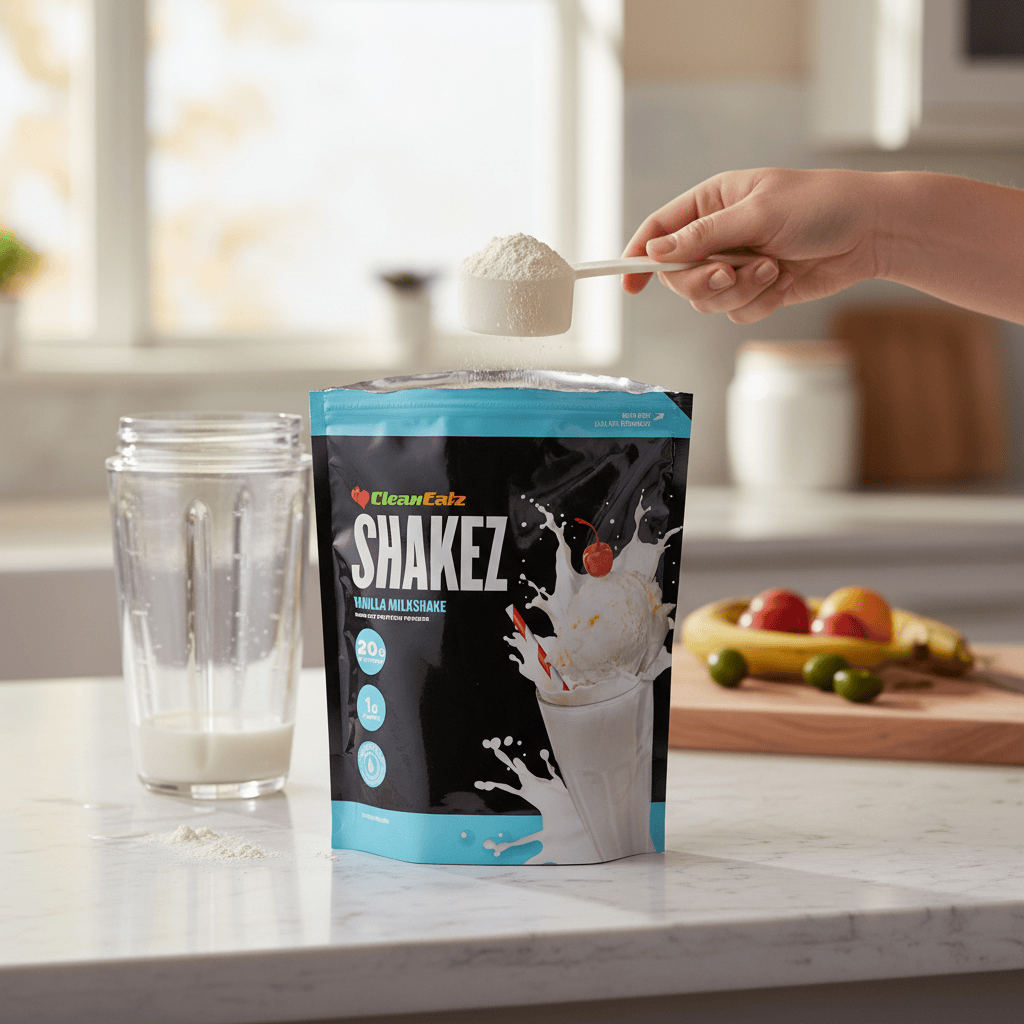
Our own Shakez Protein Powder has 20 grams of whey per scoop and 1 gram of sugar, though any powder clearing 20 grams a scoop with a short ingredient list will do the job.
One part fiber means one or two of the following: a couple tablespoons of ground flaxseed or chia, a quarter to a half cup of rolled oats, or half a cup of frozen cauliflower rice. The cauliflower is the one nobody believes until they try it. It adds volume and creaminess and tastes like nothing at all, which lets you build a physically larger smoothie without adding sugar.
Liquid is where people go wrong last. Start with half a cup and add more only if the blender is struggling. Water is fine. Unsweetened almond milk is fine. Fruit juice isn't, and neither is any plant milk that doesn't say unsweetened on the front.
Aim for 350 to 450 calories and 30 grams of protein minimum if the smoothie is replacing a meal. If it's truly a snack, halve everything and land near 200 calories with 15 to 20 grams of protein.
Weight loss smoothie recipe
What's a good smoothie to start with?
Quick answer
A berry, spinach and protein blend: about 460 calories, 45 grams of protein and 11 grams of fiber in about 22 ounces. It takes two minutes to blend, and it freezes in bags for the whole week.
This is the baseline. Learn it, then wander.
- 3/4 cup unsweetened almond milk
- 1/2 cup baby spinach, tightly packed
- 1 scoop vanilla protein powder (about 25 g protein)
- 1/2 cup plain nonfat Greek yogurt
- 2 tablespoons ground flaxseed
- 1/4 cup old-fashioned rolled oats
- 1 cup frozen mixed berries
- 5 to 6 ice cubes
- 1
Blend the spinach first
Almond milk goes in first, so nothing cements to the bottom. Add the spinach and blend for twenty to thirty seconds until the green flecks are gone, because they won't disappear later.
- 2
Layer the rest
Add the protein powder, yogurt, flaxseed and oats. Then the berries. Ice goes in last.
- 3
Blend until it holds its shape
Blend for sixty to ninety seconds on high, tamping if your blender came with a tamper. Stop and look at it. If it holds its shape on a spoon, you're done. If it's loose, add more ice. If the blender is laboring, add two tablespoons of almond milk at a time, no more.
Smoothie recipe nutrition
What you end up with
Those numbers are estimated from USDA FoodData Central, with a 130-calorie scoop of powder from typical labels. USDA's file has no frozen mixed berry blend, so that line is an estimate, averaged from frozen strawberries, blueberries and raspberries. Your exact numbers will drift depending on the powder, so read your own label rather than trusting mine. With a 20-gram scoop, protein is about 40 grams.
That runs a little over the 450-calorie ceiling. Drop the oats and you're at about 385 calories and 9 grams of fiber, which is the better version on a low-activity day. The protein number sits above the 30-gram threshold with margin, and that's deliberate. It costs you very little, and it's the single variable most likely to be under-delivered when you eyeball a scoop.
By our rough math, ingredients come to around $2.50 to $3.00 a serving if you buy in bulk, depending on the powder. A juice bar smoothie often costs far more and usually carries less protein.
Smoothie freezer packs for the week
Making it a week's worth
Take five quart freezer bags. Into each: the flaxseed, the oats, the berries, the spinach, and the protein powder in a small separate bag so it doesn't clump against the frozen fruit. Freeze them flat. On a weekday, one bag goes in the blender with the yogurt, almond milk and ice. Two minutes, start to finish.
If even that is more than your mornings can absorb, our High Protein Overnight Oats solve the same problem from the other direction: 20 grams of protein per pouch, about 270 to 300 calories depending on flavor, and the only preparation is adding milk and chilling it the night before. You could alternate, smoothie on the days you have five minutes and oats on the days you don't. There's a wider spread of the same idea in our grab-and-go range.
Weight loss smoothie mistakes
What mistakes undo a weight loss smoothie?
Quick answer
Five: a juice base, measuring by handful, stacking every healthy add-in, calling a meal a snack and buying it at a juice bar. Measuring is the big one, because the error repeats every single morning.
Using juice as the base. A cup of orange juice is about 110 calories and 21 grams of sugar before a single piece of fruit goes in. Coconut water is gentler at about 45 calories but still buys you nothing. Use water or unsweetened almond milk, and if you want citrus flavor, put an actual orange in.
Measuring by handful. This is the big one, and it's invisible. A handful of almonds is often half a cup, which is about 415 calories. A drizzle of almond butter is often three tablespoons, which is about 295. Two cups of frozen fruit instead of one is another 50 to 80. Any one of those slips puts a smoothie well over what you think it is, and it happens consistently, which means the error compounds every morning. Measure for three weeks. Your eye gets calibrated and then you can stop.
Stacking everything healthy. Protein powder and Greek yogurt and almond butter and chia and hemp and flax and half an avocado and a spoon of honey. Each addition is individually defensible. Even at one scoop, half a cup of yogurt, half an avocado and a tablespoon of the rest, that's about 675 calories before any fruit goes in. Pick your protein, one fiber source and stop. Added fats like nut butter and avocado don't belong in a weight loss smoothie unless you're deliberately trying to gain, and if you are, we wrote a separate guide on building smoothies for weight gain that inverts nearly every rule on this page.
Calling a meal a snack. A 500-calorie smoothie at ten in the morning followed by lunch at noon isn't a snack. It's a second breakfast that you've mentally exempted from the accounting. Decide before you blend: this replaces something, or it's small. Half measures produce the worst outcome available.
Buying it. Last, and easiest to fix. Large juice bar smoothies can run past 600 calories with a lot of sugar and whatever protein happens to be in the yogurt. Bowls are often worse once granola and honey land on top. Chains with 20 or more locations have to provide written nutrition information on request, so ask. If it's over 400 calories with less than 20 grams of protein, it's a milkshake with a good story.
Smoothie flavor variations
How do you keep smoothies from getting boring?
Quick answer
Swap the flavor and keep the skeleton. Chocolate peanut butter, tropical green, cinnamon roll and coffee frappe all use the same protein and fiber base. People quit smoothies out of boredom, not out of disbelief.
People quit smoothies out of boredom, not out of disbelief. Here are four alternates, all built on the same skeleton.
- Chocolate peanut butter. Frozen banana, chocolate protein powder, two tablespoons of powdered peanut butter, two tablespoons of cocoa, half a cup of Greek yogurt and almond milk. It's about 400 calories, and it tastes like a milkshake, which is the point.
- Tropical green. Frozen mango, frozen pineapple, a full cup of spinach, vanilla protein and chia. The pineapple covers any green flavor, so this is the one to hand someone who insists they hate green smoothies. It's higher in sugar than the berry version, so treat it as an occasional rather than a default.
- Cinnamon roll. Frozen banana, a third cup of oats, vanilla protein, Greek yogurt, a full teaspoon of cinnamon and a pinch of nutmeg. One small pitted date costs about twenty calories and does more for perceived sweetness than any amount of extra fruit.
- Coffee frappe. The same skeleton, with cold brew standing in for the almond milk, half a frozen banana and two tablespoons of oats for body. Freeze the coffee into cubes ahead of time and it stops diluting as it melts.
Smoothies in a weight loss week
Where does a smoothie fit in your week?
Quick answer
One a day, usually at breakfast, is the pattern that survives real life. Lunch and post-workout are the other sensible slots. Two is possible. Five is a diet you'll abandon by Thursday.
Breakfast replacement is where it works best for most people, because it removes a decision at the hour when time is shortest. Berry smoothie at 7 a.m., a real lunch, a snack and a controlled dinner. If dinner is the meal that reliably gets away from you, that's the one worth outsourcing. Our Weight Loss Meal Plan exists so the evening doesn't require negotiation.
Lunch replacement suits people who skip lunch or eat it standing up. The chocolate peanut butter version feels like a break rather than a restriction, which matters more than the macros do at that hour.
Post-workout is the one case where I loosen up on the carbohydrate. Protein and carbohydrate in one container after training is efficient, and it doesn't need to double as a meal replacement. If training is central to what you're doing, our guide to the best exercises for weight loss covers how the two sides fit together, and the High Protein Meal Plan adds 2 extra ounces of meat per meal, about 10 grams of protein, for the rest of the day.
Whichever slot you pick, the smoothie is one meal. The other two still have to hold up, and that's where most smoothie plans actually fail. For the broader food framework, start with our guide to the best foods for weight loss. If the bottleneck is time rather than knowledge, the complete meal prep guide is the more useful read. If you'd rather not solve it at all, Build A Meal Plan has a High Protein filter that surfaces the options directly.
 Make it easy withWeight Loss Meal PlanFrom $89.95View plan
Weight loss smoothie next steps
What should you do next?
Quick answer
Start with the berry recipe and measure everything for three weeks. A 250-calorie miss every morning is 1,750 calories a week, which can be your whole deficit. Then get bored and use a variation.
Smoothies are neither the shortcut the wellness industry sells nor the trap the backlash claims. They're a container, and containers are judged by their contents.
The version that works is thick, slow to drink, past 30 grams of protein, built on whole fruit, measured rather than estimated and eaten instead of a meal. The version that fails is thin, fast, under-proteined, juice-based, guessed at and eaten alongside everything else.
If you take one thing from this page, take the measuring. Not forever, three weeks. Do the arithmetic: 250 extra calories a morning is 1,750 a week, about the same as the deficit many people are counting on. That's the whole story more often than any question of ingredients or timing.
Start with the berry recipe. Get bored, then use a variation. And treat the smoothie as one solved meal out of three, not as a diet.
Smoothies for weight loss FAQ
Smoothies, answered
Are smoothies actually good for weight loss?
Yes, when they replace a meal instead of joining one. A smoothie that lands between 350 and 450 calories, carries at least 30 grams of protein, uses whole fruit rather than juice and comes out thick enough to need a spoon has a real chance of holding you until your next meal. A thin, low-protein, juice-based one does the opposite.
How much protein should a weight loss smoothie have?
At least 30 grams for a meal-replacement smoothie. Research on breakfast protein suggests about 30 grams in a single meal is where the fullness effect becomes clear, though it doesn't always lower what you eat later. For a true snack smoothie, 15 to 20 grams is reasonable.
Why do most smoothies fail at helping weight loss?
There are three reasons, usually together. They're too thin, so they're gone in ninety seconds and never register as a meal. They're short on protein, often under 15 grams. And they're eaten on top of a normal breakfast rather than instead of one, which turns a 500-calorie drink into 500 extra calories.
Are smoothies better than juice for weight loss?
Yes, mostly because of calories rather than anything metabolically special. A 2024 JAMA Pediatrics meta-analysis found that in adults the link between 100% fruit juice and weight gain went away once total calories were accounted for. Juice is easy to over-drink. Whole fruit brings fiber and bulk, so you get more food for the same calories.
Should I use frozen or fresh fruit in weight loss smoothies?
Frozen, almost every time. It builds thickness without watering the smoothie down the way ice does, it often costs less, it doesn't spoil, and it lets you pre-portion. Frozen berries are the best default because they're lower in sugar than mango, pineapple or banana. Fresh fruit works too, with extra ice.
How thick should a weight loss smoothie be?
Thick enough that a straw is annoying. A small trial of the same meal at two thicknesses found the thicker version produced more fullness and a slower eating rate, though not less food later. Aim for the texture of soft-serve, and expect it to take ten to fifteen minutes to finish.
Can I drink a smoothie every day & still lose weight?
Yes, provided it's standing in for a meal and your total intake still leaves you in a deficit. One smoothie a day, usually at breakfast, is the pattern most people can sustain. Living on smoothies alone isn't sustainable and isn't worth attempting, so keep your other meals real and measured.
What is the best time to drink a weight loss smoothie?
Breakfast, for most people. It puts protein at the meal where people are most rushed and most likely to skip or grab whatever's close. Post-workout is the other sensible slot if you train in the morning and want protein and carbohydrate in one container, without cooking anything.
More smoothie & protein guides
Keep reading
 Weight loss
Are Protein Shakes Good for Weight Loss?
 Dorothy M. Shirnyl, RND · May 8, 2026
 Weight loss
Quick Peanut Butter Banana Protein Shake for Weight Loss
 SaVanna Shoemaker, MS, RDN, LD · Jul 27, 2026
 Weight loss
Weight Gain Smoothies: 5 Recipes & the Real Calorie Math
Dorothy M. Shirnyl, RND · Jan 13, 2023Sources
On this page